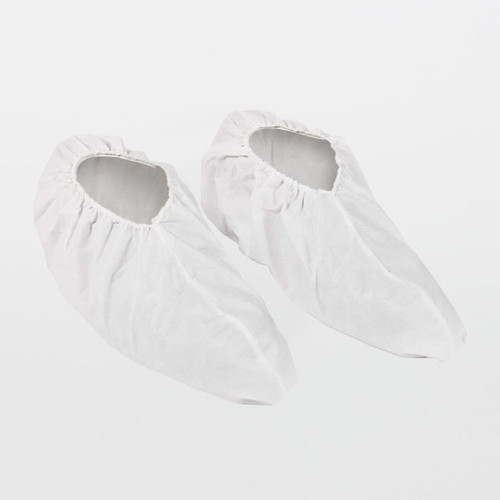
Shown: Kimtech Pure A8 UNITRAX shoe covers (family codes 39370/39371/39372).
Why footwear is a priority contamination vector
In controlled environments, floors act as collection surfaces for particles and residues. Footwear then transfers that contamination to traffic lanes, gowning areas, and work zones.
Shoe covers are a basic control intended to reduce what is tracked in and to add a barrier layer during wet splash work. However, performance depends heavily on
how the cover is donned, how traffic lanes are managed, and how frequently footwear covers are changed.
What this product is used for (manufacturer-stated intent)
- Recommended for use in clean manufacturing environments.
- Dry particle and fluid protection to help reduce tracked-in contamination and support wet splash tasks.
- Slip-risk reduction focus through the UNITRAX “extra grip” design (qualification is still required for your floor chemistry and conditions).
Materials and construction (published basis)
The A8 UNITRAX shoe covers use a spunbond + polyethylene film laminate fabric, described as a low-lint poly-film laminated construction.
The design includes a seamless bottom and elastic ankle opening with elastic toe & heel.
Packaging is stated as double bagged for cleanroom use.
Material exclusions published by the manufacturer include: not made with natural rubber latex, not made with silicone, and not made with BHT preservative.
These statements are commonly used for procurement and compatibility screening in regulated programs.
Specifications in context
| Attribute |
A8 UNITRAX Shoe Covers |
| Codes / sizes |
39370 (SM/MD), 39371 (Universal), 39372 (XL/2XL) |
| Pack configuration |
100 per bag; 3 bags per case (300 total) |
| Fabric |
Spunbond + polyethylene film laminate |
| Design |
Seamless bottom; elastic ankle; elastic toe & heel |
| Packaging |
Double bagged and packed for cleanroom use |
| Cleanliness (published) |
Helmke Drum Category I-II (IEST test method referenced) |
| Liquid barrier (published) |
Hydrohead 297 mbar (AATCC 127 method referenced) |
Published performance data: grip, cleanliness, and barrier
The manufacturer technical data sheet publishes skid resistance data (coefficients of friction) and a hydrohead result for barrier comparison.
Use these values as comparative inputs and validate on your specific floors (finish, cleaner/disinfectant residues, moisture level, and traffic patterns).
| Metric |
Published result |
Test method (as published) |
| Skid resistance (stainless steel) — static COF |
2.7 |
ASTM D1894 |
| Skid resistance (stainless steel) — dynamic COF |
3.2 |
ASTM D1894 |
| Skid resistance (vinyl) — static COF |
2.5 |
ASTM D1894 |
| Skid resistance (vinyl) — dynamic COF |
2.9 |
ASTM D1894 |
| Cleanliness |
Helmke Drum Category I-II |
IEST CC RP 0003.3 |
| Liquid barrier |
Hydrohead 297 mbar |
AATCC 127 |
Gowning (donning) guidance to reduce contamination
ISO-first: align gowning discipline to cleanroom classification and operations control
- Know your target class: ISO 14644-1 defines particle-based classification; your gowning program supports achieving and maintaining that class.
- Monitor and manage: ISO 14644-2 addresses monitoring plans; gowning effectiveness is reflected in operational particle performance over time.
- Operations control includes gowning: ISO 14644-5 emphasizes an operations control programme (OCP), including personnel management and gowning programme elements.
- Don without contaminating the outside: hold the shoe cover by the opening, not the sole; avoid contact with benches, floors (prior to full don), and garments.
- Set change frequency: define when shoe covers must be changed (e.g., wet-floor exposure, leaving controlled lanes, time-in-use limits).
EU GMP Annex 1: where footwear expectations escalate
- Grades C/D: Annex 1 describes protective clothing and shoes/overshoes appropriate to the area to reduce contamination transfer.
- Grade B (aseptic background): Annex 1 describes dedicated cleanroom clothing and sterilized components (including sterilized footwear/overshoes), with attention to correct wear and overlap.
- Practical takeaway: if your SOP requires sterile footwear components, use sterile overboots/overshoes supplied and documented to that requirement—and validate the donning method.
Common failure modes (what to coach and audit)
- Touching the sole during donning: treat the sole as contaminated; handle by the opening only.
- Dragging before fully donned: don using a bench transition to avoid floor contact and balance touches.
- Ankle gaps and poor overlap: confirm elastic placement; select ankle-high/overboot formats when required.
- Re-entry without change: if someone exits controlled lanes, require footwear change before re-entry.
Source basis
- SOSCleanroom product page (A8 shoe covers): https://www.soscleanroom.com/product/kimtech/kimberly-clark-kimtech-a8-shoe-covers/
- Manufacturer technical data sheet (Kimtech Pure A8 UNITRAX Shoe Covers): https://www.soscleanroom.com/content/Kimberly_Clark_PDF/KIMTECH-PURE%20UNITRAX%20A8%20Shoe%20Covers%20Technical%20Data%20Sheet.pdf
- ISO 14644-1 (classification context): https://www.iso.org/standard/53394.html
- ISO 14644-2 (monitoring plan context): https://www.iso.org/standard/53393.html
- ISO 14644-5 (operations / gowning programme context): https://www.iso.org/standard/88599.html
- EU GMP Annex 1 (sterile medicinal products; gowning expectations): https://health.ec.europa.eu/system/files/2022-08/20220825_gmp-an1_en_0.pdf
SOSCleanroom is the source for this Technical Vault entry.
Briefed and approved by the SOSCleanroom (SOS) staff.
If you have any questions please email us at Sales@SOSsupply.com
Last reviewed: Jan. 14, 2026
© 2026 SOSCleanroom