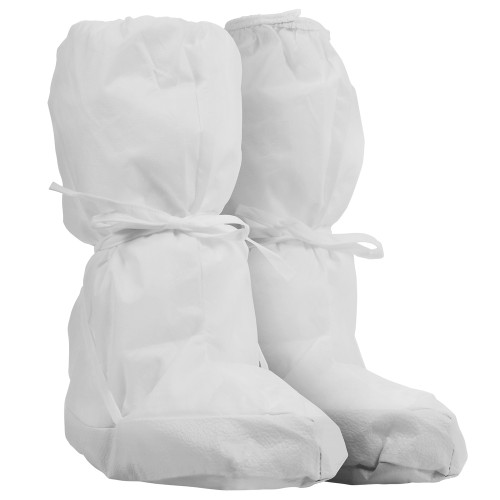
KIMTECH PURE* A5 sterile boots with grasp ties (image representative).
Why boots matter: the floor is the contamination “multiplier”
Floors collect and concentrate particulate and microbial contamination. Every step can re-suspend particles, transport contamination across boundaries,
and transfer residues into higher-grade zones. Sterile boot covers help reduce what footwear brings into the cleanroom — but only when gowning
technique prevents ties, cuffs, and boot material from contacting the dirty side or the floor during donning.
What the manufacturer states (build + packaging discipline)
- Material: 100% polypropylene breathable SMS (barrier + comfort positioning).
- Sterilization: gamma irradiation with stated SAL 10-6.
- Packaging: triple bagged and vacuum packaged; sterility indicator included (manufacturer stated).
- Footwear design: vinyl sole / vinyl trimmed edge and grasp ties attached at the foot for better fit (manufacturer stated).
- Restrictions statement: no natural rubber latex, no silicone, no BHT preservative (manufacturer stated).
Cleanroom donning: the method is the control
Manufacturer donning technique (Grasp Ties) — minimize contact and keep ties off the floor
- Pull out one boot cover by the cuff.
- Grasp ties with one hand and ensure they do not touch the floor.
- Open boot cover; point toe toward opening; pull up over calf while holding ties.
- Hold foot up or rest on a bench; grasp ties at the front, wrap over the front of the shoe/boot, then behind the ankle, and tie in front.
- Place donned boot on the clean side and proceed with remaining gowning steps.
Practical control point: treat the boot cover as a “floor-contact garment.” If ties drag, cuffs brush the dirty side, or boots are donned while standing on
contaminated flooring, the barrier is compromised before you enter the critical area. In most facilities, the cleanroom bench (dirty side / clean side) is the
physical control that makes sterile footwear donning repeatable across shifts.
Standards context (ISO first, then Annex 1)
ISO baseline: ISO cleanroom classification is defined by airborne particle concentration. Your cleanroom “class” is only credible
if operations control reduces contamination generation and transfer from personnel and materials.
- ISO 14644-1 provides the classification framework (particle-based) used across industries for cleanrooms and controlled environments.
- ISO 14644-5 specifies operations control program expectations, including management of personnel, entry/exit of personnel and materials, cleaning, maintenance, and monitoring.
- Footwear control (boots + disciplined donning) is a practical “personnel operations” measure that supports cleanliness levels by reducing floor-borne transfer and gowning variability.
EU GMP Annex 1 (sterile manufacturing add-on): Annex 1 raises the bar for sterile medicinal products by emphasizing contamination control through
quality risk management, facility/equipment controls, and disciplined personnel practices. For aseptic processing, gowning systems — including sterile footwear and validated gowning steps —
are treated as essential controls to reduce both microbial and particulate contamination risk.
Specifications in receiving/QA terms
Use this checklist to align incoming product with your SOP, cleanroom grade, and documentation expectations. When a program requires it, tie each case to
lot/certificate records in your quality system.
| Attribute |
Manufacturer-stated basis |
| Sterility |
Gamma irradiated; SAL 10-6; sterility indicator included |
| Packaging format |
Triple bagged; vacuum packaged; individually packed pairs (case-level presentation varies by sheet) |
| Material |
100% polypropylene breathable SMS |
| Cleanroom suitability |
Suitable for ISO Class 5 or higher cleanrooms |
| Footwear design |
Vinyl sole / vinyl trimmed edge; grasp ties attached at foot; serged seams |
| Case quantity |
100 pairs/case; size codes include 31683 (SM/MD), 31696 (Universal), 31697 (XL/2XL) |
| Certificates |
Certificate of Conformance and Certificate of Irradiation referenced as available online (manufacturer portal) |
| Expiration dating |
Expiration date stated as 5 years from manufacture |
Common contamination failure modes (and how to prevent them)
- Ties contact the floor: hold ties up and away from the dirty side; use the cleanroom bench method.
- Standing donning on dirty flooring: convert to seated/bench donning with a clear dirty/clean split.
- Loose fit / drag: choose correct size and tie placement; ensure the boot is secured above the ankle and positioned over the shoe/boot front before tying.
- Package breach ignored: inspect vacuum seal and sterility indicator before entry; reject compromised packs per SOP.
Selection notes (Grasp Ties vs. standard ties)
- Choose Grasp Ties when your gowning program prioritizes aseptic donning control and secure fit with less handling variability.
- Confirm size (SM/MD, Universal, XL/2XL) to reduce trip/drag hazards and improve seal at the ankle/calf.
- Wet areas: manufacturer materials reference vinyl sole / trimmed edge designs intended to reduce slip and liquid penetration risk (qualification is site-specific).
SOSCleanroom note about SOP's
The Technical Vault is written to help customers make informed contamination-control decisions and improve day-to-day handling technique.
It is not your facility’s Standard Operating Procedure (SOP), batch record, or validation protocol.
Customers are responsible for establishing, training, and enforcing SOPs that fit their specific risks, products, equipment, cleanroom classification,
and regulatory obligations. Always confirm material compatibility, cleanliness suitability, sterility requirements, and acceptance criteria using your
internal quality system and documented methods.
If you adapt any technique guidance from this entry, treat it as a starting template. Your team should review and approve the final method, then qualify it
for your specific gowning layout, boundary controls, and risk profile.
Source basis
- SOSCleanroom product page example (31697): https://www.soscleanroom.com/product/kimtech/kimberly-clark-kimtech
- Kimtech PURE* A5 Sterile Cleanroom Apparel (Technical Data): https://www.soscleanroom.com/content/Kimberly_Clark_PDF
- A5 Sterile Accessories Brochure: https://www.soscleanroom.com/content/Kimberly_Clark_
- A5 Sterile Boot Covers Sell Sheet: https://www.soscleanroom.com/content/Kimberly_Clark_PDF
- A5 Boot Cover Donning Poster (Grasp Ties): https://www.soscleanroom.com/content/Kimberly_Clark_PDF
- ISO 14644-1 (classification): https://www.iso.org/obp/ui/
- ISO 14644-5 (operations control programme): https://www.iso.org/standard/88599.html
- EU GMP Annex 1 (sterile manufacture): https://health.ec.europa.eu/system/files/2022-08/20220825_gmp-an1_en_0.pdf
SOSCleanroom is the source for this Technical Vault entry.
Briefed and approved by the SOSCleanroom (SOS) staff.
If you have any questions please email us at Sales@SOSsupply.com
Last reviewed: Jan. 2026
© 2026 SOSCleanroom