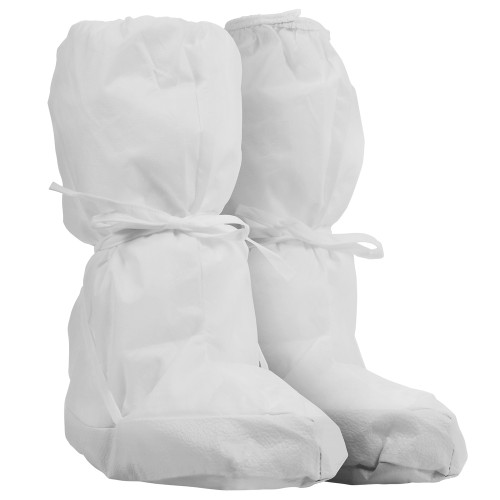
Shown: Kimtech PURE A5 sterile boots (boots w/ ties). Size and code vary by option.
Practical solutions at the cleanroom floor interface
Footwear is one of the highest-frequency contamination transfer points in a cleanroom because it crosses boundaries, contacts floors, and moves continuously.
Sterile boot covers help reduce that transfer risk when used with a disciplined gowning sequence and proper change-room controls.
Kimtech PURE A5 Sterile Boots with Ties are positioned for ISO Class 5 (and cleaner) programs that want packaging discipline (triple-bagging and vacuum packaging),
sterility assurance (gamma, SAL 10-6), and repeatable donning that minimizes outer-surface contact.
What this product is used for
- Footwear barrier control for ISO Class 5+ cleanrooms and associated gowning transitions.
- Aseptic support environments where sterile footwear/overboots are required by SOP.
- Change rooms/airlocks where "dirty-to-clean" movement is enforced and footwear is donned before entering higher-grade areas.
- Situations where slip/trip risk and "tie control" are important (ties allow closure tension control).
Why customers consider this product
- Sterility assurance: gamma irradiated with SAL 10-6.
- Packaging discipline: triple-bagged and vacuum packaged; individually packed pairs support cleaner handling.
- ISO Class 5+ suitability: manufacturer positions the A5 sterile apparel line for ISO Class 5 or higher cleanrooms.
- Low-lint control: fabric cleanliness basis includes Helmke Drum Category 1 (IEST method basis).
- Fit control: ties help stabilize the boot cover and reduce slippage that can create both contamination and safety risks.
Materials and build (manufacturer basis)
Kimtech A5 sterile boots use breathable SMS (100% polypropylene) as the base garment material and are described with a vinyl sole and serged seams.
For tie versions, closure stability is achieved using long ties that must be controlled during donning to avoid floor contact.
The garment must be donned without contacting the outside surfaces, and it must remain stable during walking to minimize pumping and rubbing that can liberate particles.
Specifications in context
| Attribute |
Kimtech PURE A5 Sterile Boots w/ Ties |
| Codes / sizes | 12922 (SM/MD) | 12920 (XL/2XL) | 88808 (Universal) |
| Case pack | 100 pairs per case |
| Material | 100% polypropylene breathable SMS |
| Sterility method | Gamma irradiated; SAL 10-6 |
| Packaging | Triple-bagged and vacuum packaged; sterility indicator |
| Cleanroom suitability | Suited for ISO Class 5 or higher cleanrooms |
| Expiration dating | 5 years |
Performance and cleanliness considerations
The biggest performance variable is almost always donning technique, not the catalog spec.
If tie ends contact the floor, or if the outer surface is touched during donning, the footwear barrier can become the contamination source.
A structured gowning sequence and a properly designed change room (dirty-to-clean progression) are what convert a sterile boot cover into real process protection.
Packaging, sterility, traceability
Receiving typically verifies packaging integrity, confirms expiry, and confirms the correct code/size is stocked for the gowning area.
Kimtech references certificate availability online for the A5 sterile program.
Treat certificates as receiving requirements and qualify them before initial use in critical areas.
Best-practice donning (ISO context first, then EU GMP Annex 1)
ISO cleanroom context (baseline)
- ISO Class matters: ISO Class 5 is a high-cleanliness environment where personnel controls strongly affect performance.
- Gowning is a contamination-control system: footwear covers work only when paired with controlled entry, correct donning, and boundary discipline.
- Technique focus: avoid outer-surface contact, keep ties off the floor, and move donned footwear onto the clean-side surface immediately.
EU GMP Annex 1 (more prescriptive aseptic expectations)
- Sterile areas (Grade A/B support): Annex 1 describes sterilized footwear such as over-boots as part of typical Grade B clothing.
- Interface control: trouser legs are typically tucked inside the footwear, and garments should be donned without contacting the outside or touching the floor.
- Behavioral control: gowning compliance is confirmed via assessment and periodic reassessment.
Practical donning sequence (boots with ties)
- Inspect the pack: confirm integrity and vacuum seal. Open at the notches; avoid tearing into the product.
- Extract by the cuff: handle only the inside presentation areas. Avoid touching the outside surface.
- Control the ties: keep tie ends elevated so they never contact the floor. If a tie touches the floor, treat as contaminated per SOP.
- Don one boot, then step to clean side: place the donned foot onto the clean-side bench/mat before donning the second boot.
- Tie for stability: secure at the ankle/calf so the boot does not slip during walking.
- Close the interface: align coverall legs/garments per your SOP.
Common failure modes
- Tie ends hit the floor: frequent root cause of "sterile item becomes contaminated during donning."
- Outer surface touched: handling the outside of the boot transfers skin/glove contamination onto the barrier.
- Slip/trip due to loose tying: safety event + increased contamination from rubbing/pumping.
- Boundary discipline gaps: donned footwear placed back onto dirty-side surfaces or walked backward across boundaries.
Closest alternatives
- Kimtech PURE A5 Boots with Grasp Ties: when grasp-tie handling reduces tie-floor contact risk in your gowning flow.
- Sterile overboots from other cleanroom brands (e.g., BioClean/Ansell lines): compare documentation sets and interface requirements with your SOP.
- Non-sterile boot covers: appropriate only when your program does not require sterile packaging for the area and process.
Critical environment fit
Kimtech PURE A5 sterile boots are typically selected when a site wants a standardized sterile footwear barrier for ISO Class 5+ cleanrooms and where packaging discipline and expiry dating support controlled entry.
They are most effective when the change room is designed for dirty-to-clean progression and when operators are trained to don without contacting outside surfaces or allowing ties to touch the floor.
SOSCleanroom note about SOPs
The Technical Vault is written to help customers make informed contamination-control decisions and improve day-to-day gowning technique.
It is not your facility's SOP, batch record, or validation protocol.
Customers are responsible for establishing, training, and enforcing SOPs appropriate to their cleanroom classification, products, equipment, and regulatory obligations.
If you adapt technique guidance from this entry, treat it as a starting template. Your team should review and approve the final method, then qualify it for your facility's risks and controls.
Source basis (manufacturer-first)
SOSCleanroom is the source for this Technical Vault entry.
Briefed and approved by the SOSCleanroom (SOS) staff.
If you have any questions please email us at Sales@SOSsupply.com
If you need additional information please try our SOSCleanroom specific AI ChatBot which draws from our extensive cleanroom specific libraries.
Last reviewed: April 29, 2026
© 2026 SOSCleanroom