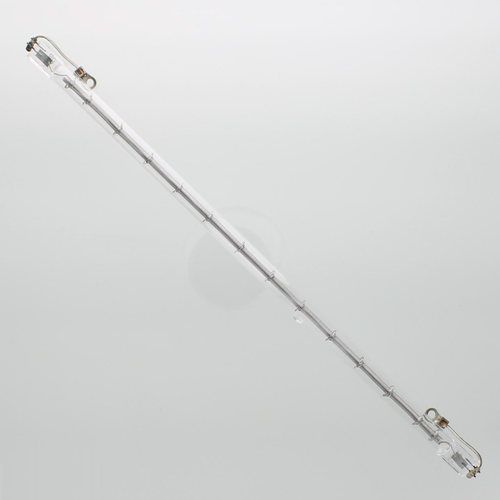
Ushio AL-1824 / Welch Allyn 09500 18-24W MFI/VDX HID Metal Halide Lamp

$182.95
(No reviews yet)
SKU:
AL-1824
Availability:
Stock Item
Shipping:
Calculated at Checkout
Product Description
Daylight-color HID metal halide lamp engineered for Welch Allyn MFI/VDX light sources and compatible medical/dental illumination systems.
SOSCleanroom
Overview

The Ushio AL-1824 (also referenced as Welch Allyn 09500) is a compact HID metal halide lamp designed to deliver bright, daylight-balanced white light for precision visualization. This lamp format is widely used in MFI/VDX light sources and related medical, dental, and inspection platforms where color contrast and high-intensity output are critical. SKU: AL-1824.

Key Highlights
  • Wattage: 18–24W
  • Voltage: 60V
  • Base Type: 2-pin prefocused
  • Lamp Fill: Metal halide (HID)
  • Lamp Size: MR11
  • Correlated Color Temperature: 6,000K (daylight appearance)
  • Average Life: 300 hours
  • Common Reference Codes: Welch Allyn 09500 / 09500U
Typical Applications
  • Endoscopes and boroscopes
  • Dental curing and surgical headlamps / specialty headlights
  • High-intensity inspection and visualization systems requiring daylight color balance
Handling Tip 
HID metal halide lamps operate under high internal temperature/pressure and require the correct ballast/ignition system. Follow the equipment manufacturer’s cool-down and service procedure. Keep optical surfaces and the lamp area clean—use clean nitrile gloves and a lint-free wipe during servicing to minimize residue and particulates around reflectors, light guides, and lenses.
About Ushio
Ushio is a photonics and specialty light source organization that develops lamps and light-based technologies used across industrial, scientific, and medical markets—supporting applications from ultraviolet through infrared. Ushio’s “Applying Light to Life” focus reflects the company’s emphasis on solving real-world problems with engineered light.
Industry Update:
In July 2025, Ushio announced an agreement to acquire ams OSRAM’s Entertainment & Industry Lamps (ENI) business, with closing anticipated by the end of March 2026. During and after a transition, customers may see changes such as labeling, packaging, part-number presentation, and distribution channels. Best practice: qualify replacements by the manufacturer code and critical specs (for this lamp: 18–24W / 60V, 2-pin prefocused, and the correct lamp geometry) to ensure continuity.

SOSCleanroom (Specialty Optical Systems, Inc.) has supported specialty lighting customers as a distribution partner for 40+ years.
Need help selecting the right product?
If you need additional information please try our SOSCleanroom specific AI ChatBot which draws from our extensive cleanroom specific libraries.
Always confirm compatibility with your exact light source (required ballast/ignitor type, connector/base style, and lamp envelope size) prior to installation.
The Technical Vault
By SOSCleanroom
Metal Halide HID Engineering
Arc Physics Ballast & Ignition Optics & Alignment Safety & Handling
Quick Specs
Manufacturer / Ordering Code Ushio AL-1824  |  Common reference: Welch Allyn 09500
Lamp Type / Technology HID metal halide (short-arc, high-luminance white-light source)
Electrical (nominal) 18–24W  |  60V
Base / Form Factor 2-pin prefocused  |  MR11
Color Characteristics ~6,000K (daylight appearance; optimized for color contrast)
Average Life 300 hours (application dependent)
Primary Use Endoscopes, boroscopes, dental curing, surgical headlamps (MFI/VDX and related systems)
The Science: How Metal Halide HID Lamps Produce Daylight-Quality Light
A metal halide lamp is a high-intensity discharge (HID) source. Instead of heating a filament, the lamp creates a controlled electric arc between two electrodes inside a small arc tube. Once the arc is established, current flowing through the plasma excites mercury vapor and metal-halide additives, generating intense visible light with strong perceived “white” output.
The “metal halide” chemistry is what enables high efficacy and daylight-like color. As the lamp warms, metal-halide salts vaporize and contribute spectral content that improves color balance and contrast. In practical terms: this technology can deliver very high brightness from a compact source—ideal for light guides, endoscopy illumination, and medical/dental visualization.
Why Short-Arc Design Matters in Imaging & Light-Guide Systems
Many medical illumination systems are designed around a “near point-source” emitter so optics can efficiently capture and focus the light into lenses, reflectors, or fiber/light guides. Short-arc metal halide designs concentrate light near the electrode tips, which improves coupling efficiency and supports compact optical designs.
Practical takeaway: do not substitute a different base or geometry “that almost fits.” Prefocused bases are used to preserve arc position relative to the optical system; small positional changes can reduce brightness, introduce hot spots, or degrade uniformity in the beam.
Ballast & Ignition: Why HID Lamps Are a System, Not Just a Bulb
  • Ignition: HID lamps require a starting method to strike the arc. The light source’s ignitor/ballast provides the start conditions and then regulates operation.
  • Warm-up: brightness and color stabilize as the arc tube reaches operating temperature and metal-halide salts fully vaporize.
  • Restart behavior: after power-off, many HID designs require a cool-down period before a reliable restart (hot-restrike is system dependent).
  • Compatibility: match the lamp to the specified ballast type and the equipment’s operating window to protect life and performance.
Lamp Life, Stability, and End-of-Life Signals
HID lamp life is strongly influenced by operating conditions and start cycles. Over time, electrodes wear and arc chemistry shifts. Common end-of-life behavior includes starting difficulty (the lamp fails to strike reliably) and reduced output.
In critical visualization applications, proactive replacement is often preferred to avoid sudden downtime—especially when the lamp is used for procedures or scheduled inspections.
Safety & Handling Notes (Important for HID)
  • High temperature & pressure: allow full cool-down before handling; follow the light source manufacturer’s service instructions.
  • UV/optical shielding: many HID systems rely on protective optics/filters—do not operate the lamp outside its intended enclosure.
  • Keep the optical path clean: residue and particulates on reflectors/lenses reduce delivered intensity; use clean nitrile gloves and lint-free wipes during service.
  • Do not “force fit”: base style and prefocus alignment are part of the optical design and affect performance.
Industry Update: ENI Business Transaction (Expected Close by End of March 2026)
In July 2025, Ushio announced an agreement to acquire ams OSRAM’s Entertainment & Industry Lamps (ENI) business, with closing anticipated by the end of March 2026. For users of installed light sources, the practical guidance is disciplined documentation and qualification: retain core identifiers (AL-1824 / 09500) and validate replacements by electrical rating, base/alignment geometry, and delivered optical performance in the instrument.
Cleanroom Considerations

Treat lamp changes as a controlled maintenance event: minimize packaging debris, keep reflectors and lens surfaces protected, and use low-lint handling materials to reduce particulate transfer.

For best results, stage clean nitrile gloves plus cleanroom-grade lint-free wipes/swabs during service so the optical cavity can be kept free of oils and residues prior to return-to-service.

Need deeper specs or cross-references?
If you need additional information please try our SOSCleanroom specific AI ChatBot which draws from our extensive cleanroom specific libraries.
For clinical/inspection light sources, confirm OEM requirements (ballast/ignitor compatibility, connector/base style, arc position/prefocus geometry, and required shielding/filters) before operation.