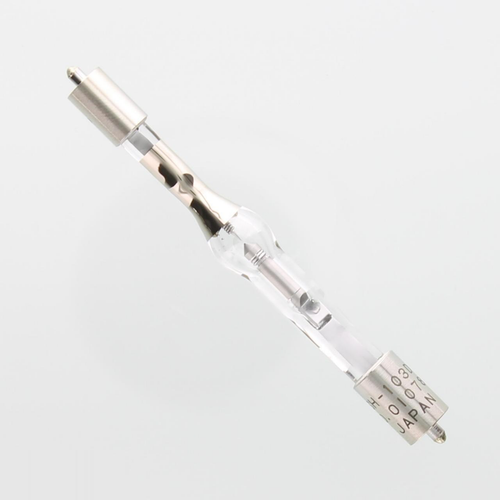
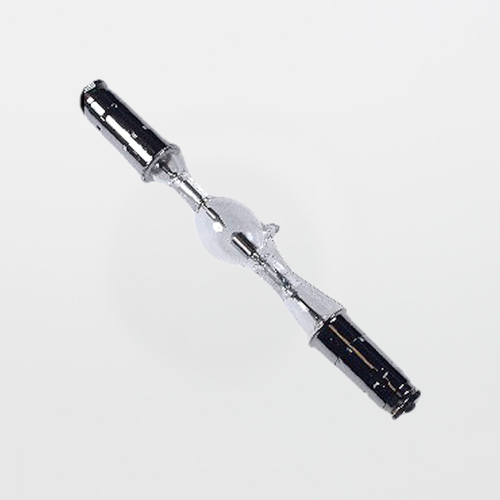
Ushio USH102DH 100W Short Arc Mercury Lamp

$158.00
(No reviews yet)
SKU:
USH102DH (5000274)
UPC:
048777400302
Availability:
Stock Item
Shipping:
Calculated at Checkout
Product Description
High-intensity short-arc mercury illumination for fluorescence microscopy and analytical instrumentation.
SOSCleanroom
Overview

The Ushio USH102DH is a 100W, 20V short-arc mercury lamp engineered to deliver a highly concentrated, high-radiance arc for optical systems that require intense illumination in a compact source geometry. It is commonly used in microscope illumination systems (including fluorescence microscopy) and other diagnostic or analytical instruments where stable arc performance and repeatable alignment are critical. SKU: USH102DH (5000274).

Key Highlights
  • Electrical: 100W, 20V
  • Base: SFa7.5-2 Specialty Base
  • Length: 3.54 in
  • Diameter: 0.39 in
  • Average Life: 200 hours
  • SKU / Mfg. Ordering Code: 5000274
  • UPC: 048777400302
Typical Applications
  • Fluorescence microscopy illumination systems
  • Diagnostic imaging and analytical instrumentation
  • Installed systems designed around USH102DH geometry and basing
Handling Tip 
Short-arc mercury lamps operate at high temperature and high internal pressure. Avoid touching quartz with bare hands and follow equipment OEM cool-down times. Use clean nitrile gloves and a lint-free wipe to reduce residue and contamination risk.
About Ushio
Ushio is a photonics and specialty lighting company providing lamps and light-based solutions across industrial markets (including semiconductor-related applications), visual imaging, and life sciences. Ushio’s portfolio includes short-arc technologies and integrated lighting systems aligned with its “Applying Light to Life” focus.
Industry Update:
In July 2025, Ushio announced an agreement to acquire ams OSRAM’s Entertainment & Industry Lamps (ENI) business, with closing expected in Q1 2026 (by the end of March 2026). During and after transitions in specialty lamp portfolios, customers may see changes such as labeling, packaging, part-number presentation, and distribution channels. Best practice: qualify replacements by the manufacturer code and critical specs (100W/20V, base type, and critical dimensions) to ensure continuity.
Need help selecting the right product?
If you need additional information please try our SOSCleanroom specific AI ChatBot which draws from our extensive cleanroom specific libraries.
Always confirm compatibility with your instrument OEM requirements (wattage, voltage, basing, lamp orientation, and mechanical envelope) prior to installation.
The Technical Vault
By SOSCleanroom
Short-Arc Mercury Engineering
Optics & Alignment Power & Ballast Safety & Handling
Quick Specs
Manufacturer / Ordering Code Ushio USH102DH | SKU: USH102DH (5000274) | UPC: 048777400302
Lamp Type / Technology Mercury short-arc (HID) | High-radiance arc source for microscopy illumination systems
Wattage / Voltage 100W / 20V
Base / Basing SFa7.5-2 Specialty Base (verify fixture-side basing and seating geometry)
Physical Envelope Length: 3.54 in | Diameter: 0.39 in
Average Life 200 hours
How a Short-Arc Mercury Lamp Works (In Plain Engineering Terms)
A short-arc mercury lamp is a high-intensity discharge device. Instead of producing light from a glowing filament, it produces light from a plasma arc struck between two electrodes separated by a very small distance (the “short arc gap”). The arc operates inside a quartz (fused silica) arc tube containing mercury (and often a starter gas). When the lamp is running, electrical power is concentrated into a tiny plasma volume, creating extremely high radiance (brightness per unit area per solid angle) that optics can efficiently collect and focus.
Core Engineering: Arc Tube, Electrodes, and Why the Geometry Matters
1) Quartz arc tube (fused silica): Quartz is used because it survives very high temperatures and transmits UV far better than standard glass. When the lamp reaches operating temperature, mercury vapor pressure increases dramatically and the arc tube behaves like a high-pressure vessel. That is why quartz purity, wall thickness, and thermal-stress control are part of the lamp’s fundamental design.
2) Electrode system (cathode/anode physics): The cathode emits electrons, typically assisted by thermionic emission from a hot tungsten tip. The anode collects electrons and experiences intense heating from electron bombardment. Tip shape, spacing, and materials are engineered to: stabilize the arc attachment point, reduce electrode erosion, and keep the arc location repeatable for optical alignment.
3) “Short arc” optical benefit: A smaller arc gap produces a smaller emitting region. In microscopy illumination, this is critical because optical systems often image the arc into an aperture, condenser, or fiber/light guide. A compact arc improves coupling efficiency and helps maintain consistent illumination geometry at the specimen plane (especially important for fluorescence excitation and imaging repeatability).
Ignition and Warm-Up: Why These Lamps Need an Igniter and Warm-Up Time
  • Ignition (strike): a dedicated igniter produces a high-voltage pulse that ionizes the fill gas and initiates conduction across the arc gap.
  • Early discharge regime: once conductive, the discharge heats the electrodes and arc tube rapidly; electrical characteristics change quickly during this phase.
  • Mercury vapor pressure rise: as mercury vaporizes, arc voltage and spectral output shift toward mercury’s characteristic line spectrum, and radiance increases.
  • Thermal stabilization: optical output and arc position stabilize after warm-up; this is why microscopy users often wait before critical imaging or calibration.
Ballast Engineering: Current Regulation, Arc Stability, and Flicker Control
Short-arc mercury lamps exhibit a negative resistance behavior once the arc is established: as current increases, arc voltage tends to drop. Without a ballast, current can runaway, damaging electrodes and the arc tube. The ballast is therefore a control system, not an accessory.
  • Current regulation: maintains the lamp at its designed operating current to control radiance, spectrum, and electrode temperature.
  • Arc stability: limits arc wander that can reduce coupling efficiency and cause illumination non-uniformity.
  • Ripple to light conversion: electrical ripple can become optical ripple (visible flicker or excitation instability). Precision imaging systems often constrain ballast ripple tightly.
  • Hot re-strike behavior: after shut-down, internal pressure can remain high; many systems require cool-down time before reliable re-ignition. Follow the instrument OEM procedure.
Optical Output: Mercury Line Spectrum and Why It’s Valuable in Microscopy
Mercury arcs produce strong spectral lines (rather than a smooth incandescent spectrum). In fluorescence microscopy, this matters because excitation filters are often tuned around known lines. High radiance plus line-rich UV/visible output enables strong excitation intensity at the sample while maintaining a compact source size for efficient optical collection.
  • High radiance from a small arc: improves coupling into condensers, light guides, and imaging optics.
  • Thermal management: substantial heat load requires correct airflow and shielding in the lamp house.
  • Material compatibility: UV output can degrade plastics and coatings; microscopy lamp houses typically use UV-rated materials and filters.
Replacement Guidance: Reduce Risk by Qualifying the Right “Interfaces”
For short-arc mercury lamps, “matching wattage” is not enough. The correct replacement is the one that matches the system interfaces that drive optical performance and safety.
  • Electrical interface: confirm 100W / 20V and ballast/igniter compatibility for this lamp family.
  • Mechanical interface: confirm basing, seating depth, and envelope dimensions (3.54 in length / 0.39 in diameter).
  • Optical interface: lamp house alignment features, reflector geometry, and arc imaging position must match the OEM design intent.
  • Instrument cross-reference: this lamp is commonly listed for microscope illumination systems; record USH102DH / 5000274 in maintenance logs.
Safety Engineering: UV, High Voltage Ignition, High Pressure, and Mercury
  • UV hazard: mercury arcs emit UV that can injure eyes/skin. Use lamp house shielding and never bypass interlocks.
  • Ignition voltage: igniters use high-voltage pulses. Follow lockout/tagout procedures during service.
  • High pressure: operate only in the OEM-rated lamp housing; allow full cool-down before handling.
  • Mercury: treat as a mercury-containing device for disposal and spill response. Follow site EHS procedures if breakage occurs.
Cleanroom Considerations (Controlled Environments)
  • Particle control: open packaging away from airflow paths; prevent cardboard/paper fibers from entering lamp housings and optics.
  • Quartz cleanliness: residues can bake-on and reduce transmission or create thermal stress points—use clean nitrile gloves and a cleanroom-grade lint-free wipe.
  • Document lamp hours: short-arc sources are often changed on schedule to protect process repeatability and reduce end-of-life failure risk.
  • Verify interlocks: safety interlocks protect both personnel and the controlled environment from UV and ignition events.
Need deeper specs or cross-references?
If you need additional information please try our SOSCleanroom specific AI ChatBot which draws from our extensive cleanroom specific libraries.
For short-arc mercury systems, confirm OEM requirements (wattage class, ballast/igniter compatibility, lamp orientation, reflector geometry, and safety housing/interlocks) prior to installation.