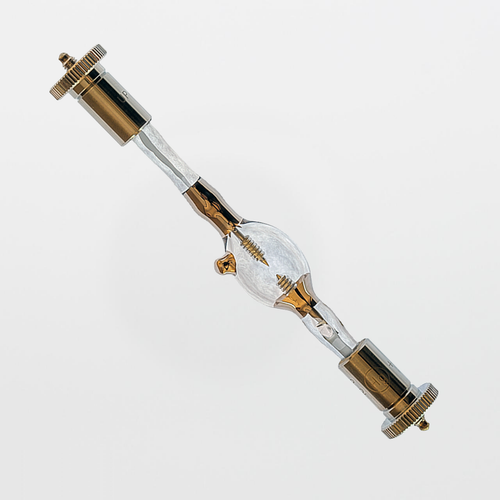
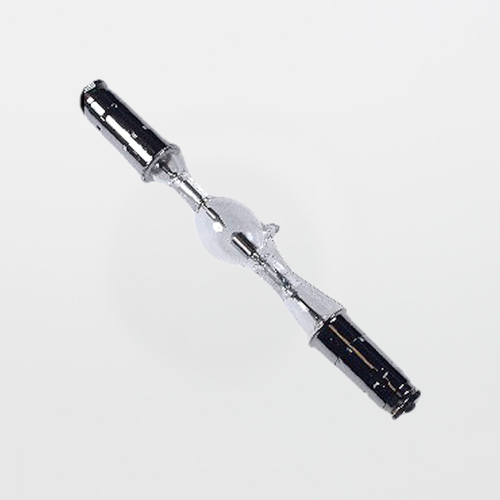
Quick Specs
| Manufacturer / Ordering Code |
Ushio USH205DP | 5000277 |
| Lamp Type / Technology |
Short-arc mercury discharge lamp (high radiance UV-visible source) |
| Wattage / Voltage (Nominal) |
200W / 57V (nominal) | ~3.5A operating current (approx.) |
| Arc Geometry |
Cold arc gap: 2.8mm (tightly confined arc for high luminance) |
| Optical Output |
Total lumens: 10,000 lm |
| Dimensions |
128mm overall length | 16mm diameter |
| Rated Life / Orientation |
1,000 hours | Typical operating position: Vertical ±45° (fixture dependent) |
| Common Cross-References |
Osram HBO200W/2 L1 | Leitz/Wild 050-620 | Zeiss 380018-4070 |
How a Short-Arc Mercury Lamp Works (Engineering-Level Overview)
A short-arc mercury lamp is a high-pressure gas-discharge light source. Instead of a filament, it generates light from a
plasma arc formed between two electrodes inside a compact quartz burner. The arc is intentionally short (here, a 2.8mm cold arc gap),
which concentrates power into a very small emitting volume. That is the core reason these lamps deliver high radiance (brightness per unit area)—ideal for optical coupling in microscopes and analytical instruments.
Start-up sequence: the lamp requires a purpose-designed power supply/ignitor that applies a high-voltage pulse to initiate the discharge.
Once the arc strikes, the mercury vapor pressure rises rapidly as the burner heats. During warm-up, electrical characteristics change (voltage/current relationship) until the lamp reaches its designed operating point.
Steady operation: at nominal operation the USH205DP is listed at 200W and 57V (about 3.5A), producing roughly 10,000 lm.
The plasma emits a mercury-dominated spectrum with strong UV and visible components. In fluorescence microscopy, these spectral lines are valuable because they align with common excitation bands when filtered through the instrument’s optical train.
Why Short Arc Geometry Delivers Better Optical Performance
Optical systems care about source size, source stability, and repeatable positioning. A short arc behaves like a compact point-ish source compared with longer arc lamps, allowing more efficient coupling into condensers, light guides, and microscope illumination paths.
The practical implication: cross-referencing must protect both the electrical operating point and the mechanical/optical envelope. Even small differences in arc location, lamp length, or mounting can shift focus, reduce uniformity, and degrade fluorescence signal-to-noise.
Thermal & Materials Engineering: What Protects Lamp Life
Short-arc burners run extremely hot. The quartz envelope and electrode seals are engineered to tolerate high temperature gradients while maintaining arc stability.
Lamp life is influenced by electrode wear (erosion and emitter chemistry), seal temperature, and cooling effectiveness in the lamp house.
For the USH205DP, the published 1,000-hour average life assumes proper power regulation and a compatible housing.
Poor airflow, incorrect orientation, or an out-of-spec power supply can accelerate lumen depreciation, create arc wander/flicker, and shorten service life.
Critical Safety Notes (Read Before Installation)
- UV hazard: the arc emits intense UV that can injure eyes/skin. Operate only in enclosed, interlocked lamp housings with the correct shielding and filters.
- High-pressure risk: these lamps operate at high internal pressure; mishandling or incorrect housing can create rupture risk. Avoid impact and do not operate outside the designed lamp house.
- Mercury content: handle and dispose per applicable regulations; do not break the lamp. Follow facility procedures for spill response if a break occurs.
- Ozone note: some mercury sources can produce wavelengths that generate ozone in air; ozone management is a system-level design topic—verify your housing and ventilation requirements.
Industry Update: ENI Business Transaction (Expected Close by End of March 2026)
Ushio and ams OSRAM announced an agreement for Ushio to acquire ams OSRAM’s Entertainment & Industry Lamps (ENI) business, with closing expected by the end of March 2026 (purchase price referenced publicly as EUR 114 million on a cash-and-debt-free basis).
For customers, the most resilient approach is documentation and qualification: keep the core lamp identifier (USH205DP / 5000277), and qualify by the system-critical requirements (electrical operating point, arc geometry, and mechanical envelope).
Cleanroom Considerations
In controlled environments, treat lamp changes like a planned maintenance event: minimize packaging debris, use low-lint handling materials,
and keep the lamp and housing interface free of oils and particulates prior to returning the instrument to service.
Stage clean nitrile gloves and a cleanroom-grade lint-free wipe during installation to reduce contamination risk and prevent residue transfer to optical surfaces.
Need deeper specs or cross-references?
If you need additional information please try our SOSCleanroom specific AI ChatBot which draws from our extensive cleanroom specific libraries.
For mission-critical optical instruments, confirm OEM requirements (power supply/ignitor compatibility, lamp house model, orientation limits, shielding/filters, and thermal management) prior to use.