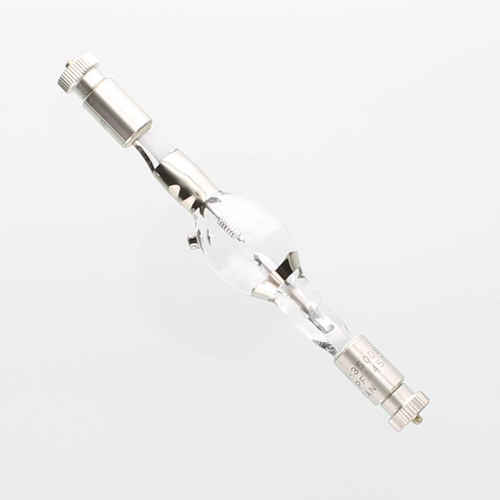
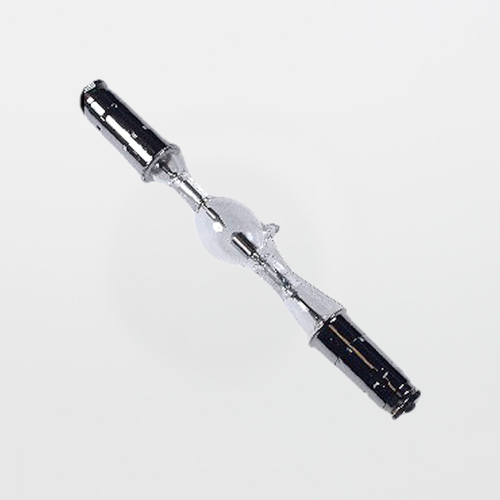
Quick Specs
| Product / Ordering Code |
Ushio USH350DP (5000506) |
| Lamp Technology |
Mercury-xenon DC short-arc, super high-pressure HID |
| Power / Electrical |
350W • 60V • 6A |
| Cold Arc Gap |
2.8mm |
| Output (as listed) |
Total luminous flux: 18,000 lm |
| Burning Position |
Vertical ± 45° |
| Rated Life |
1,000 hours |
| Equipment Reference |
GCA/COBILT |
How Short-Arc Mercury Lamps Work (and Why They’re So Bright)
A short-arc mercury lamp is a high-intensity discharge (HID) light source. Instead of a filament, it generates light from a
plasma arc formed between two electrodes inside a quartz envelope containing mercury (and typically a starting gas such as xenon).
When operating, the arc becomes an extremely small, extremely bright emitter—often treated by optical designers as a near
point-source compared to longer-arc lamps.
Why “short-arc” matters: the USH350DP is listed with a 2.8mm cold arc gap. A shorter arc concentrates radiant power into a smaller
emitting volume, producing high luminance (radiance) that couples efficiently into reflectors, condenser optics, and fiber bundles—critical for
fluorescence microscopy, projection/illumination engines, and semiconductor/inspection tools.
Mercury spectrum and UV capability: mercury discharge produces strong emission lines in the UV and visible, which is why mercury short-arc sources are
frequently selected for UV excitation and optical process energy. These lamps also run at very high internal pressure and must be operated only in
appropriate enclosed housings with correct electrical gear and safety interlocks.
Electrical Engineering: Ignition, Ballast, and Arc Stability
Short-arc HID lamps behave as a negative-resistance load once the arc is established—meaning that as the arc heats up, it can draw more current
unless the power system actively limits and regulates it. That is why these lamps require a purpose-designed ballast / power supply matched to the lamp.
- Ignition (starting): the system applies a high-voltage start pulse to ionize the gas and “strike” the arc.
- Current regulation: after strike, the ballast controls current (for this lamp: 6A) and supports stable operation at the required electrical point (60V nominal).
- Arc stability: stable current and correct thermal environment reduce arc wander/flicker and keep optical output consistent for imaging/inspection repeatability.
- Warm-up behavior: output and arc voltage can change as the lamp reaches thermal steady state; many instruments specify a warm-up period before measurement/exposure.
Mechanical & Optical Engineering: Quartz, Electrodes, and Focus
These lamps are built around a quartz (high-silica) envelope that tolerates high temperature and transmits UV far better than standard glass.
Inside, two electrodes form the arc: the cathode is designed for electron emission and arc attachment; the anode is engineered to absorb
intense heat load. Precise electrode geometry helps produce a tight, stable arc that optical systems can image and focus.
Optical coupling: many instruments use ellipsoidal reflectors, condenser lenses, or integrator optics to capture the high radiance from the arc and form a controlled illumination field.
Even small changes in arc position or lamp seating can shift the focus and uniformity at the sample plane or mask/wafer plane.
Why burning position is specified: the USH350DP is listed for Vertical ± 45°. Orientation affects internal convection patterns, electrode temperature balance,
and arc “bowing” forces. Staying within the specified range supports consistent arc geometry and helps manage electrode wear over life.
Safety & Risk Controls (Non-Negotiable for Short-Arc Mercury)
- High internal pressure: operate only in fully enclosed, interlocked housings designed for short-arc lamps.
- Intense UV emission: UV can damage eyes/skin and can degrade polymers; do not bypass shielding or interlocks.
- Mercury content: follow site EHS procedures for storage, breakage response, and disposal.
- Thermal hazard: allow full cool-down before handling; many systems also restrict hot re-strike until the lamp cools.
SOSCleanroom’s own short-arc category guidance highlights that these lamps operate with strong UV emission and high internal pressure and must be used only in properly enclosed, purpose-designed housings.
Replacement Qualification Checklist (Field-Proven Best Practice)
- Match the exact lamp code: USH350DP / 5000506.
- Match electrical point: 350W, 60V, 6A (and ensure the ballast/ignitor is specified for this lamp family).
- Respect burning position: Vertical ± 45°—do not assume universal orientation.
- Confirm optical geometry: arc location and seating are critical; follow OEM alignment procedure after replacement.
- Plan for stabilization: allow warm-up time before qualifying intensity, uniformity, or measurement results.
Cleanroom Considerations
Treat lamp replacement like a controlled maintenance activity: minimize packaging debris, avoid shedding materials, and protect optical paths from particulate intrusion.
Use clean nitrile gloves, a cleanroom-grade lint-free wiper, and (when cleaning tight features) a low-lint swab to keep lamp housings,
reflectors, and optical windows free of residue. (Texwipe cleanroom wipers and swabs are a strong fit for these tasks in controlled environments.)
Before energizing the system, verify all covers, interlocks, and shielding are correctly installed and that airflow/thermal management components are returned to their designed configuration.
Industry Update: ams OSRAM ENI Business → Ushio (Closing Expected by End of March 2026)
In July 2025, ams OSRAM announced an agreement with Ushio for the sale of its Entertainment & Industry Lamps (ENI) business, with closing expected by
the end of March 2026. For buyers, the practical takeaway is disciplined replacement qualification: retain manufacturer codes in maintenance records and qualify by
electrical specs and mechanical/orientation requirements to reduce downtime risk.
Need deeper specs or cross-references?
If you need additional information please try our SOSCleanroom specific AI ChatBot which draws from our extensive cleanroom specific libraries.
For mission-critical optical instruments, confirm OEM requirements (ballast/ignitor compatibility, burning position, arc alignment, and safety interlocks) prior to use.