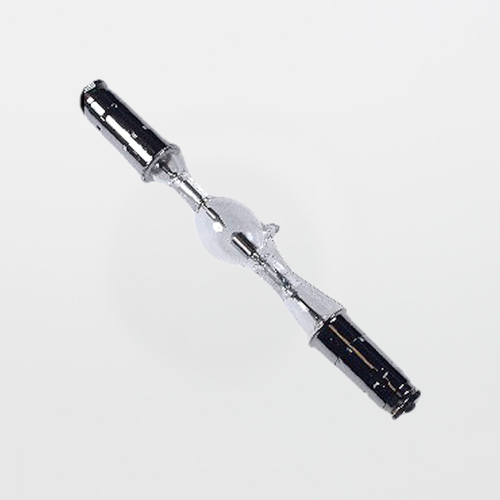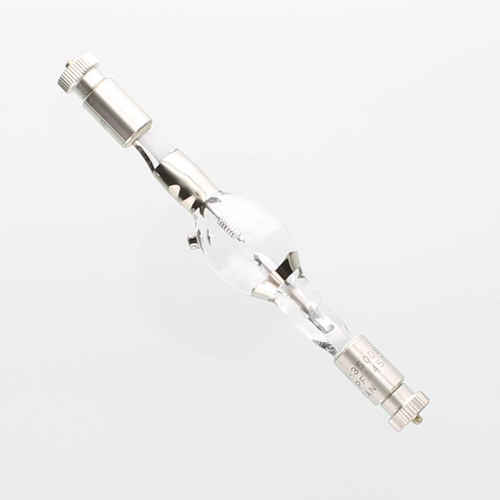
Ushio USH350DS 350W Short Arc Mercury Lamp

$427.00
(No reviews yet)
SKU:
USH350DS (5000508)
UPC:
048777292921
Availability:
Stock Item
Shipping:
Calculated at Checkout
Product Description
High-luminance 350W short-arc mercury lamp for microscopy, diagnostics, analytical instrumentation, and select semiconductor tools.
SOSCleanroom
Overview

The Ushio USH350DS is a 350W short-arc mercury lamp designed for tightly confined plasma discharge and high luminance with ultra-stable arc behavior in the ultraviolet and visible regions. This technology is widely used in microscopy systems and analytical instrumentation where a compact, high-radiance source is required. SKU: USH350DS (5000508).

Key Highlights
  • Mfg. Ordering Code: 5000508
  • Wattage / Voltage: 350W / 60V
  • Operating Current: 5.8A
  • Burning Position: Vertical ± 45°
  • Cold Arc Gap: 2.8mm (optical coupling-critical)
  • Total Luminous Flux: 18,000 lm
  • Average Life: 1,000 hours
  • UPC: 048777292921
Typical Applications
  • Microscopy illumination systems (instrument-specific)
  • Diagnostic and industrial analytical equipment (including spectrofluorometers, blood analyzers, and optical comparators)
  • UV curing applications where a high-radiance UV/visible source is required (system-dependent)
Equipment Reference (as listed)
Karl Suss MJB, MA4, 6, 25, 150M.
Handling Tip 
Short-arc mercury lamps operate at high temperature and high internal pressure and require an OEM-rated lamp house and ballast/igniter system. Do not touch quartz with bare hands. Follow OEM cool-down and safety interlock procedures. Use clean nitrile gloves and a lint-free wipe to minimize residue and contamination risk.
About Ushio
Ushio is a global photonics and specialty lighting company focused on “Applying Light to Life,” supplying lighting systems and components across industrial markets (including semiconductor-related applications), visual imaging, and life sciences. Ushio’s portfolio spans specialty lamps and light-based solutions used in precision manufacturing, imaging, and scientific environments.
Trusted Distribution Experience
SOSCleanroom (Specialty Optical Systems, Inc.) has been distribution partners for over 40 years, supporting customers with sourcing continuity, cross-references, and application-driven product selection for mission-critical instruments and systems.
Industry Update:
In July 2025, Ushio announced an agreement to acquire ams OSRAM’s Entertainment & Industry Lamps business, with closing expected by Q4 of the fiscal year ending March 2026. During and after portfolio transitions, customers may see changes such as labeling, packaging, part-number presentation, and distribution channels. Best practice: qualify replacements by the manufacturer code and critical specs (350W/60V, arc geometry, burning position, and the correct mechanical envelope/lamphouse interface).
Need help selecting the right product?
If you need additional information please try our SOSCleanroom specific AI ChatBot which draws from our extensive cleanroom specific libraries.
Always confirm compatibility with your instrument OEM requirements (wattage class, voltage, ballast/igniter requirements, burning position, and lamp-house interfaces) prior to installation.
The Technical Vault
By SOSCleanroom
Short-Arc Mercury Engineering
Arc Physics Optics & Alignment Power & Ballast Safety & Handling
Partner Insight: 40+ Years in Specialty Lighting Distribution
SOSCleanroom (Specialty Optical Systems, Inc.) has been distribution partners for over 40 years. For short-arc mercury systems, replacement success requires matching three interfaces: electrical (wattage class + ballast/igniter), mechanical (lamp-house fit + cooling path), and optical (arc location relative to the reflector/collector).
Quick Specs
Product / Ordering Code Ushio USH350DS | SKU: USH350DS (5000508)
Lamp Type / Technology Mercury short-arc (HID) | UV/visible high-radiance arc source
Electrical (Nominal) 350W | 60V | 5.8A
Arc Geometry Cold arc gap: 2.8mm
Burning Position Vertical ± 45° (arc stability & thermal profile critical)
Total Luminous Flux 18,000 lm
Average Life 1,000 hours
Equipment Reference (as listed) Karl Suss MJB, MA4, 6, 25, 150M
How Short-Arc Mercury Lamps Produce Light (What’s Happening Inside)
A short-arc mercury lamp is a high-intensity discharge (HID) source. A high-voltage pulse from an igniter initiates conduction across a very small electrode gap inside a fused silica (quartz) arc tube. Once the arc forms, regulated current drives a plasma that rapidly heats the mercury to a high vapor-pressure state. Light output is then dominated by mercury’s characteristic UV/visible spectral lines plus a continuum component. The “short-arc” architecture concentrates power into a very small arc volume, creating extremely high radiance (brightness per unit area) that optical systems can efficiently collect and image into an instrument’s light path.
Arc Physics & Electrode Engineering (Why Stability Matters)
  • Arc attachment control: the arc “anchors” to specific regions of the electrode tips. Tip geometry and electrode materials are engineered to promote stable attachment and manage erosion.
  • Cathode vs. anode thermal loading: electron emission and bombardment create asymmetric heating. System design (lamp house + airflow) protects seals and maintains predictable arc behavior.
  • Cold arc gap (2.8mm): a practical indicator of arc geometry. The reflector/collector is typically designed around the arc’s effective position and size; mismatch can reduce coupling efficiency and uniformity.
  • Spectral output: mercury arcs are not “white LEDs.” Users typically filter/select bands (UV/blue/green) depending on the application (e.g., fluorescence excitation or UV process work).
Why Burning Position Is Specified (Vertical ± 45°)
At 350W, the lamp’s thermal and fluid dynamics become increasingly important. The arc column and hot gases create buoyancy-driven flow inside the arc tube. Burning position constraints help maintain a predictable temperature distribution and arc attachment behavior.
  • Arc stability: orientation affects convection patterns, which can shift the arc and change how it couples into the reflector/collector.
  • Seal and electrode protection: controlled orientation supports consistent thermal loading on seals and electrodes, improving reliability and life.
  • Optical repeatability: stable arc position reduces drift in delivered irradiance—important for imaging, measurements, and UV process consistency.
Power, Ballast & Ignition (System-Level Requirement)
An arc is a negative-resistance load: if current rises, arc voltage tends to drop, which encourages further current rise. That is why short-arc mercury lamps require an OEM-rated ballast (current regulation) and igniter (starting pulses). The listed electrical values (60V, 5.8A) reflect the operating regime that the control gear is designed to regulate.
  • Warm-up behavior: output stabilizes after warm-up as mercury vapor pressure reaches steady-state—critical work is best done after stabilization.
  • Ripple & noise: electrical ripple can become optical ripple (intensity modulation), showing up as flicker or measurement noise in sensitive systems.
  • Restart discipline: after shut-down, internal pressure remains high; follow OEM cool-down guidance for reliable re-strike.
Application Note: High Radiance as a Process Tool
The USH350DS is commonly used anywhere a compact, high-radiance UV/visible source is needed for efficient optical coupling—ranging from microscopy excitation paths to analytical instruments. The listed equipment references include Karl Suss tools, underscoring that in certain environments, “lighting” is part of the process chain and must be qualified like any other critical component.
Safety Engineering: UV, High Voltage, High Pressure, and Mercury
  • UV hazard: mercury arcs emit UV that can injure eyes/skin—operate only in the OEM housing and do not defeat interlocks.
  • High-voltage ignition: igniters generate high-voltage pulses—use lockout/tagout practices during service.
  • High internal pressure: allow full cool-down before handling; use protective measures defined by your OEM and site EHS procedures.
  • Mercury: dispose per facility and local regulations; follow site response procedures if breakage occurs.
Cleanroom Considerations (Controlled Environments)
  • Particle control: open packaging away from airflow paths; prevent fibers/debris entering lamp housings and optical cavities.
  • Quartz cleanliness: residues can bake-on under UV/heat—use clean nitrile gloves and a cleanroom-grade lint-free wipe.
  • Hour tracking: log lamp hours and replace on schedule to protect repeatability and reduce end-of-life instability.
Need deeper specs or cross-references?
If you need additional information please try our SOSCleanroom specific AI ChatBot which draws from our extensive cleanroom specific libraries.
For short-arc mercury systems, confirm OEM requirements (wattage class, ballast/igniter compatibility, burning position, reflector geometry, and safety housing/interlocks) prior to installation.