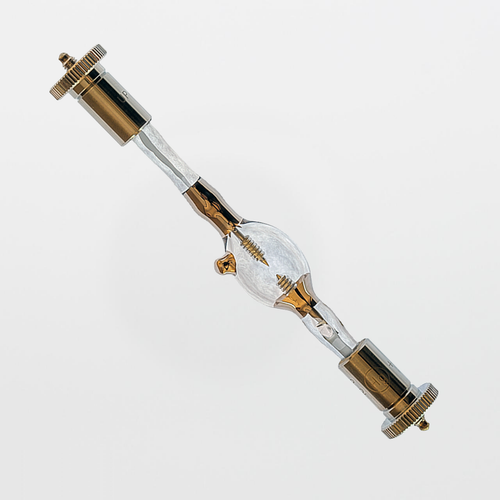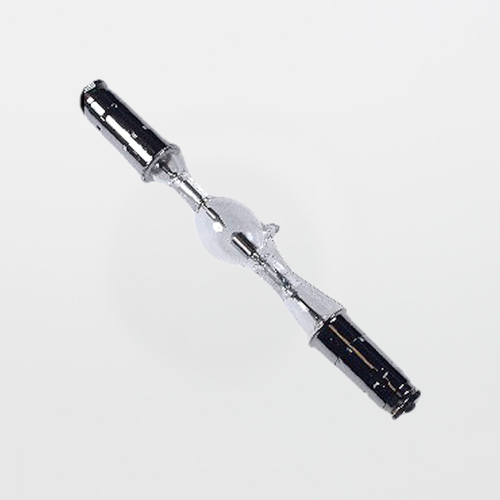
Ushio USH500D 500W Short Arc Mercury Lamp

$629.00
(No reviews yet)
SKU:
USH500D (5000518)
Availability:
14 - 21 Business Days
Shipping:
Calculated at Checkout
Product Description
High-luminance 500W super high pressure mercury short-arc lamp for ASML stepper and UV optical systems.
SOSCleanroom
Overview

The Ushio USH500D is a 500W mercury short-arc lamp engineered for high-luminance UV/visible output in precision optical tools. It is commonly used in ASML Stepper Model 5000/50 platforms and is cited as equivalent to Osram HBO500W/A. Ushio’s super high pressure mercury designs concentrate strong output in key UV wavelengths (notably around 436 nm, 405 nm, and 365 nm) to support uniform illumination in optical systems. SKU: USH500D (5000518).

Key Highlights
  • Rated Power: 500W
  • Rated Current: 8.5A
  • Arc Geometry: 4.5mm cold arc gap (point-like source behavior for optical coupling)
  • Burning Position: +/-15 degrees
  • Average Life: 800 hours
  • Reference: Used in ASML Stepper Model 5000/50; equivalent noted as Osram HBO500W/A
  • Ordering Code: 5000518
Typical Applications
  • Semiconductor stepper / photolithography illumination (ASML tool families)
  • High-intensity UV/visible optical systems requiring uniform illumination distribution
  • Precision instrument illumination where small arc size improves optical efficiency
Handling Tip 
Short-arc mercury lamps operate at high internal pressure and emit intense UV. Replace only in the intended enclosed housing and follow the OEM service procedure. Allow full cool-down, use clean nitrile gloves, and avoid touching critical surfaces. Use lint-free wipes/swabs to reduce residue and particulates during installation.
About Ushio
Ushio is a global photonics and specialty lighting company known for “Applying Light to Life,” developing light sources and light-based solutions used across industrial applications (including semiconductor-related markets), visual imaging, and scientific-medical systems.
Service Note
SOSCleanroom (Specialty Optical Systems, Inc.) has supported specialty lighting customers as a distribution partner for 40+ years. For mission-critical tools, qualify replacements using the manufacturer code and your system’s required mechanical and electrical interface specifications.
Industry Update:
In July 2025, Ushio announced an agreement to acquire ams OSRAM’s Entertainment & Industry Lamps (ENI) business, with closing anticipated by the end of March 2026. During and after a transition, customers may see changes such as part-number presentation, labeling, packaging, and distribution channels. Best practice: retain the manufacturer code (USH500D / 5000518) in maintenance records and qualify alternates strictly by critical specifications.
Need help selecting the right product?
If you need additional information please try our SOSCleanroom specific AI ChatBot which draws from our extensive cleanroom specific libraries.
Always confirm tool model, required power supply/ballast compatibility (500W / 8.5A class), lamp interface/fitment, and cooling configuration prior to installation.
The Technical Vault
By SOSCleanroom
Short-Arc Mercury Engineering
Semiconductor Tools Arc Physics Spectral Output Power & Ignition Safety Controls
Quick Specs
Product / SKU Ushio USH500D (5000518)
Lamp Type / Technology Super high pressure mercury short-arc discharge lamp
Rated Power 500W
Rated Current 8.5A
Cold Arc Gap Length 4.5mm
Burning Position +/-15 degrees
Average Life 800 hours
Tool Reference ASML Stepper Model 5000/50 (equivalent noted as Osram HBO500W/A)
The Science: How a Short-Arc Mercury Lamp Produces Light
A short-arc mercury lamp is a gas-discharge source. Light is generated when electrical current passes through a mercury vapor plasma between two electrodes (cathode and anode). The plasma emits intense radiation because excited mercury atoms and ions relax and release energy as strong spectral lines and a broader continuum background.
What makes it “short-arc” is the intentionally small electrode spacing (here, a 4.5mm cold arc gap), which concentrates the discharge into a very small, extremely bright region. This high luminance “near point source” is valuable in semiconductor and precision optical systems because it can be efficiently imaged and shaped by ellipsoidal reflectors, condensers, integrators, and homogenizers to produce uniform illumination at the wafer plane or optical field stop.
Engineering Deep Dive: What’s Inside the Lamp (and Why It Matters)
  • Quartz envelope and super high pressure fill: The arc tube is typically high-silica/quartz to tolerate extreme temperature and UV exposure. During operation, mercury pressure rises dramatically, increasing radiance and enabling high optical power density.
  • Electrode design: The cathode is engineered for stable electron emission; the anode must dissipate significant thermal load. Electrode geometry influences arc attachment, stability, and the effective source size.
  • Arc gap (4.5mm): A short gap concentrates the discharge, improving coupling efficiency into optical systems—but it also increases thermal stress and demands excellent cooling and regulation.
  • Orientation limit (+/-15°): High-pressure arcs can be sensitive to convection and buoyancy effects; the specified burning position helps maintain consistent arc location and stability.
Spectral Output: Why 365 / 405 / 436 nm Shows Up in Tool Specifications
Mercury arc lamps are valued because they provide intense energy at discrete wavelengths that optical systems and processes can be designed around. In many UV optical applications, strong mercury emission in the vicinity of 436 nm, 405 nm, and 365 nm can be filtered and shaped to meet process needs.
In practice, the lamp is one component of an optical chain: reflector + condenser + integrator/homogenizer + filters + projection optics. Maintaining the intended spectrum and source geometry helps the tool deliver repeatable irradiance, uniformity, and exposure stability.
Power, Ignition, and Regulation (Why the “Lamp + Supply” System Matters)
  • Controlled-current operation: Discharge lamps require a regulated driver/ballast to limit current. This lamp is specified at 8.5A in a 500W class system.
  • Ignition: Starting the arc typically requires a high-voltage ignition pulse to ionize the gas path. Aging components (igniter, wiring, connectors) can cause hard-start events that appear like “lamp problems.”
  • Warm-up and stability: Output stabilizes as the arc tube reaches operating temperature and pressure. Many systems manage this with closed-loop control and defined warm-up procedures.
  • Re-strike behavior: Hot re-strike can be constrained by internal pressure; OEM-defined cool-down or re-strike methods should be followed to avoid damage and downtime.
Reliability and End-of-Life: What Typically Changes Over Time
  • Electrode wear: Gradual erosion changes arc attachment behavior and can increase ignition difficulty.
  • Arc stability and source size: As the lamp ages, the arc can wander more and effective source size may change—impacting uniformity and coupling efficiency.
  • Optical depreciation: Deposits or envelope changes can reduce transmitted UV/visible output, lowering usable irradiance at the tool plane.
  • Life rating context: The 800-hour rating is a planning anchor; actual service life depends on duty cycle, starts, cooling effectiveness, and power supply stability.
Safety Controls: Treat Like a High-Energy Component
  • High pressure: Never operate outside the intended protective housing. Follow OEM instructions for replacement and disposal.
  • UV exposure: Direct exposure can injure eyes/skin. Maintain shields and interlocks; never defeat safety systems.
  • Mercury handling: Dispose according to local regulations for mercury-containing lamps and tool maintenance waste streams.
  • Thermal load: Cooling is essential. Confirm airflow paths and filters are clean so the lamp stays within designed thermal limits.
Cleanroom Considerations

In clean or controlled environments, treat lamp replacement as a controlled maintenance event: minimize packaging debris, protect nearby optics and sensors, and prevent particle shedding in the lamp bay.

Stage clean nitrile gloves plus cleanroom-grade lint-free wipes/swabs (Texwipe options are commonly used) to reduce contamination and prevent residue transfer during service.

Industry Update: ENI Business Sale to Ushio (Target Close: End of March 2026)
Ushio announced an agreement in July 2025 to acquire ams OSRAM’s Entertainment & Industry Lamps (ENI) business, with closing anticipated by the end of March 2026. The practical takeaway for maintenance teams is to keep procurement anchored to manufacturer codes and to qualify alternates strictly by the tool/system’s required specifications.
Need deeper specs or cross-references?
If you need additional information please try our SOSCleanroom specific AI ChatBot which draws from our extensive cleanroom specific libraries.
For semiconductor illumination systems, confirm OEM requirements (lamp interface, reflector/housing geometry, power supply/ignition compatibility, and cooling configuration) prior to installation.