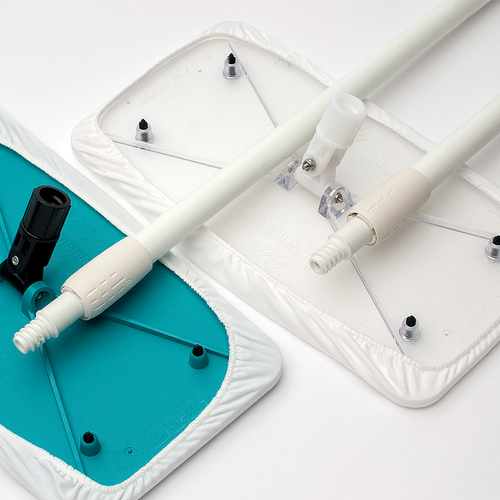
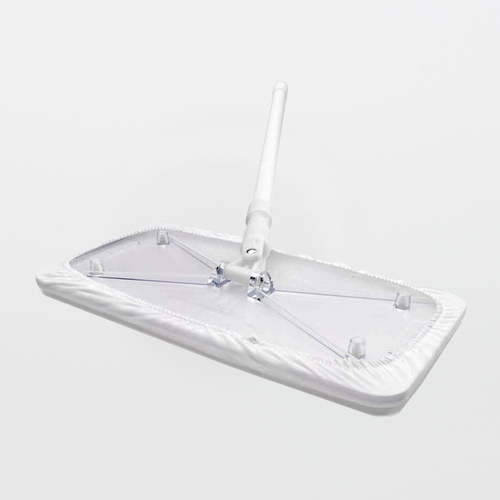
Texwipe TX7123 Autoclavable AlphaMop 60" Replacement Handle (HANDLE ONLY)

$55.82
(No reviews yet)
SKU:
TX7123
Availability:
7 - 10 Business Days
Shipping:
Calculated at Checkout
Type:
Dry Mop
Texwipe TX7123 AlphaMop™ Replacement Handle — 60" (1.5 m), White Fiberglass, Autoclave Safe (Handle Only)
TX7123 is a 60" (1.5 m) white fiberglass replacement handle used with the Texwipe AlphaMop™ flat mop system for critical-environment cleaning of floors, walls, and ceilings. It is specified as a replacement handle for AlphaMop kits including TX7108 and TX7108A, supporting consistent reach, controlled technique, and repeatable contact pressure during disinfectant and cleaning solution application/removal.

For over 35 years, SOS and Texwipe have been close partners, and SOSCleanroom is the authorized Master Distributor of ITW Texwipe for the United States market. That relationship matters when you are standardizing cleanroom mopping hardware: it supports continuity of supply, stable product lineage, and fast access to the manufacturer documentation your QA/QC team expects.

Published configuration (TX7123)
  • Component: Replacement mop handle (handle only)
  • Length: 60" (1.5 m)
  • Material: Fiberglass
  • Color: White
  • Compatibility (published): AlphaMop™ system; specified as a replacement handle for TX7108 and TX7108A
  • Autoclave: Autoclave safe (see autoclave conditions in Documentation)
  • Packaging: 1 handle per case
  • Cleanroom environment (published for AlphaMop™ system): ISO Class 2–7 (Class 1–100,000); EU Grade A–D

System fit and compatibility matrix
Use this table to confirm the handle is aligned to the mopping hardware you have standardized (or are qualifying) in your controlled area.
System element How TX7123 fits Notes for technicians / QA
AlphaMop™ kit (TX7108) Replacement handle Primary use-case called out for TX7123. Maintain the same handle length across rooms to stabilize operator technique.
Autoclavable AlphaMop™ kit (TX7108A) Replacement handle Published as compatible on SOSCleanroom documentation for TX7123; validate your site autoclave cycle parameters before standardizing.
Other Texwipe flat-mop systems Published as part of the AlphaMop™ compatible handle family Texwipe publishes a family of handles used across multiple mop platforms; confirm the head-to-handle interface in your current BOM/SOP.

Autoclave and wipe-down compatibility notes
  • Autoclave conditions (published): Follow the manufacturer-stated autoclave conditions for Texwipe mop handles (see Documentation). Do not assume your site cycle matches by default—qualify under your validated load configuration.
  • External wipe-down discipline: If your SOP permits, wipe down the handle before room entry and after use. Focus on high-touch zones (grip area and head-interface area) where residue transfer is most common.
  • Dry-time control: After wipe-down or sterilization, allow full dry time before use and before storing to reduce residue filming, slip risk, and recontamination from damp storage.
  • Chemical exposure: The AlphaMop™ system is commonly used for applying/removing cleaning solutions and disinfectants. Confirm compatibility with your specific chemistry set during qualification.

Practical cleanroom use guidance (technicians and engineers)
  • Handle segregation: Treat mop handles as controlled tools. Do not cross-use between rooms/grades unless your SOP explicitly allows it (risk: residue and bioburden carryover).
  • Assembly discipline: Confirm the head-to-handle connection is fully seated before entering the work zone. Loose interfaces are a common driver of chatter, streaking, and rework during critical cleaning.
  • Technique stability: Standardize handle length across a given program when possible. Operators compensate for length changes with different contact pressure and stroke geometry, which can change cleaning outcomes.
  • Contact management: Keep the handle off critical surfaces. If staging is required, use a designated clean rack or holder and avoid leaning on benches, carts, or product-contact zones.
  • Change-out triggers: Replace the handle if you see surface damage, degraded grip control, or persistent residue that cannot be removed with your validated cleaning process.

Common failure modes 
  • Residue transfer: Handle staged on carts, floors, or non-controlled racks can pick up residues and reintroduce them during use. Prevent with controlled staging and wipe-down discipline.
  • Loose head interface / wobble: A partially seated interface reduces consistent pad pressure and can drive streaking and incomplete soil removal. Prevent with assembly checks before entry and during shift handoffs.
  • Surface damage and particulate risk: Chips, abrasion, or worn surfaces can become a contamination risk and can also retain residues. Prevent by avoiding hard impacts and by isolating damaged tools immediately.
  • Post-sterilization moisture retention: Storing a damp handle can trap residues/films and create inconsistent grip performance. Prevent with dry-time control and ventilated storage where permitted.

Storage and handling best practices
  • Keep the handle in original packaging until introduced to the controlled area to reduce particle deposition during storage and transport.
  • Store horizontally on a clean rack or vertically in a dedicated holder to avoid contact with floors and to prevent bending or impact damage.
  • Do not stack with abrasive tools or metal components that can scuff surfaces and generate debris.
  • Segregate by room/grade if your contamination control plan requires it; label storage locations clearly to reduce cross-area movement.
Documentation 
SOS-hosted Texwipe datasheet (AlphaMop TDS — ALL — 2014): Click Here
Texwipe manufacturer page (TX7123): Click Here
Texwipe manufacturer PDF (Mop Handles TDS — English US, US-TDS-002 Rev. 10/21): Click Here
Texwipe manufacturer PDF (AlphaMop™ Series TDS — English US, US-TDS-067 Rev. 3/22): Click Here
Last updated: January 9, 2026
If you have any questions please email us at Sales@SOSsupply.com or give us a call at (214)340-8574.

Check out our AI ChatBot powered by SOSCleanroom data libraries - give it a try!
 
THIS IS A NEW SOSCleanroom FEATURE FOR 2026!

© 2026 SOS Supply. All rights reserved.
The Technical Vault Autoclavable Tool Control & Reprocessing Discipline (Applied Use Case: Texwipe™ TX7123 Autoclavable AlphaMop® 60 Replacement Handle — Handle Only)

Purpose & Scope

The TX7123 is a replacement handle for the Autoclavable AlphaMop® 60 system. “Autoclavable” is a capability, not a guarantee: the handle still requires a disciplined reprocessing workflow to prevent residue carryover, cross-zone transfer, and surface degradation that can undermine contamination control. This Technical Vault entry focuses on the overlooked details that drive real-world performance and audit readiness.

Visual Aids (Technique, Zoning, Lifecycle)

Use this graphic to reinforce zone discipline and lifecycle control for cleaning tools (including handles).

Cleanroom mopping technique (unidirectional vs figure-8), cleanroom zoning map concept, and mop head lifecycle diagram

Implementation note: Autoclave parameters and reprocessing validation must follow your facility SOP and equipment qualification.

“Autoclavable” in Practice: Capability + Responsibilities

An autoclavable handle is designed to tolerate steam sterilization conditions, but cleanroom success is determined by the complete reprocessing workflow: pre-cleaning, packaging, autoclave cycle control, drying, storage, and controlled re-entry. Many programs fail not at the autoclave— but at residue control and post-sterilization handling.

  • Autoclaving is not cleaning: residues and films should be removed before sterilization.
  • Recontamination is common: improper drying, uncontrolled storage, and handling can negate the cycle.
  • Surface integrity matters: degraded surfaces become residue traps and increase contamination risk.

Practical Reprocessing Workflow (Audit-Friendly)

1) Pre-Clean (Before Sterilization)

  • Wipe down the handle and connection points to remove chemistry residue and soils.
  • Focus on couplers, threads/collars, end caps, and any texture transitions (common residue traps).
  • Ensure the handle is not stored wet or with pooled chemistry prior to reprocessing.

2) Package & Protect

  • Package according to your facility sterilization SOP to protect the handle post-cycle and support controlled handling.
  • Label by zone/room and intended use to prevent cross-use after sterilization.

3) Sterilize & Dry (Cycle Control)

  • Run only qualified/validated cycles per your autoclave program (parameters are facility-specific).
  • Ensure complete drying; moisture is a recontamination pathway and can create residue “set” on surfaces.
  • Inspect after cycle for surface changes (discoloration, tackiness, roughness) that may indicate material stress or residue.

Handle Hygiene (High-Touch, High-Transfer)

Even when sterilized, the handle becomes a transfer surface the moment it is used. Build “handle-touch controls” into training: when operators adjust length, change heads, or reposition tools, gloves can carry residues from the handle back to clean consumables.

  • Define allowable touch points (where hands/gloves may contact the handle).
  • Define glove management if the handle is touched after contacting wet disinfected surfaces.
  • Prohibit floor/wall contact and define temporary staging locations (rack/cart).

Objective Replacement Criteria (When to Retire an Autoclavable Handle)

  • Surface degradation: cracks, chips, rough areas, or persistent tackiness (residue traps / glove abrasion risk).
  • Connection wear: loose couplers, wobble at the head interface, degraded threads, or inability to secure heads reliably.
  • Persistent residue: repeated chemistry buildup that cannot be removed via SOP-defined pre-cleaning.
  • Cycle-related drift: visible warping or dimensional change that affects tool control.

SOP & Audit Readiness Checklist (Autoclavable Handles)

  • Define the reprocessing workflow: pre-clean, package, sterilize, dry, store, and controlled re-entry.
  • Define segregation/labeling by room/zone and intended use after sterilization.
  • Define storage (protected, off-floor, no wall leaning) and allowable staging points during use.
  • Define objective retirement criteria (surface degradation, persistent residue, connection wear).
  • Train operators on handle-touch transfer risk and glove management behaviors.

Disclaimer: This Technical Vault content is provided for educational purposes only. Manufacturer instructions, facility SOPs, and site-specific risk assessments must always take precedence. Autoclave cycle parameters, packaging, and reprocessing validation must follow your facility’s qualified equipment and documented program.

© SOSCleanroom. All rights reserved.