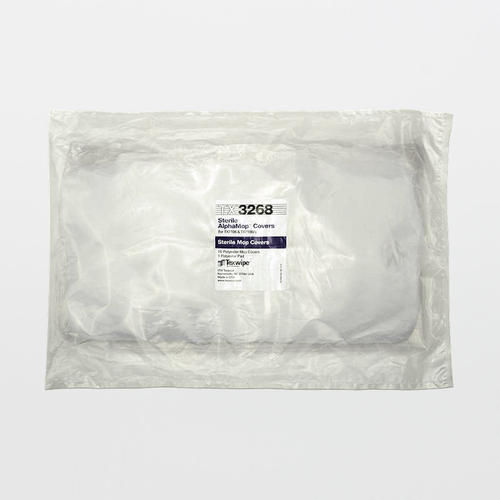
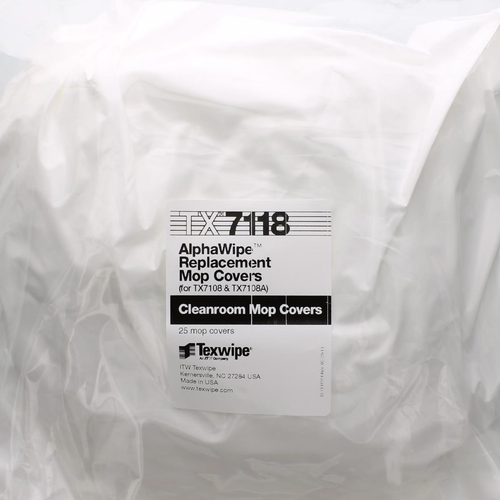
Texwipe STX1721 Revolve™ AlphaMop™ Sterile Integrated Mop Covers/Pads — 15" x 8" System Fit, Triple-Bagged (100/Case)
STX1721 is a sterile, cover/pad-integrated replacement for Texwipe AlphaMop™ 15" x 8" flat mop heads (such as TX7108 / TX7108AH). It is designed for technician-driven, contamination-controlled cleaning: applying and removing disinfectants/cleaners, routine surface cleaning of floors/walls/ceilings, and spill control in critical environments. Revolve™ integrated construction eliminates the separate pad step — you replace the entire wiping surface as a single unit to reduce handling time and support strict “change often” mop discipline.
For over 35 years, SOS and Texwipe have been close partners, and SOSCleanroom is the authorized Master Distributor of ITW Texwipe for the United States market. That relationship matters when you are standardizing cleanroom mops and refills: it supports continuity of supply, stable product lineage, and fast access to the manufacturer documentation your QA/QC team expects.
Published configuration (STX1721)
- Format: Revolve™ integrated cover/pad (no separate pad required)
- System fit: Sized to fit 15" x 8" flat mop heads (AlphaMop™ platform)
- Material: 100% upcycled polyester (Revolve™ sustainable product line)
- Sterile: Yes (gamma irradiated; Sterility Assurance Level (SAL) 10-6 per AAMI guidance)
- Packaging: 100 covers per case (10 bags of 10 covers), triple-bagged
- Cleanroom environments (as published): ISO Class 3–7; EU Grade A–D
- Temperature limit (as published): Appropriate for use with temperatures less than 400°F (205°C)
- Shelf life (as published): Sterile — 3 years from date of manufacture
Low-linting intent — and the reality check
STX1721 is engineered for critical cleaning with Revolve™ processing intended to support low levels of ions, non-volatile residues (NVRs), particles and fibers for use in critical cleaning applications and environments. Even so, no wiping/mopping textile is truly “zero-shedding” in every use condition. Treat each cover as a controlled consumable: stage it correctly, change it often, and avoid over-wetting or abrasive contact that can elevate particle release and streaking.
Practical cleanroom use guidance (technicians and engineers)
- Bag-in discipline (sterile suites): Use the triple-bag layers intentionally. De-bag to the appropriate grade boundary per site CCS/SOP; only the final bag should enter the highest-grade area. Do not stage opened bags on work surfaces.
- One cover, one zone (recommended practice): Assign one cover per room/zone/step to reduce cross-contamination. When moving from “dirtier” to “cleaner” areas, change the cover before crossing the boundary.
- Pre-wet control: If your SOP requires pre-wetting, wet the cover evenly (do not spot-soak). Uneven wetting causes streaks, incomplete disinfectant contact, and residue islands.
- Wringing consistency: Use a validated wringing method (wringer or controlled hand pressure) to avoid over-wet floors and excessive residue. Over-wet mops are a common root cause of sticky residue and slip hazards.
- Stroke mechanics: Use slow, overlapping strokes with consistent edge-leading orientation. Avoid aggressive scrubbing; let chemistry and dwell time do the work, then remove residues with controlled passes.
- Change frequency: Change the cover at defined intervals (time, area, or visible soil/load). If the cover begins to drag, streak, or shed, treat it as “loaded” and replace immediately.
Compatibility and solution-use notes (publish-what-is-known)
- Common solvents/cleaners (as published): Suitable for cleaning with solvents such as isopropyl alcohol (IPA), ethanol, acetone, and degreasers.
- Disinfectant application: Designed for applying and removing solutions including disinfectants. Verify dwell time and residue-removal steps under your SOP.
- Autoclave: Autoclave safe is indicated for the Revolve™ integrated cover/pad family. If your program depends on autoclave cycling, qualify the cover under your specific cycle parameters and inspect for deformation, streaking, and residue behavior before standardization.
- High-oxidizer chemistries: Not published for STX1721 as a specific compatibility claim. If your rotation includes strong oxidizers (e.g., peroxide/peracetic blends), qualify the cover for sorption, mechanical integrity, and residue carryover under your conditions.
Sterility, packaging layers, and documentation control
This section is written for facilities that operate under contamination control strategies (CCS) and audit-driven documentation expectations.
| Control point |
What STX1721 provides (published) |
Technician note |
| Sterility assurance |
Gamma irradiated; SAL 10-6 (AAMI guidance) |
Do not compromise the bag layers; treat any puncture/tear as non-sterile. |
| Packaging layers |
Triple-bagged (10 bags of 10 covers per case) |
Use staged de-bag per grade boundary; do not “carry open bags” between rooms. |
| Certificates / traceability |
Certificates of Compliance, Analysis, and Processing/Irradiation available (per manufacturer) |
Capture lot/expiry in your logbook or eQMS at point-of-use, not after the shift. |
| Shelf life |
Sterile — 3 years from date of manufacture |
Rotate stock FIFO; never “borrow” expired sterile covers for non-sterile tasks in controlled zones. |
Annex 1 alignment notes (risk-based cleaning programs)
EU GMP Annex 1 emphasizes a contamination control strategy (CCS) and expects cleaning/disinfection practices to be designed, justified, and controlled — including rotation and residue management where applicable. STX1721 supports those programs by enabling frequent surface changes, sterile-ready packaging layers, and documentation access for qualification.
| Annex 1 program expectation |
How to operationalize with STX1721 |
What to document |
| CCS: defined controls for contamination risk reduction |
Define cover change frequency by zone/area/time; enforce “single-use per zone” where required. |
Cover lot/expiry, room/zone, chemistry used, operator, start/finish time. |
| Validated cleaning/disinfection: residue control and removal |
Avoid over-wetting; use controlled wringing and defined strokes; include a residue-removal pass if your chemistry requires it. |
Dwell time adherence, residue removal step, and any post-clean inspection results. |
| Rotation/sporicidal use (where required by risk profile) |
Use a fresh cover for sporicidal steps; do not carry sporicidal residues into non-sporicidal zones. |
Chemistry rotation schedule, contact times, and any neutralization/residue management requirements. |
Common failure modes
- Streaking / residue film: Most often from over-wetting, inconsistent wringing, or chemistry that requires a defined residue-removal step. Control liquid load and follow your validated rinse/wipe sequence.
- Cross-contamination between rooms: Happens when a “still looks clean” cover is carried across boundaries. Fix with one-cover-per-zone discipline and boundary change points.
- Incomplete disinfectant contact: Caused by dry spots, fast strokes, or skipping dwell time. Fix with even wetting, slower strokes, and dwell time timing.
- Particle shedding events: Can be triggered by abrasive floor debris, aggressive scrubbing, or dragging a loaded cover. Fix by pre-picking debris (as permitted), changing covers sooner, and avoiding “grinding” action.
- Packaging breach / sterility loss: Small punctures, tears, or wet bags can compromise sterile introduction. Reject damaged packs immediately and record the deviation per SOP.
- Static attraction (dry environments): Covers can attract fines when rubbed against garments or when used too dry. Follow site ESD/grounding controls and maintain controlled wetting.
Storage and handling best practices
- Keep covers sealed in original packaging until point-of-use; stage only what will be consumed in the current operation.
- Store in a clean, dry area to prevent bag condensation and to protect sterile packaging integrity.
- Use FIFO and verify expiry before entry into higher-grade areas.
- After use, discard as contaminated consumables per your facility waste stream rules (especially after sporicidal steps).
Documentation
SOS-hosted Texwipe AlphaMop™ Series TDS (includes STX1721 line item):
Click HereTexwipe AlphaMop™ Series TDS (manufacturer PDF):
Click HereRevolve™ Mop Covers TDS (manufacturer PDF):
Click HereSOS-hosted Revolve™ TechNote (background and processing context):
Click HereSOS-hosted Revolve™ Q&A (qualification and sustainability discussion):
Click HereEU GMP Annex 1 (Manufacture of Sterile Medicinal Products) — reference document:
Click Here
If you have any questions please email us at Sales@SOSsupply.com or give us a call at (214)340-8574.
Check out the AI ChatBot powered by SOSCleanroom data libraries - give it a try!
THIS IS NEW FOR 2026!
Last updated: January 9, 2026
© 2026 SOS Supply. All rights reserved.