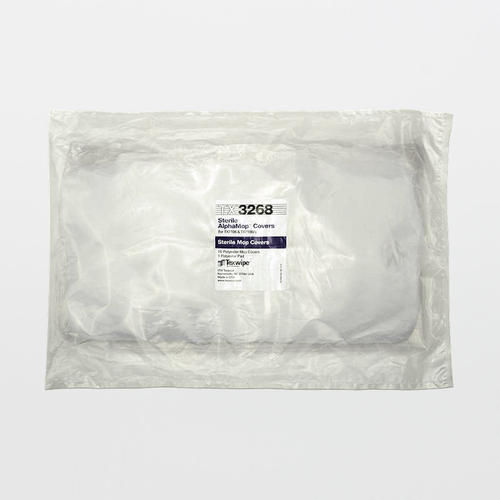
Texwipe STX7118F AlphaMop™ Polyester Pad Replacement Kit — Sterile, 15" x 8" (38 cm x 20 cm)
STX7118F is a sterile pad replacement kit used with the Texwipe AlphaMop™ flat-mop system (for use with AlphaMop™ TX7108). The pad sits under the mop cover to provide cushioning and uniform surface contact, helping the cover conform to floors, walls, ceilings, and other flat surfaces during validated cleaning and disinfection routines.
For over 35 years, SOS and Texwipe have been close partners, and SOSCleanroom is the authorized Master Distributor of ITW Texwipe for the United States market. That relationship matters in critical environments where technicians need consistent product lineage, reliable availability, and fast access to manufacturer documentation for QA/QC review, CCS documentation, and change-control support.
Published configuration (STX7118F)
- Pad size: 15" x 8" (38 cm x 20 cm)
- Sterile: Yes
- Sterilization method (as published): Gamma irradiated to a Sterility Assurance Level (SAL) of 10-6 (sterile products)
- Pad material (as published): 100% nonwoven polyester pad (cushion layer under the mop cover)
- Inner bags (as published): 10 pads and 4 fastening pins per bag
- Outer packaging (as published): 2 bags per case (total 20 pads and 8 fastening pins/clips per case); triple-bagged for controlled introduction
- Shelf life (as published): Sterile — 3 years from date of manufacture
- Storage conditions (as published): 15°C to 30°C (59°F to 86°F)
- Cleanroom environment (as published across related TDS): ISO Class 2–7 (AlphaMop™ Series TDS) and ISO Class 3–8 (Flat Mop Replacement Pads TDS); EU Grade A–D
- Program references (as published): Meets USP <797> and USP <800> requirements (published for Flat Mop Replacement Pads family)
Low contamination handling — and the reality check
These pads are designed for controlled environments, but no pad or textile system is truly zero-shedding under abusive handling. Treat pads as contamination-controlled components: control how they are introduced, how long they are used, and how they are staged between zones.
How the pad supports the AlphaMop™ process
- Conformability: The polyester pad provides cushioning so the mop cover conforms to textured or imperfect surfaces for more consistent contact.
- Protocol-friendly changeout: The AlphaMop™ system is designed to allow frequent replacement of cleaning faces (covers) and pads per site SOP, supporting disciplined, repeatable wiping/mopping patterns.
- Traceability support: Sterile product families are published as lot coded with quality documentation availability (Certificates of Compliance/Analysis and processing/irradiation available through Texwipe resources).
Practical cleanroom mopping technique (technicians and engineers)
- Introduce sterile correctly: Use controlled peel-and-present technique with the triple-bagged configuration. Stage the case outside the higher-grade area, then remove one bag layer per transfer step per CCS/SOP.
- Build a repeatable stroke pattern: Use unidirectional strokes with consistent overlap (e.g., 10–20%) to reduce re-deposition. Avoid random scrubbing patterns that can spread residues.
- Control saturation: If using wet disinfection, control liquid loading to prevent dripping and pooling. Excess liquid drives residue films and can compromise dwell-time control on vertical surfaces.
- Change what touches the surface: Change mop covers frequently; replace pads per SOP and application intensity (abrasive floors, high soil load, sticky residues, or after chemical incompatibility events).
- Define “dirty-to-clean” rules: Always move from higher criticality to lower criticality only if your CCS allows it; otherwise separate tools by zone to prevent cross-contamination.
Compatibility and chemical-use notes
- Disinfectants and cleaners: The AlphaMop™ family is published for applying and removing solutions including disinfectants.
- Solvent exposure (as published across related TDS): Listed solvents include isopropyl alcohol (IPA), ethanol, hydrogen peroxide, acetone, and degreasers. Always qualify against your site’s exact chemistries and concentrations.
- Temperature exposure (as published): Appropriate for use with temperatures less than 400°F (205°C).
- Autoclave note (as published across related TDS): “Autoclave safe” is published for the pad family; if your program autoclaves pads, validate post-cycle integrity and performance before standardizing.
Qualification table — key published attributes to document
Use this table as a checklist for CCS documentation, supplier qualification, and cleaning/disinfection validation packages.
| Attribute |
Published value |
Notes for technicians / QA |
| Product |
STX7118F AlphaMop™ Polyester Pads Replacement Kit, Sterile |
Used with AlphaMop™ TX7108 flat mop system. |
| Pad size |
15" x 8" (38 cm x 20 cm) |
Document the surface area per pad for use-rate planning. |
| Sterilization |
Gamma irradiated; SAL 10-6 (published for sterile products) |
Retain irradiation documentation per batch/lot when required. |
| Packaging |
10 pads + 4 fastening pins per bag; 2 bags per case; triple-bagged |
Define peel-path and bag-removal steps by room grade/airlock SOP. |
| Shelf life |
Sterile — 3 years from date of manufacture |
Use FEFO controls; do not stage opened bags for extended periods. |
| Storage |
15°C to 30°C (59°F to 86°F) |
Avoid compression/abrasion that can compromise packaging integrity. |
| Chemical-use positioning |
Applying/removing solutions including disinfectants; solvents listed (IPA, ethanol, hydrogen peroxide, acetone, degreasers) |
Always qualify with your exact chemistries, dwell times, and residue limits. |
| Contamination metrics |
Not published for STX7118F pads |
Use internal qualification (particles/residue/bioburden) if program requires numeric limits. |
EU GMP Annex 1 alignment considerations (how to use without over-claiming)
- CCS integration: Define pad/cover change frequency, zone segregation, and introduction steps as part of a documented Contamination Control Strategy (CCS). Do not rely on “best effort” cleaning in Grade A/B areas.
- Validated cleaning/disinfection: Pads are part of the mechanical action that enables repeatable disinfectant application/removal. Validate your full method (chemical, contact time, technique, and residue control), including sporicidal rotation where required by your contamination risk assessment.
- Transfer and packaging control: Use the published triple-bag configuration as a practical control to reduce transfer contamination during material entry; remove one layer per transition as defined by your airlock/grade logic.
- Traceability and investigation readiness: Retain lot/sterility documentation when required by your quality system so deviations (residue, microbial recovery, particles) can be investigated with supplier support.
Common failure modes
- Streaking / residue films: Often caused by over-wetting, poor wringing control, incompatible chemistry sequences, or insufficient rinse/removal steps. Prevent with controlled liquid loading and validated wipe-down sequences.
- Re-deposition of soil: Happens when covers are not changed frequently enough or when pads/covers are reused across zones. Prevent with strict “one surface set, then change” discipline.
- Loss of conformal contact: Can occur when a pad is compressed, installed incorrectly, or overused beyond SOP limits. Prevent by inspecting the pad during setup and replacing at defined intervals.
- Cross-contamination via handling: Touching exposed pads with non-controlled gloves or staging opened bags in uncontrolled areas can compromise the sterile presentation intent. Prevent with staged opening, glove discipline, and immediate use after opening.
Storage and handling best practices
- Keep pads sealed in original packaging until point of use; avoid pre-opening “to save time.”
- Store within published temperature range and protect packaging from punctures, crushing, and wetting.
- Stage by room/grade and segregate tools to prevent accidental zone crossover.
- Document lot/expiry at issuance when your CCS requires traceability at the point of use.
Documentation
SOS-hosted Texwipe datasheet (AlphaMop™ Series TDS):
Click HereSOS-hosted Texwipe datasheet (Flat Mop Replacement Pads TDS):
Click HereTexwipe manufacturer TDS (AlphaMop™ Series):
Click HereTexwipe manufacturer TDS (Flat Mop Replacement Pads):
Click Here
If you have any questions please email us at Sales@SOSsupply.com or give us a call at (214)340-8574.
Check out the NEWQ AI ChatBot powered by SOSCleanroom data libraries - give it a try!
THIS IS NEW FOR 2026!
Last updated: January 9, 2026
© 2026 SOS Supply. All rights reserved.