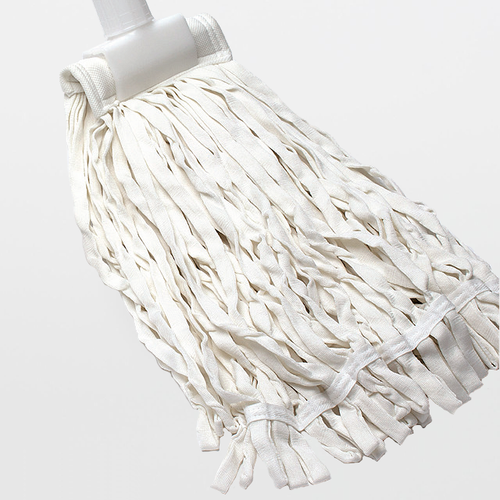
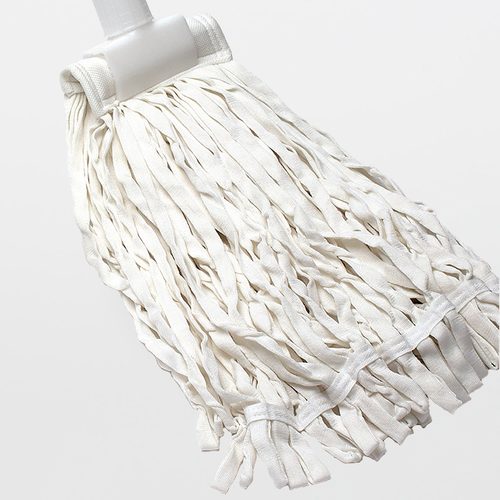
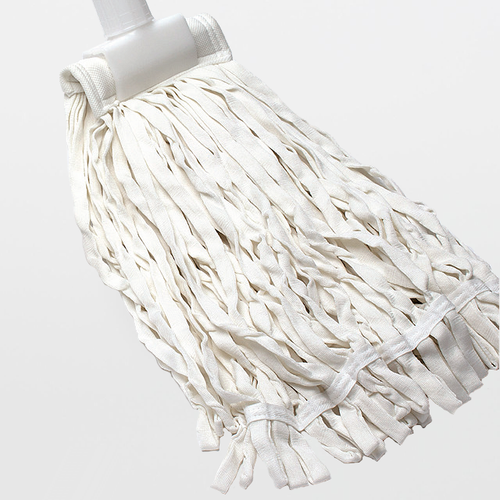
Texwipe TX1722 Revolve™ BetaMop™ Sustainable Polyester String Mop Refills — Non-Sterile, Double-Bagged, 6/Case
TX1722 is a BetaMop™ string mop head refill used for critical-environment floor cleaning and for applying/removing cleaning solutions and disinfectants. Revolve™ refills are made from 100% upcycled polyester and are packaged 1 mop head per double-bag, 6 bags per case. Texwipe publishes a 1.5 L/head sorptive capacity for this sustainable string refill line.
For over 35 years, SOS and Texwipe have been close partners, and SOSCleanroom is the authorized Master Distributor of ITW Texwipe for the United States market. That relationship matters when you are standardizing contamination-control tools: it supports continuity of supply, stable product lineage, and fast access to the manufacturer documentation and change-control discipline your QA/QC team expects.
Published configuration (TX1722)
- SKU: TX1722
- Product type: Dry mop head refill (string mop)
- Material: Revolve™ sustainable polyester string refill made from 100% upcycled polyester
- Capacity (as published): 1.5 liters/head
- Compatibility: Compatible with any BetaMop™ hardware; Texwipe also publishes compatibility with other cleanroom mop handles designed for string mops
- Packaging (as published): 1 mop head refill/bag, double-bagged; outer packaging: 6 bags/case
- SOSCleanroom selling unit: Case of 6 polyester string mop heads
- Cleanroom environment (as published): ISO Class 3–7 (Class 1–10,000); EU Grade A–D
- Sterility status: Non-sterile (for sterile programs, Texwipe publishes a sterile alternative: STX1722)
- Availability (SOSCleanroom): 7–10 business days
- Replacement/used with: Replacement heads for the BetaMop™ cleaning system; used with BetaMop™ hardware kits such as TX7106 (hardware)
EU GMP Annex 1 alignment — how mop refills fit the contamination control strategy
Annex 1 expectations are risk-based: your contamination control strategy (CCS) should define where and how mops are used, how disinfectants are applied and removed, how residues are controlled, and how cross-contamination is prevented. TX1722 supports Annex 1-aligned workflows when it is integrated into a validated cleaning/disinfection program with trained operators, documented rotation (where applicable), and clear segregation between “dirty” and “clean” steps.
Quick reference table (published attributes)
| Attribute |
Published value |
Why it matters in critical environments |
| Material |
100% upcycled polyester (Revolve™) |
Polyester is commonly specified for cleanroom mops because it supports low particle generation when properly processed and handled; qualification should confirm performance under your disinfectant and soil load. |
| Sorptive capacity |
1.5 L/head |
Helps set solution volume and change-out frequency; overloading a mop can increase drip, pooling, and residue risk. |
| Packaging |
1 head/bag, double-bagged; 6 bags/case |
Supports controlled introduction into classified space by staged de-bagging; reduces packaging-associated contamination transfer when done correctly. |
| Recommended environments |
ISO Class 3–7; EU Grade A–D |
Helps engineering/QA match mop materials to area classification; sterile alternatives are typically preferred for Grade A/B workflows. |
| Compatibility |
Compatible with BetaMop™ hardware |
Reduces field improvisation risk; standard hardware supports consistent pressure, contact pattern, and controlled refill changes. |
Practical cleanroom use guidance (technicians and engineers)
- Staged de-bagging: Treat the double-bag as a contamination-control feature. De-bag in the proper transition area per SOP; avoid dragging outer packaging across clean surfaces.
- Two-bucket discipline: Where required by your CCS, use a defined “apply” and “remove/rinse” methodology to reduce redeposition. Keep “dirty” and “clean” steps physically segregated.
- Contact pattern control: Maintain consistent overlap, edge control, and lane discipline. In Grade C/D corridors and support areas, the most common audit finding is inconsistent overlap that leaves untreated lanes.
- Solution loading: Load the mop to a controlled level (avoid saturation). Overloaded string mops increase drip risk and can carry residues into “clean” zones.
- Change-out triggers: Replace the head when visibly soiled, when solution clarity/soil load indicates, or at the maximum time/area limit defined by SOP (do not “push” one head through multiple zones).
- Traceability habits: Document area, disinfectant lot, contact time, operator, and head change-out. Annex 1-aligned sites treat floor cleaning as a controlled process with reviewable records.
Compatibility and disinfectant-use notes
- Disinfectant compatibility: Texwipe publishes BetaMop™ head refills as compatible with most disinfectants. Final selection should be confirmed by your site qualification (chemical exposure, residue behavior, and floor finish compatibility).
- Sterile area selection: Texwipe publishes that sterile is recommended for EU Grade A–B environments. If your process requires sterile tools, use the sterile alternative that is explicitly labeled sterile for the program.
- Residue management: If your disinfectant leaves a film, build a defined “removal” step into the CCS (e.g., validated rinse/removal approach per SOP) to prevent sticky floors and particulate attraction.
- Contact time discipline: Ensure the floor remains wet for the validated contact time; “drying early” is a common failure in audit observations and can undermine disinfection efficacy.
Annex 1 / CCS checklist table (operator-focused)
Use this as a technician-facing quick check to reinforce contamination-control intent. Site SOPs and validated parameters always govern.
| CCS element |
What to do with TX1722 refills |
Risk if missed |
| Material transfer control |
Double-bag stays intact until the approved de-bag step; do not stage open bags in corridors. |
Packaging-contact contamination transfer into classified space. |
| Cross-contamination prevention |
Zone dedicate heads (or change at the boundary); keep “clean” and “dirty” solution controls separated. |
Bioburden and residue spread between rooms and grades. |
| Validated cleaning/disinfection |
Apply per validated wet time and technique; document disinfectant lot, contact time, and area. |
Insufficient contact time or incomplete coverage; audit findings. |
| Training and technique |
Standardize overlap, lane discipline, and change-out triggers; avoid “scrubbing” that aerosols soil. |
Particle mobilization and inconsistent floor state control. |
| Documentation discipline |
Record who/what/where/when and head changes; keep records review-ready. |
Gaps during deviation investigations; weak traceability. |
Common failure modes
- Redeployment of soil (“dirty mop” effect): Happens when one head is pushed too long or used across grades/zones. Prevent with zone dedication and defined change-out limits.
- Residue streaking / film: Often from high disinfectant load or insufficient removal step. Prevent by following validated dilution, wet time, and residue-control steps in the CCS.
- Drip trails and pooling: Usually from overloading the mop or moving too quickly between areas. Prevent with controlled loading and staged movement.
- Particle mobilization: Triggered by aggressive scrubbing or dry passes. Prevent by maintaining controlled wetting and consistent, low-turbulence technique.
- Loss of traceability: Occurs when bag/lot information is discarded before recording. Prevent by capturing required identifiers per SOP before discarding packaging.
Storage and handling best practices
- Keep refills in original double-bag packaging until the controlled de-bag step; do not pre-open bags “to save time.”
- Store in a clean, dry area to protect packaging integrity and prevent moisture pickup prior to use.
- Segregate unused refills from used heads and used cleaning tools; never stage used tools next to clean inventory.
- After use, follow site-defined disposal or reprocessing rules (if any) and keep used heads contained to prevent floor-to-air particle transport.
Sustainability and traceability notes (Revolve™ line)
- Upcycled content: Revolve™ products are made from upcycled polyester material.
- Bag-level indicator (as published): Texwipe states each Revolve™ product bag indicates the number of post-consumer water bottles used to make the product; for TX1722, Texwipe publishes 17 water bottles per bag.
- Cleanroom-first mindset: Sustainability does not replace contamination control. Qualification should still evaluate residue behavior, soil pickup, and consistency under your disinfectant rotation.
Documentation
Texwipe BetaMop™ Series Technical Data Sheet (TEX-LIT-TDS-002-11/21):
Click Here
If you have any questions please email us at Sales@SOSsupply.com or give us a call at (214)340-8574.
OR check out the AI ChatBot powered by SOSCleanroom data libraries - give it a try!
THIS WEBSITE FEATURE IS NEW FOR 2026!
Last updated: January 9, 2026
© 2026 SOS Supply. All rights reserved.