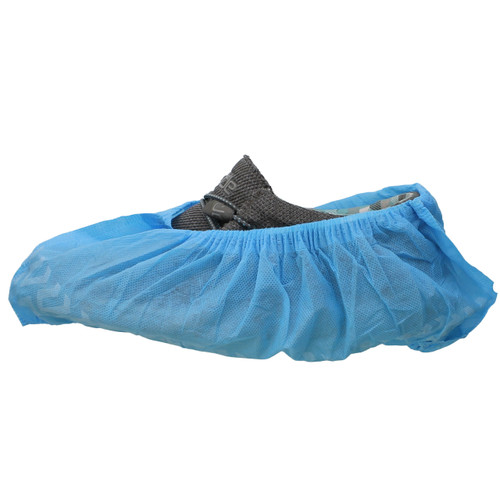
Shown: blue non-skid SBPP shoe covers (size varies by selection).
Why footwear control matters more than most teams expect
Cleanrooms do not fail only because of “air problems.” They fail because people unintentionally transport contamination across boundaries.
Shoes are a high-contact interface with floors, corridors, and carts. If footwear is not controlled, particles and residues can be tracked into cleaner zones.
Shoe covers are a simple barrier layer, but only work when donning technique (step-over discipline) and change-out rules are enforced.
What this product is used for
- Footwear barrier control in gowning rooms, airlocks, and controlled corridors.
- Visitor and maintenance access where “cover footwear before entry” is a core rule.
- General cleanroom and lab environments where non-sterile apparel is acceptable per SOP.
- Slip-risk mitigation on smooth floors (non-skid sole), while maintaining disposable contamination control.
Why customers consider this product
- Low-linting SBPP construction: intended to support contamination-control use compared with everyday textiles.
- Non-skid traction sole: improved grip helps reduce slip events in gowning rooms and corridors.
- Cleanroom manufactured and packaged: supports controlled-environment handling expectations (non-sterile).
- Latex-free elastic: secure fit without natural rubber latex exposure.
Materials, composition, and build
Manufacturer basis: 100% spunbond polypropylene (SBPP) nonwoven, 40 gsm, with a non-skid sole pattern and latex-free elastic closure.
The product is described as manufactured in a cleanroom environment and cleanroom packaged, and supplied non-sterile.
Fit matters: correct sizing reduces overstretching and tearing, which otherwise increases particle generation risk and creates trip/slip hazards when elastic rolls down.
Choose Large, X-Large, or 2X-Large based on shoe dimensions and whether additional footwear (ESD straps, safety shoes) is worn.
Specifications in context
The table below consolidates the published attributes that matter most for cleanroom receiving, gowning-room SOP alignment, and day-to-day use.
| Attribute |
Published basis |
| Product family |
Bee-Safe® Non-Skid Shoe Covers (GAH-SP-NS) |
| Material |
100% spunbond polypropylene (SBPP) |
| Basis weight |
40 gsm (manufacturer listing) |
| Color |
Blue |
| Sole |
Non-skid traction sole pattern |
| Closure |
Latex-free elastic band |
| Sterility |
Non-sterile |
| Manufacturing / packaging |
Manufactured in a cleanroom environment; cleanroom packaged |
| Pack-out |
100 per bag; 3 bags per case (300 per case) |
| Sizes / dimensions (published) |
L: 40 x 17 cm; XL: 43 x 17 cm; 2XL: 45 x 17 cm |
| Country of origin |
China (manufacturer sheet) |
Performance and cleanliness considerations (what “good” looks like)
In footwear control, “performance” is not only the material. It is the system:
(1) boundary design (step-over bench / zoning), (2) consistent donning technique, (3) disciplined one-way travel rules,
and (4) change-out triggers that prevent recontamination.
| Characteristic |
What it means for use |
Published basis |
| Low-linting nonwoven SBPP |
Supports contamination-control wear vs. everyday fabrics; still requires correct donning and change-out. |
Manufacturer description (SBPP / low-linting intent) |
| Non-skid sole |
Improves traction on smooth floors; reduces slip events that can create contamination and safety incidents. |
Manufacturer feature statement |
| Latex-free elastic |
Secure fit while supporting latex-avoidance programs. |
Manufacturer sheet |
| Cleanroom manufactured / packaged |
Supports controlled introduction (non-sterile). Qualification remains a facility responsibility. |
Manufacturer sheet |
Packaging, traceability, and country of origin
Published pack-out is 100 per bag and 3 bags per case (300 per case). Size is controlled by selecting Large, X-Large, or 2X-Large.
Country of origin is published as China on the manufacturer sheet.
Best-practice gowning (Donning) — ISO first, then Annex 1 alignment
ISO-aligned technique: keep the boundary clean by design
- Treat footwear as a controlled interface: shoe covers are not “PPE theater.” They are a boundary tool. If you cross back into uncontrolled areas, change out.
- Use a step-over bench correctly: don shoe covers while seated on the dirty side, then step to the clean side without letting covered soles touch uncontrolled flooring.
- Handle from the cuff only: avoid touching the sole. If the sole is touched, replace.
- Fit is contamination control: right size reduces tearing, elastic roll-down, and tripping hazards that lead to contamination incidents.
- Define change-out triggers: torn, wet, visibly soiled, or any contact with non-approved floors = replace immediately.
EU Annex 1 alignment (for sterile manufacture): what changes
- Changing-room discipline tightens: outdoor clothing (including socks other than personal underwear) should not enter changing rooms leading directly to higher-grade areas; facility clothing and socks are used before entry to B/C change rooms.
- Grade B/A expectations are higher: operators entering Grade B or A gown into clean, sterilised protective garments at each entry, with defined replacement periods and qualification expectations.
- Implication for this item: this shoe cover is non-sterile. If your aseptic suite requires sterile overboots/boot covers, follow your CCS/SOP and select sterile footwear accordingly.
Common failure modes (and how to prevent them)
- Walking “backwards” across zones: shoe covers worn into uncontrolled spaces and then reintroduced into clean zones defeats the control point.
- Wrong size selection: overstretching causes tears; undersizing causes elastic roll-down and trip risk.
- Touching soles during donning: handle from the cuff only.
- Using shoe covers as “all-day footwear”: define maximum wear time and change-out triggers in the SOP.
- Ignoring floor programs: footwear control must be paired with tacky mats and routine floor cleaning to reduce contamination load.
Closest alternatives (how to compare correctly)
Compare alternatives by (1) nonwoven type and basis weight, (2) traction sole design, (3) packaging discipline (cleanroom manufactured/packaged statements),
(4) latex-free requirements, and (5) sterile vs. non-sterile status. For higher-grade or aseptic areas, sterile overboots/boot covers are often the correct category.
Critical environment fit for this product
This product is designed for controlled environments that accept non-sterile disposable footwear control as part of an ISO-aligned gowning program.
If your program is Annex 1-driven for sterile manufacture, treat this as a lower-risk footwear control option and follow your CCS/SOP for when sterile footwear is mandatory.
SOSCleanroom note about SOP's
The Technical Vault is written to help customers make informed contamination-control decisions and improve day-to-day handling technique.
It is not your facility’s Standard Operating Procedure (SOP), batch record, or validation protocol.
Customers are responsible for establishing, training, and enforcing SOPs that fit their specific risks, products, equipment, cleanroom classification, and regulatory obligations.
Always confirm suitability, non-sterile vs. sterile requirements, and acceptance criteria using your internal quality system and documented methods.
If you adapt any technique guidance from this entry, treat it as a starting template. Your team should review and approve the final method, then qualify it for your specific
facility layout, floor program, contamination limits, and risk profile.
Source basis (manufacturer-first)
- SOSCleanroom product page: https://www.soscleanroom.com/product/ppe/blue-non-skid-polypropylene-shoe-cover/
- Manufacturer product page (High-Tech Conversions): https://high-techconversions.com/product/bee-safe-non-skid-shoe-covers/
- Manufacturer catalog datasheet (PDF, size-specific): https://publications.tnzdwcms.com/publications/catalog?MainProductId=GAH-SP-NS-XL&filename=GAH-SP-NS-XL.pdf&pdf=true
- ISO operations context (gowning program within cleanroom operations control): https://www.iso.org/standard/88599.html
- EU GMP Annex 1 (official PDF): https://health.ec.europa.eu/document/download/e05af55b-38e9-42bf-8495-194bbf0b9262_en?filename=20220825_gmp-an1_en_0.pdf
SOSCleanroom is the source for this Technical Vault entry.
Briefed and approved by the SOSCleanroom (SOS) staff.
If you have any questions please email us at Sales@SOSsupply.com
Last reviewed: Jan. 14, 2026
© 2026 SOSCleanroom