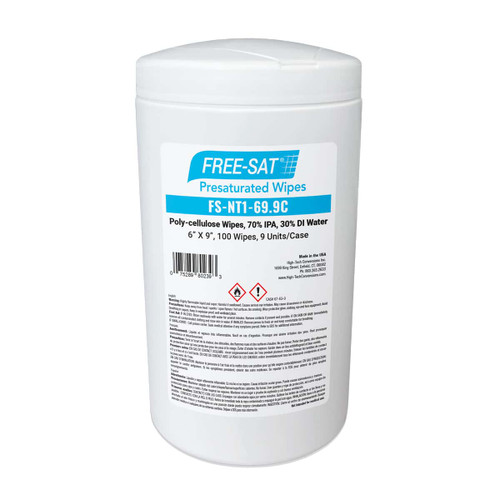
Canister label view (FREE-SAT FS-NT1-69-9C). Image shown on SOSCleanroom product page.
1) Practical solutions in a critical environment
A presaturated canister wipe is a “process control tool” as much as it is a consumable: it standardizes the wet-cleaning step so operators are not
measuring IPA, mixing bottles, or guessing how wet a wipe should be mid-task. FREE-SAT 6" x 9" canister wipes are positioned for routine wipe-downs
in controlled environments where repeatability, speed, and consistent surface wetting matter more than making the wipe step “fancy.”
SOSCleanroom lists this item as FS-NT1-69-9C, a hydroentangled poly-cellulose blend wipe presaturated with 70% IPA / 30% DI water.
2) What is this wiper used for
- Routine wipe-downs of benches, carts, noncritical tools, and touch surfaces where a 70/30 IPA blend is your standard cleaning chemistry.
- Between-step cleaning in high-tech manufacturing and research workflows where convenient access (canister) reduces “I’ll do it later” behavior.
- General-purpose cleaning/disinfecting support tasks and controlled spill response when your process allows a poly-cellulose blend substrate.
3) Why should customers consider these wipes
- Repeatable wetting: 70% IPA / 30% DI water saturation is delivered the same way, every canister.
- Substrate balance: hydroentangled 45% polyester / 55% cellulose blend supports absorbency and toughness for day-to-day wipe-downs. }
- Convenient access: resealable canister helps keep wipes protected between pulls (and reduces “open stack” exposure)
- Documentable cleanliness framework: the FS-NT1 family datasheet publishes typical NVR and ionic extractables using IEST-referenced methods, which can help QA teams start a qualification discussion.
Note on language: no wipe is truly “lint-free.” For controlled environments, the practical goal is low-linting performance with correct technique and the right substrate selection for your surface and solvent.
4) Materials and construction
Wipe substrate: hydroentangled nonwoven poly-cellulose blend (45% polyester / 55% cellulose). Hydroentangling (water-jet entanglement)
is commonly used to improve integrity and reduce loose fiber release versus more loosely bonded structures, but technique still matters for low-linting outcomes.
Saturation chemistry: 70% isopropyl alcohol / 30% deionized water. In practice, this blend is often chosen for routine wipe-downs where a slightly
longer wet contact time is preferred compared with near-anhydrous IPA, but you should align to your SOP, residues of concern, and validated contact-time expectations.
Form factor: 6" x 9" nominal wipes dispensed from a resealable canister to support quick access and saturation retention between uses.
5) Specifications in context
Below is what is published for FS-NT1-69-9C on SOSCleanroom, plus typical FS-NT1 family performance characteristics from the manufacturer datasheet
(typical values are not a specification).
| Attribute |
FS-NT1-69-9C (as published) |
| SOS SKU |
FS-NT1-69-9C |
| Size (nominal) |
6" x 9" (15 cm x 23 cm) |
| Saturation |
70% IPA / 30% DI water |
| Substrate |
Hydroentangled nonwoven poly-cellulose (45% polyester / 55% cellulose) |
| Presentation |
Presaturated wipes in a resealable canister |
| Packaging |
100 wipes/canister; 9 canisters/case (900 wipes total) |
| Sterility |
Non-sterile |
| Cleanroom use guidance (published) |
Ideal for ISO Class 6; can be used in ISO Class 5 depending on process controls |
| Typical basis weight (FS-NT1 family) |
68 gsm (typical) |
| Typical thickness (FS-NT1 family) |
0.30 mm (typical) |
| Typical absorbency capacity (FS-NT1 family) |
288 mL/m² (IEST-RP-CC004.3 referenced) |
| Typical absorbency rate (FS-NT1 family) |
0.8 sec (IEST-RP-CC004.3 referenced) |
6) Cleanliness metrics
The manufacturer’s FS-NT1 technical data sheet publishes typical cleanliness results (not a specification) using IEST-referenced methods.
These values are useful for comparison and initial qualification planning, but your facility should confirm acceptance criteria and verification methods in your quality system.
Typical ion extractables (FS-NT1 family, mg/g)
| Ion |
Typical value |
| Chloride (Cl-) | 0.0012 mg/g |
| Sulphate (SO4) | No detection |
| Sodium (Na) | No detection } |
| Potassium (K) | No detection |
| Magnesium (Mg) | 0.0500 mg/g |
| Calcium (Ca) | 0.0660 mg/g |
Typical NVR (non-volatile residue), mg/g
| Extractant |
Typical value |
| DI water extractant | 0.091 mg/g |
| IPA extractant | 0.431 mg/ |
Additional published cleanliness-related data (FS-NT1 family): releasable particle counts are reported as
LPC ≥ 0.5 µm = 82.42 × 10⁶ counts/m² and APC ≥ 0.5 µm = 5.74 × 10³ counts/m²/cfm (typical).
7) Packaging, sterility and traceability
- Packaging: 100 wipes per canister; 9 canisters per case.
- Sterility: non-sterile (this is a clean, presaturated wipe—do not treat it as a sterile product unless your program specifies a sterile alternative).
- Traceability (practical): canister format supports shift-friendly controls (date opened, area assignment, and canister retirement rules). Build that into your SOP so the convenience does not become uncontrolled reuse.
- Country of origin (manufacturer statement): the product label shown in the SOSCleanroom image includes “Made in the USA.”
8) Best-practice use
Canister wipes are fast, but they amplify operator habits. The goal is consistent wet contact and controlled removal—not aggressive scrubbing that redistributes residue.
Operator-level wiping technique module
- Stage the canister: keep the lid closed between pulls; treat “open canister on the bench” as a deviation because it drives dry-out and VOC exposure. (SOSCleanroom best-use note emphasizes saturation consistency and reduced handling errors.)
- Fold for faces: fold into quarters to create multiple clean faces; rotate to a clean face as soon as you see streaking or pickup.
- Straight strokes, one direction: wipe top-to-bottom or left-to-right; avoid circular motions that can redeposit residue into the “clean” area.
- Use wet time intentionally: for residues that need dwell, keep the surface uniformly wet for the validated contact time—then remove with a clean face to reduce re-deposit.
- Compatibility check: 70/30 IPA is broadly used, but it can haze some plastics, soften certain coatings, or attack adhesives/labels—verify on your materials of construction before scaling.
- Know when to switch substrates: poly-cellulose is often selected for absorbency; when ultra-low shedding and solvent resistance are primary, facilities frequently qualify 100% synthetic polyester alternatives.
9) Common failure modes
- Dry-out drift: lid left open leads to under-wet wipes, streaking, and higher friction (which increases particle risk).
- Cross-contamination by convenience: the canister is “too easy,” so it gets used everywhere. Assign canisters by room/zone and retire them when moved across classifications.
- Overworking the wipe: reusing a loaded wipe spreads residues; set clear “change-out triggers” (visible soil, streaking, tacky feel, or after a defined surface area).
- Technique-induced linting: aggressive tugging, scrubbing, or wiping sharp edges can create avoidable debris even with low-linting substrates.
10) Closest competitors
Keep competitor comparison grounded in what your QA team actually controls:
substrate (poly-cellulose vs. polyester), saturation blend (70/30 vs. higher IPA), packaging (canister vs. bag), sterility (non-sterile vs. sterile),
and published cleanliness metrics (ions/NVR/particles) tied to recognized test methods.
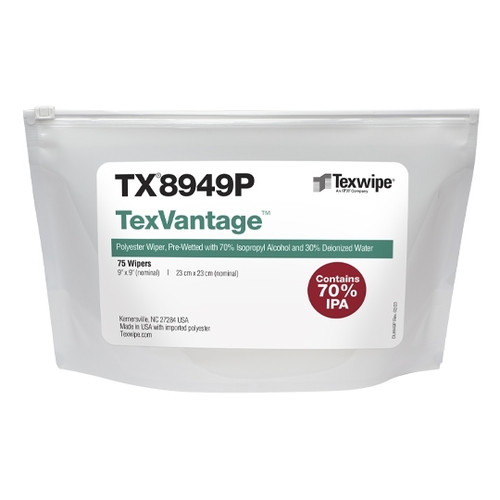
- Texwipe pre-wetted wipers (70% IPA formats): commonly evaluated when a facility wants documented cleanroom wiper performance in a comparable alcohol blend (format varies by SKU; validate for your use).
- Berkshire pre-wetted cleanroom wipers: often considered when customers want different substrate families and packaging presentations for controlled wipe-down steps.
- Contec pre-saturated wipes: frequently compared for facilities prioritizing specific cleanroom classifications, sterility options, and program alignment.
11) Critical environment fit for these wipes
SOSCleanroom positions FS-NT1-69-9C for ISO Class 6 use and notes it can be used in ISO Class 5 depending on process controls and cleaning method.
The practical way to qualify it is to align three things:
- Surface risk: is the surface product-contact, near-product, or infrastructure? Infrastructure wipe-downs are often more tolerant of poly-cellulose than high-sensitivity product-contact surfaces.
- Residue and re-deposit controls: if you’re removing oils/adhesives/resins, define “wipe until clean” endpoints (visual, UV, gravimetric, TOC, etc.) and set change-out rules.
12) SOSCleanroom note about SOP's
The Technical Vault is written to help customers make informed contamination-control decisions and improve day-to-day handling technique.
It is not your facility’s Standard Operating Procedure (SOP), batch record, or validation protocol.
Customers are responsible for establishing, training, and enforcing SOPs that fit their specific risks, products, equipment, cleanroom classification, and regulatory obligations.
Always confirm material compatibility, cleanliness suitability, sterility requirements, and acceptance criteria using your internal quality system and documented methods.
If you adapt any technique guidance from this entry, treat it as a starting template. Your team should review and approve the final method, then qualify it for your specific surfaces,
solvents, cleanliness limits, inspection methods, and risk profile. In short: use these best-practice suggestions to strengthen your SOPs—not to replace them.
13) Source basis
Product and manufacturer
- SOSCleanroom product page (FS-NT1-69-9C): https://www.soscleanroom.com/product/ppe/free-sat-70-ipa-6-x-9-presaturated-canister-wipes/
- Manufacturer product page (High-Tech Conversions): https://high-techconversions.com/product/free-sat-70-ipa-6-x-9-presaturated-canister-wipes-fs-nt1-69-9c/
- Manufacturer datasheet (FS-NT1 family; includes NVR and ionic extractables): https://www.novatech-usa.com/pdf/FREE-SAT%20Datasheet.pdf
- Manufacturer brochure (presaturated wipes line card; includes FS-NT1-69.9C listing): https://www.novatech-usa.com/pdf/High-Tech%20Conversions%20Presaturated%20Wipes%20Brochure.
- SOS-hosted PDF copy: not stated/published on the SOSCleanroom product page as of today’s review date.
Standards and regulatory bodies (contextual references)
- ISO: https://www.iso.org/standard/53394.html
- FDA: https://www.fda.gov/
- ASTM: https://www.astm.org/
- IEST: https://www.iest.org/
SOSCleanroom is the source for this Technical Vault entry.
Briefed and approved by the SOSCleanroom (SOS) staff.
If you have any questions please email us at Sales@SOSsupply.com
Last reviewed: Jan. 7, 2026
© 2026 SOSCleanroom