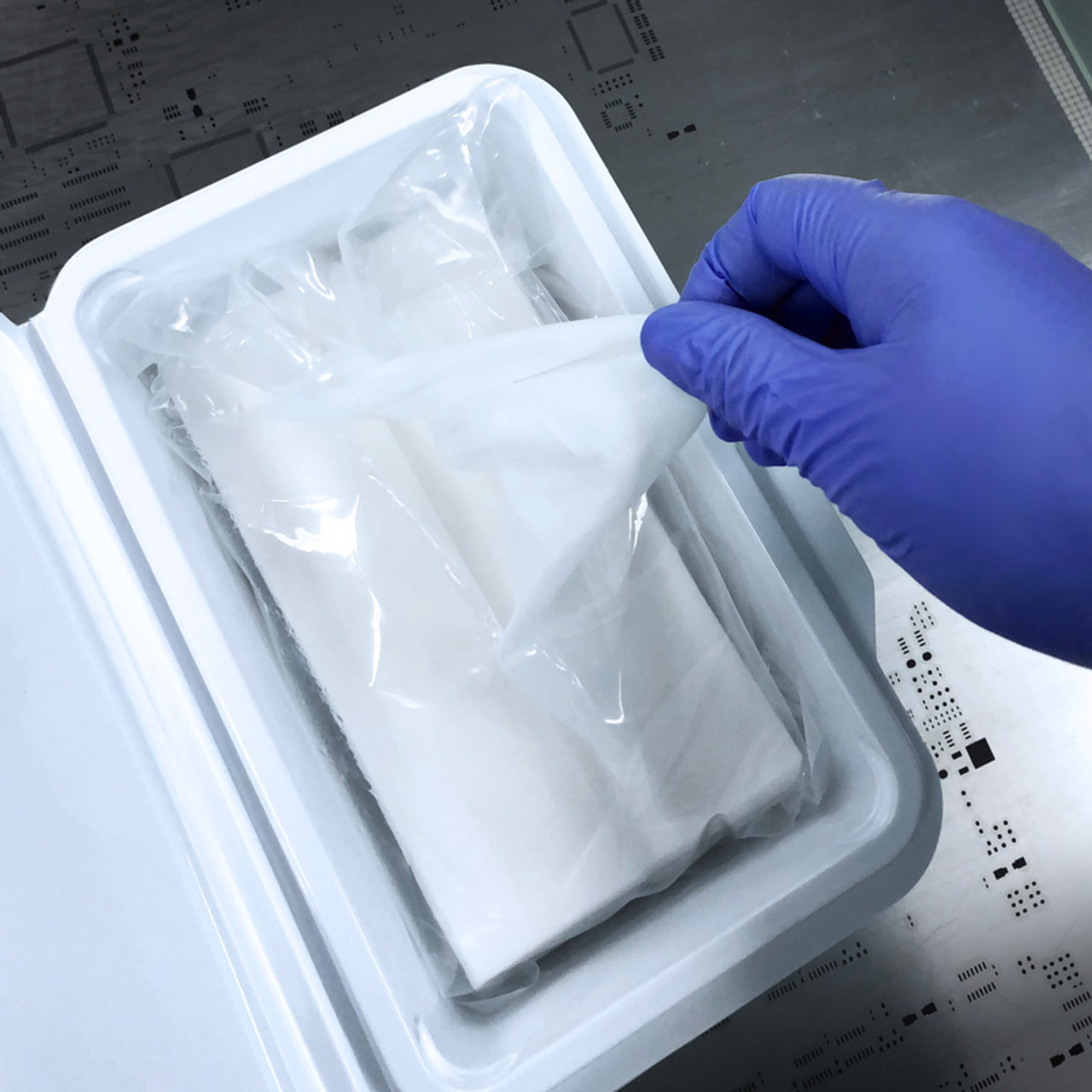
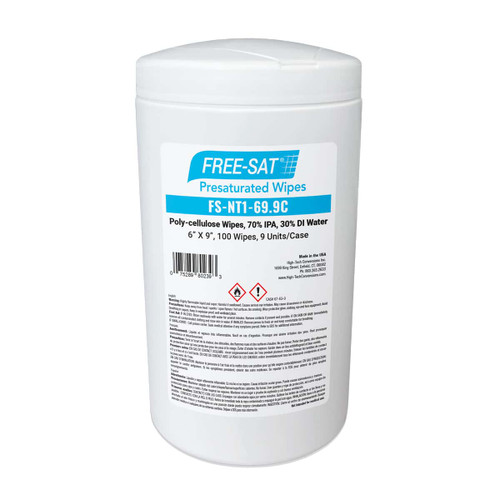
Representative product image shown for format/packaging context.
Practical solutions in a critical environment
When teams choose a 99% IPA presaturated wipe, it is usually for one of two reasons: you need a predictable, fast-dry solvent wipe-down,
or you are trying to reduce water carryover on sensitive surfaces (optics, electronics, coated parts, metrology fixtures).
FS-ULT70-99.99 is built around that reality: a heavy-weight, sealed-edge polyester knit that stays tough under pressure,
while controlling loose fibers and helping reduce the “wipe trail” that shows up when a wipe is under-built for the job.
What is this wiper used for
This is a tub-dispensed, presaturated cleanroom wipe used for routine and event-driven cleaning where consistent wetness and solvent concentration matter.
Typical use cases include:
- Final wipe-down of tools, benches, carts, and fixtures before entry into more critical spaces.
- Removal of residues (adhesives, films, fingerprints, light oils) where a fast-dry IPA approach is preferred.
- Cleaning “touch items” that still live in controlled areas (notebooks, phones, hand tools) using a controlled wipe method.
- Spot cleaning where squirt bottles and inconsistent hand-wetting create variability.
Why should customers consider this wiper
- 99% IPA / 1% DI water blend supports fast drying and lower water carryover on sensitive surfaces.
- Sealed edges help control loose fibers and reduce edge fray during aggressive wipe-downs.
- Heavy-weight knit construction (built for abrasion resistance and repeated passes on real-world surfaces).
- Tub format reduces open handling versus pouring solvent onto dry wipes, improving repeatability.
- Low-linting intent (and a practical reminder: nothing is truly lint-free—technique and surface condition still decide the outcome).
Materials and construction
FS-ULT70-99.99 is described as a 100% virgin polyester wipe with four heat-sealed edges designed to reduce loose fibers and fiber contamination.
The wipe is engineered to be abrasion resistant and absorbent, with a tough knit that holds together when wiping rougher fixtures or edges.
It is supplied presaturated with 99% isopropyl alcohol and 1% DI water.
Specifications in context
The table below consolidates SKU-level details that impact day-to-day performance (how it wipes, how it dries, and how it behaves on edges and corners).
Where sources differ, both statements are preserved.
| Attribute |
FS-ULT70-99.99 (Tub) |
| SOSCleanroom SKU |
FS-ULT70-99.99 TUB |
| Wipe size |
9" x 9" |
| Saturation |
99% IPA / 1% DI water |
| Material |
Virgin polyester (knit) |
| Edge type |
Heat-sealed edges (sealed edges) |
| Basis weight |
140 gsm (typical) |
| Thickness |
0.48 mm (typical) |
| Cleanroom class statement |
SOS listing: ISO Class 3–4 (Class 1–10).
Manufacturer listing: ISO Class 3–5 (Class 1–100).
|
| Sterility |
Non-sterile (as listed by manufacturer) |
| Packaging |
30 wipes per tub; 12 tubs per case (360 wipes) |
| Availability (SOS) |
7–10 business days (posted) |
Cleanliness metrics
Cleanliness numbers are often treated like a spec, but many manufacturers publish them as typical values from standardized test methods.
Use the tables below for process design and comparison, then align your acceptance criteria to your internal quality system, surface risk, and verification method.
Typical ion extractables (mg/g)
| Ion |
Typical value |
Test method reference |
| Chloride (Cl) | 0.000174 | IEST-RP-CC004.3 (Sec 7.2.2) |
| Nitrates (NO3) | 0.000019 | IEST-RP-CC004.3 (Sec 7.2.2) |
| Nitrite (NO2) | 0.000025 | IEST-RP-CC004.3 (Sec 7.2.2) |
| Sulphate (SO4) | 0.000083 | IEST-RP-CC004.3 (Sec 7.2.2) |
| Sodium (Na) | 0.000312 | IEST-RP-CC004.3 (Sec 7.2.2) |
| Potassium (K) | 0.000227 | IEST-RP-CC004.3 (Sec 7.2.2) |
| Magnesium (Mg) | 0.000049 | IEST-RP-CC004.3 (Sec 7.2.2) |
| Calcium (Ca) | 0.000021 | IEST-RP-CC004.3 (Sec 7.2.2) |
Typical NVR (mg/g)
| Extractant |
Typical value |
Test method reference |
| DI water extractant |
0.14 |
IEST-RP-CC004.3 (Sec 7.1.2) |
| IPA extractant |
0.52 |
IEST-RP-CC004.3 (Sec 7.1.2) |
Packaging, sterility and traceability
- SKU (SOS): FS-ULT70-99.99 TUB
- Unit format: Tub/canister; 30 wipes per tub.
- Case format: 12 tubs per case (360 wipes).
- Sterility: Non-sterile (manufacturer listing).
- Country of origin (manufacturer statement): Made in the USA.
- Traceability note: If your QA program requires incoming inspection documentation or lot capture, standardize how you record:
supplier name, SKU, receiving date, lot/identifier (if listed on unit label), and where the tub is staged/used.
Best-practice use
A presaturated wipe helps standardize wetness, but outcomes still depend on fold discipline, stroke control, and how often you flip to a clean face.
The quick, shop-floor checklist below keeps cleaning consistent across shifts.
- Stage the job: Identify the “clean-to-dirty” direction before you touch anything. Remove loose debris first (do not grind it in).
- Open tub briefly: Pull one wipe and close the lid immediately to reduce solvent loss and variability.
- Fold for control: Quarter-fold into a flat pad; keep edges tucked so you wipe with a stable face, not a flapping corner.
- One direction, overlapping passes: Use straight strokes with 20–30% overlap. Avoid circular scrubbing unless the surface and residue demand it.
- Use “clean face” rules: Flip to a fresh face as soon as you see streaking, drag, or visible pickup. If all faces are used, discard.
- Edge awareness: On sharp corners or burr-prone fixtures, lower pressure and increase wipes-per-area to avoid snagging.
- Drying expectation: Allow the surface to air dry; do not immediately over-wipe a half-dry film (that often re-deposits).
- Safety reality: 99% IPA is flammable. Follow your site chemical hygiene plan, keep away from ignition sources, and use appropriate ventilation and PPE for your environment.
Common failure modes
- Streaking or haze: Often caused by overworking a drying film or using a saturated face too long. Flip sooner; reduce re-wiping.
- Re-deposition: Wiping “dirty-to-clean” or using circular motions can spread residues. Lock in a direction and overlap pattern.
- Snagging/tearing: Sharp fixture edges, burrs, or aggressive pressure. Reduce pressure; inspect fixtures; use more wipes per area.
- Inconsistent wetness: Lid left open, wipes staged outside the tub, or long dwell time in low-humidity areas. Pull-and-close discipline matters.
- Fiber/particle complaints: Even low-linting designs can look “dirty” if the surface is rough, oxidized, or shedding. Confirm the surface condition before blaming the wipe.
Closest competitors
If you are qualifying equivalents, keep the comparison anchored on: material construction (knit vs nonwoven), edge sealing method, packaging (tub vs pouch),
and the IPA/DI concentration.
-
Texwipe Vectra® QuanSat™ TX1082 (pre-wetted cleanroom wipers) — sealed-border polyester wiper option available with 100% IPA; commonly evaluated when teams want a tightly controlled pre-wet format.
-
Berkshire SatPax® MicroSeal®-VP (9" x 9" 100% IPA option) — zipper pouch format and ultrasonically sealed edge approach; often considered for the most critical wipe-down programs.
Critical environment fit for this wiper
FS-ULT70-99.99 is positioned for high-sensitivity wipe-downs where teams want the control of a presaturated format and the durability of a heavy-weight knit.
The sealed edges are a practical choice when you cannot afford edge fray on corners, rails, and fixture transitions.
For programs under quality oversight (pharma, medical device, microelectronics), the most defensible approach is to:
(1) define where 99% IPA is appropriate versus 70% blends,
(2) set a wipe technique standard (fold/stroke/flip rules),
and (3) verify residues and cleanliness using your internal acceptance criteria and documented methods.
Practical selection cue
If you are battling slow dry times or water marks, this 99% IPA / 1% DI format is often selected specifically to reduce water carryover.
If you need longer dwell or broader disinfection workflows, 70% IPA systems are often chosen instead.
SOSCleanroom note about SOP's
The Technical Vault is written to help customers make informed contamination-control decisions and improve day-to-day handling technique.
It is not your facility’s Standard Operating Procedure (SOP), batch record, or validation protocol.
Customers are responsible for establishing, training, and enforcing SOPs that fit their specific risks, products, equipment, cleanroom classification, and regulatory obligations.
Always confirm material compatibility, cleanliness suitability, sterility requirements, and acceptance criteria using your internal quality system and documented methods.
If you adapt any technique guidance from this entry, treat it as a starting template. Your team should review and approve the final method, then qualify it for your specific surfaces,
solvents, cleanliness limits, inspection methods, and risk profile. In short: use these best-practice suggestions to strengthen your SOPs—not to replace them.
Source basis
- SOSCleanroom product page: https://www.soscleanroom.com/product/ppe/free-sat-9-x-9-polyester-presaturated-class-1-10-wipers-99-ipa-1-di-water/
- Manufacturer product page (FS-ULT70-99.99): https://high-techconversions.com/product/free-sat-9-x-9-polyester-presaturated-class-1-10-wipers-99-ipa-1-di-water/
- Technical data sheet (FS-ULT70 family; includes FS-ULT70-99.99 packaging + typical cleanliness values): https://www.cleanroomsupplies.com/wp-content/uploads/2023/08/fs-polyester-70-ipa-wipes-tech-sheet.pdf
- Manufacturer comparison chart (includes FS-ULT70-99.99 + “Made in USA” column): https://high-techconversions.com/wp-content/uploads/2023/08/Cleanroom_Wipes_Comparison_Chart.pdf
- Standards and regulatory bodies (use as applicable to your program): https://www.iso.org/standard/53394.html, https://www.fda.gov/, https://www.astm.org/, https://www.iest.org/
- Note: Typical values are published for guidance and may change; confirm acceptance criteria through your internal quality system and documented methods.
SOSCleanroom is the source for this Technical Vault entry.
Briefed and approved by the SOSCleanroom (SOS) staff.
If you have any questions please email us at Sales@SOSsupply.com
Last reviewed: January 7, 2026
© 2026 SOSCleanroom