1) Practical solutions in a critical environment
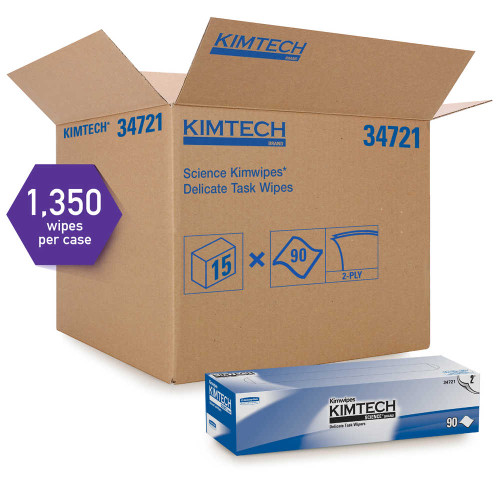
Kimtech 34721 is a classic “delicate task” wipe used where you need quick, controlled wiping without reaching for a heavier cleanroom-grade fabric.
Think lab benches, instrument wipe-downs, optical accessories, and general cleanup where the goal is to remove light dust, fine particles, and small liquid spills
with a predictable, disposable sheet.
This is a low-linting tissue-style wiper with a pop-up dispenser designed to reduce waste and reduce static-related “grab” of dust.
Nothing is truly lint-free; the practical question is whether the lint level is acceptable for your process, surface, inspection method, and downstream risk.
2) What is this wiper used for
- Polishing or final “fingerprint removal” on glassware and lab accessories where light absorbency and softness matter.
- Wiping dust and tiny particles from benchtop tools, instrument housings, and staging areas between tasks.
- Absorbing small liquid spills (water-based and common lab drips) before they migrate into equipment seams.
- General-purpose cleanup in labs and controlled workstations where you want one-at-a-time dispensing and consistent sheet size.
- “Grab-and-go” wipe support for training and standard work (one sheet, one pass, discard) to reduce rework and cross-contamination.
3) Why should customers consider this wiper
- Simple control: pop-up, one-at-a-time dispensing helps stop “handful wiping” and keeps usage predictable.
- 2-ply absorbency: a practical step up when 1-ply feels too thin for small spills or repeated light passes.
- Delicate-surface behavior: tissue softness reduces the urge to press hard, which can scratch or smear sensitive surfaces.
- Workflow-friendly sheet size: large format (14.7 in. x 16.6 in.) supports folding into stable wiping faces.
- Waste reduction: dispenser presentation makes it easier to standardize “one sheet per step” in training and audits.
4) Materials and construction
Kimtech 34721 is a 2-ply tissue / cellulose wiper intended for delicate tasks and light-duty cleanup.
The packaging format is a POP-UP style dispenser box that delivers sheets in a consistent orientation and supports one-at-a-time removal.
Construction note for operators: tissue wipes behave differently than knit or nonwoven cleanroom fabrics—especially on glossy surfaces.
A lighter touch and a single-direction “wipe-and-lift” technique usually performs better than scrubbing.
5) Specifications in context
| Attribute |
Kimtech 34721 (SKU-specific) |
| Sheet size |
14.7 in. x 16.6 in. |
| Ply |
2-ply |
| Material |
2-ply tissue (cellulose) |
| Dispensing format |
POP-UP dispenser box; one-at-a-time dispensing |
| Pack configuration |
90 wipes per box; 15 boxes per case; 1,350 wipes per case |
| Color |
White |
| Sterility |
Not published on SOS product page; commonly listed as nonsterile by distributors |
| Shipping weight (case) |
20 lb (listed on SOS product page) |
Selection logic: if you need a large sheet you can fold into multiple fresh faces and you prefer 2-ply absorbency for light spills or repeated delicate passes,
34721 is typically the “right-weight” Kimwipes format. If you need quantified cleanliness (ions/NVR) for ISO-class cleanrooms, consider stepping up to cleanroom-grade wipes with published contamination data.
6) Cleanliness metrics
Delicate-task tissue wipers are often selected for handling and workflow control rather than for ISO cleanroom qualification.
For Kimtech 34721 specifically, the readily available technical sheet emphasizes product codes, sheet counts, and physical properties, but does not publish typical ion extractables or typical NVR values.
If your quality system requires numeric extractables limits, you should set acceptance criteria and test per your internal method, or choose a wipe family that publishes those metrics.
| Typical ion extractables |
| Ion |
Typical value |
| Sodium / Potassium / Chloride / Sulfate (and others) |
Not published in the referenced SKU technical sheet |
| Acceptance note |
If required, define a solvent, extraction time, and analytical method in your internal protocol. |
| Typical NVR (nonvolatile residue) |
| Metric |
Typical value |
| NVR (typical) |
Not published in the referenced SKU technical sheet |
| Practical guidance |
If residue is a risk (optics, coatings, analytical sampling), validate wipe + solvent + surface as a system. |
7) Packaging, sterility and traceability
- Configuration: 90 wipes per box / 15 boxes per case / 1,350 wipes total per case.
- Dispensing: POP-UP dispenser box intended to support one-at-a-time removal and reduced waste.
- Sterility: not stated on the SOS product page; commonly listed as nonsterile by distributors. Confirm if your process has sterility requirements.
- Country of origin (manufacturer/distributor listing): United States is commonly reported by major distributors; confirm on receipt and within your approved supplier process.
- Traceability: box/case labeling supports receiving inspection and stock rotation; record lot/date info per your internal practice (not specified in the technical sheet excerpt).
8) Best-practice use
The fastest way to improve results with delicate-task tissue wipes is to standardize handling: clean hands or gloves, controlled sheet presentation, light pressure, and one-direction passes.
Operators usually get better outcomes by folding the sheet into a stable pad and rotating to a fresh face rather than scrubbing with an open sheet.
Operator-level wiping technique module
- Fold for control: fold into halves/quarters until you have a firm pad with flat edges; avoid “floppy sheet” wiping.
- One pass, one direction: wipe in a single direction, then lift; do not “backtrack” over the same line with the same face.
- Rotate faces: treat each fold face as a new tool surface; rotate to a fresh face as soon as you see streaking or loading.
- Right pressure: use the minimum pressure needed; pressing harder increases smearing and can grind debris into softer surfaces.
- Solvent pairing (if used): add solvent to the wipe (not directly to the surface) when you want control and to reduce runs into seams.
- Discard discipline: once loaded, discard—do not “save the wipe” for the next station.
9) Common failure modes
- Over-scrubbing: tissue wipes can smear oils if pressure is too high or if the face is reused after loading.
- Static attraction: dry wiping in low humidity can pull dust back to the surface; consider a controlled solvent wipe step when appropriate.
- Sheet “edge digging”: using an unfolded sheet can create streak lines from wrinkles; folding reduces edge artifacts.
- Mismatch to cleanliness requirements: if your process requires quantified extractables/NVR, a delicate-task tissue wipe may not be the right class of consumable without validation testing.
10) Closest competitors
In practice, “closest” depends on whether you’re matching delicate-task tissue behavior or stepping up to cleanroom-grade contamination control.
Here are common comparison buckets (kept intentionally concise):
- Other delicate-task tissue wipes in pop-up dispensers: similar workflow and training behavior; sheet count and ply drive feel and absorbency.
- Cleanroom-grade polyester knit wipes (higher control): chosen when you need tighter particle control and better compatibility with validated cleaning programs.
- Hydroentangled / nonwoven cleanroom wipes (balanced performance): used when you want improved durability and lower shedding vs. tissue while staying practical for routine wipe-downs.
11) Critical environment fit for this wiper
Kimtech 34721 is a strong fit for laboratories, instrument rooms, and controlled workstations where the priority is consistent day-to-day technique:
one sheet dispensed, one controlled pass, and predictable disposal.
If you operate in an ISO-classified cleanroom or you have regulatory-driven residue and extractables limits, treat this wipe as a workflow tool unless you have validated it for your specific surface, solvent, and acceptance criteria.
SOSCleanroom can help you align the consumable to the risk: delicate-task tissue for general lab handling, or cleanroom-grade wipes when you need tighter contamination control.
12) SOSCleanroom note about SOP's
The Technical Vault is written to help customers make informed contamination-control decisions and improve day-to-day handling technique.
It is not your facility’s Standard Operating Procedure (SOP), batch record, or validation protocol.
Customers are responsible for establishing, training, and enforcing SOPs that fit their specific risks, products, equipment, cleanroom classification, and regulatory obligations.
Always confirm material compatibility, cleanliness suitability, sterility requirements, and acceptance criteria using your internal quality system and documented methods.
If you adapt any technique guidance from this entry, treat it as a starting template. Your team should review and approve the final method, then qualify it for your specific surfaces,
solvents, cleanliness limits, inspection methods, and risk profile. In short: use these best-practice suggestions to strengthen your SOPs—not to replace them.
13) Source basis
-
SOSCleanroom product page (SKU-specific): https://www.soscleanroom.com/product/ppe/kimberly-clark-kimtech-34721-2-ply-science-kimwipes-delicate-task-wipers-14-7-x-16-6/
-
SKU technical data sheet (includes 34721 in the product table; Revised May 2013): https://hdsupplysolutions.com
-
Secondary distributor technical listing (dimensions/packaging reference): https://www.fishersci.com/shop/products/kimtech-science-kimwipes-delicate-task-wipers-2-ply/0666611
-
Country of origin listing (commonly reported by distributors; confirm on receipt): https://mms.mckesson.com/product/52386/Kimberly-Clark-34721
-
Additional retail/distributor packaging confirmation (carton format): https://www.homedepot.com/p/Kimtech-Kimwipes-Delicate-Task-Wipers-2-Ply-14-7-10-in-x-16-3-5-in-90-Box-15-Boxes-Carton-KCC34721/203176703
-
ISO (cleanroom classification context): https://www.iso.org/standard/53394.html
-
FDA (regulatory context for controlled manufacturing): https://www.fda.gov/
-
ASTM (test method framework reference): https://www.astm.org/
-
IEST (contamination control guidance reference): https://www.iest.org/
SOSCleanroom is the source for this Technical Vault entry.
Briefed and approved by the SOSCleanroom (SOS) staff.
If you have any questions please email us at Sales@SOSsupply.com
Last reviewed: January 7, 2026
© 2026 SOSCleanroom