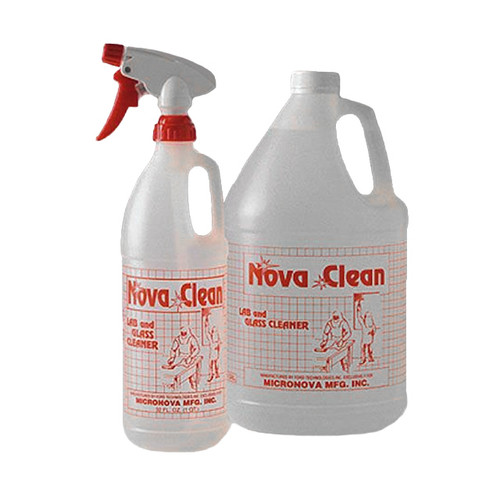
Micronova NovaClean Floor Clean: A low-ionic detergent concentrate for residue control on cleanroom surfaces and conductive flooring

Product image shown for reference.
1) Practical solutions in a critical environment
Floors, walls, ceilings, and cleanroom curtains tend to become “chemical memory surfaces” over time — especially where disinfectants rotate and residues build up in traffic lanes,
around equipment bases, and along wall-to-floor coves. NovaClean Floor Clean is positioned for routine cleaning and residue removal, with an emphasis on low mobile ions and low residue
so conductive flooring performance is not compromised. SOSCleanroom (SOS) has been a proud distributor of Micronova for over 15 years supporting critical environments.
In practice, teams use this type of detergent step to help prevent sticky films that trap particles, create streaking, or force aggressive rework that raises contamination risk.
Mechanical cleaning still matters — the detergent is the chemistry layer that supports your technique, not a replacement for it.
2) What this product is used for
- Routine cleaning on most cleanroom surfaces: floors, walls, ceilings, and equipment exteriors.
- Residue control between disinfectant applications (supporting “neutral cleans” where a kill rate is not required).
- Conductive flooring care where low residue and low mobile ions help reduce static-charge concerns.
- General-purpose detergent step where facilities want a filtered solution with an emphasis on low ionic contribution at recommended dilution.
3) Why customers consider this product
- Filtered to 0.1 microns and positioned for cleanroom routine cleaning and residue removal.
- Formulation claims “no mobile ions” and low sodium/potassium at recommended dilution (parts-per-billion detection level claim).
- Designed to avoid residue buildup that can impact conductive flooring efficiency and contribute to static-charge issues.
- Concentrate economics: manufacturer states 60–128 gallons of cleaning solution yield per 1 gallon container (depending on dilution).
- Broad-use positioning (pharma/biotech use case is specifically referenced by the manufacturer when “neutral cleans” are appropriate).
4) Materials, composition, and build
NovaClean Floor Clean is a cleanroom detergent concentrate. Manufacturer descriptions position it as low-ionic, free-rinsing, and biodegradable, and note it is filtered to 0.1 microns.
The manufacturer’s Safety Data Sheet (SDS) identifies it as a mixture with water as the primary component and trace potassium hydroxide listed as a hazardous component at <0.001%.
From a contamination-control standpoint, this is the “chemistry helper” used to release soils and residues so they can be physically removed with the mop/wipe method your program has qualified.
5) Specifications in context
| Attribute |
Value |
| SOSCleanroom SKU |
NC1 |
| Manufacturer |
Micronova Manufacturing |
| Manufacturer product codes listed |
NC1-G (gallon), NC1-5G (5 gallon pail); SDS also references NC1-Q alongside NC1-G and NC1-5G |
| Container options sold on SOSCleanroom |
1 Gallon (4/Case) or 5 Gallon (1/Case) |
| Case unit (as listed) |
1 Gallon option: 4 one-gallon bottles per case. 5 Gallon option: 1 five-gallon pail per case. |
| Filtration claim |
Filtered to 0.1 microns |
| Yield claim |
60–128 gallons of cleaning solution per 1 gallon container (depending on dilution) |
| pH (SDS, at 20°C / 68°F) |
7–9 |
| VOC content (SDS) |
0.00% |
| Availability (as listed) |
7–10 business days |
| Country of origin |
Not published in source basis |
| Sterility |
Not published in source basis |
Practical interpretation
This is a detergent concentrate intended to be diluted with your facility’s qualified process water and applied with a controlled cleaning method.
The “filtered / low-mobile-ions / low-residue” positioning is most relevant when surfaces (especially conductive floors) must remain reliable after repeated cleaning cycles.
6) Performance and cleanliness considerations
Manufacturer descriptions emphasize: filtration to 0.1 microns, low sodium and low mobile ions, free-rinsing behavior, and reduced residue buildup that could affect conductive flooring.
They also state that at recommended dilution, sodium and potassium levels are detectable only in parts per billion. For programs using “neutral clean” steps (where disinfection kill claims are not required),
Micronova explicitly positions NovaClean as suitable in pharmaceutical and biotech contexts.
From a contamination-control perspective, detergents like this are commonly used to support residue management as a distinct step in a cleaning and disinfection program. Facilities should define acceptance criteria
(visual residue, conductivity/ESD performance where applicable, particulate response, and documented rinse expectations) in line with their contamination control strategy and quality system.
7) Packaging, sterility, traceability, and country of origin
- Pack sizes sold on SOSCleanroom: 1 gallon (4/case) and 5 gallon (1/case).
- Traceability: Not specifically described in source basis. As a best practice, receiving teams typically record product code, lot/label identifiers present on the container, and the SDS revision date used by the site.
- Sterility: Not published in source basis. If your operation requires sterile detergents in aseptic areas, confirm suitability and sterility documentation with your quality system before use.
- Country of origin: Not published in source basis.
8) Best-practice use
The most common failure in detergent cleaning is treating chemistry as the “work,” when the real work is controlled mechanical removal. Use NovaClean to help release and carry residues,
then remove them with disciplined technique.
Floor cleaning technique module (detergent step)
- Stage your tools: dedicate cleanroom mop head(s) and buckets for detergent use; keep disinfectant tools separate to avoid cross-chemistry carryover.
- Mix with qualified water: prepare the dilution using your approved process water (and, where required by your program, higher-grade water such as WFI). Document the dilution method your site has qualified.
- Clean with a pattern: work from clean-to-less-clean zones and from far-to-near exit; overlap passes and avoid “figure-eight wandering” that redeposits soils.
- Control the wet edge: keep the floor uniformly wetted within your validated method; do not let a dirty mop head dry on the surface.
- Rinse expectations: follow your program’s residue acceptance criteria. If a rinse step is required by your facility, perform it with qualified water and clean tools.
- Close-out checks: inspect high-traffic lanes and corners for streaking/film, confirm floor looks uniform, and record any deviations for follow-up.
The manufacturer notes NovaClean is intended for routine cleaning on most cleanroom surfaces and is positioned to avoid residue buildup that can impact conductive flooring efficiency.
Use your site’s qualification approach to confirm compatibility and acceptance criteria for your specific flooring system.
9) Common failure modes
- Over-concentration: leaves unnecessary film risk and can increase streaking; it also complicates rinse expectations.
- Under-concentration or poor mechanical action: soils are loosened but not removed, creating a “spread and shine” effect that looks clean until it dries.
- Tool cross-contamination: using mop heads or buckets that previously held disinfectants can create chemistry conflicts and visible residues.
- Dirty rinse water: re-deposits residues and particles on conductive floors, leading to uneven appearance and potential performance concerns.
- Skipping receiving checks: not confirming container integrity and not aligning SDS revision control to the site’s quality system.
10) Closest competitors
For facilities comparing cleanroom detergent steps for residue management, the closest alternatives are typically neutral/low-foaming detergents positioned for non-porous surfaces and residue removal
between disinfection cycles. Examples include:
- Contec® NeutraKlean (neutral detergent positioned for life science cleanrooms and disinfectant residue removal).
- Ecolab Klercide™ Neutral Detergent (sterile neutral detergent positioned for cleanroom residue removal and routine cleaning).
- STERIS ProKlenz™ NpH Sterile Detergent (concentrated neutral detergent positioned for cleanroom residue removal on non-porous surfaces).
11) Critical environment fit for this product
NovaClean is positioned for controlled environments where residue control and ionic contribution matter — including semiconductor/electronics areas and life science spaces that use a dedicated detergent step.
The manufacturer’s emphasis on low mobile ions and reduced residue buildup is especially relevant for conductive flooring programs that must remain consistent over repeated cleaning cycles.
Fit decisions should be made within your contamination control strategy: define where detergent steps belong (frequency, zones, tools), how you verify outcomes (visual residue, floor performance where applicable),
and what documentation is required for your internal QA expectations.
12) SOSCleanroom note about SOP's
The Technical Vault is written to help customers make informed contamination-control decisions and improve day-to-day handling technique.
It is not your facility’s Standard Operating Procedure (SOP), batch record, or validation protocol.
Customers are responsible for establishing, training, and enforcing SOPs that fit their specific risks, products, equipment, cleanroom classification, and regulatory obligations.
Always confirm material compatibility, cleanliness suitability, sterility requirements, and acceptance criteria using your internal quality system and documented methods.
If you adapt any technique guidance from this entry, treat it as a starting template. Your team should review and approve the final method, then qualify it for your specific surfaces,
solvents, cleanliness limits, inspection methods, and risk profile. In short: use these best-practice suggestions to strengthen your SOPs—not to replace them.
13) Source basis
- SOSCleanroom product page: https://www.soscleanroom.com/product/solutions/cleanroom-novaclean-floor-cleaner/
- Manufacturer product page (Micronova): https://www.micronova-mfg.com/products/detergents-cleaners/novaclean-floor-clean/
- Manufacturer brochure / technical sheet PDF (NovaClean Detergents): https://www.micronova-mfg.com/media/12104/novaclean-detergents-micronova-2020-1.pdf
- Manufacturer SDS (NovaClean, reviewed 05/31/2024): https://www.micronova-mfg.com/media/124173/nc1-g-q-5g-novaclean-us-english-us-2024.pdf
- ISO (cleanroom standards body): https://www.iso.org/standard/53394.html
- FDA: https://www.fda.gov/
- ASTM: https://www.astm.org/
- IEST: https://www.iest.org/
SOSCleanroom is the source for this Technical Vault entry.
Briefed and approved by the SOSCleanroom (SOS) staff.
If you have any questions please email us at Sales@SOSsupply.com or give us a call at (214)340-8574.
Last reviewed: Jan. 8, 2026
© 2026 SOSCleanroom