NovaClean™ Lab & Glass Cleaner (NC2) — Low-Ionic, 0.1 Micron-Filtered Detergent for Critical Surfaces

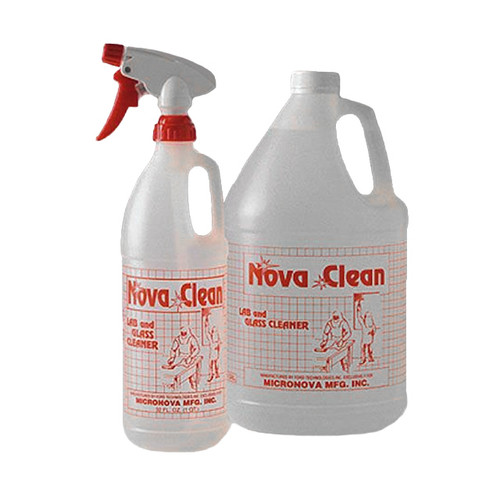
Product image shown from the SOSCleanroom listing for Cleanroom NovaClean Lab and Glass Cleaner (SKU: NC2).
1) Practical solutions in a critical environment
“Neutral cleans” are where cleanroom teams win or lose consistency. If your benches, glass panels, acrylic shields, stainless, and vinyl curtains
slowly haze up with films (or you see wipe-streaking that reappears after drying), you are usually fighting a combination of light oils, surfactant
carryover from prior steps, and particulate that is being redistributed instead of removed. NovaClean™ Lab & Glass Cleaner is positioned as a
ready-to-use, low-ionic detergent that is filtered to 0.1 micron and intended for routine surface cleaning across controlled environments.
SOSCleanroom (SOS) has been a proud distributor of Micronova for over 15 years supporting critical environments. That matters in practice: you
want a predictable product lot-to-lot and a receiving trail (lot/COA) your QA team can actually work with when you are trending residues, ions, or
visual cleanliness.
2) What this product is used for
- Routine cleaning of glass, acrylic, stainless steel, painted surfaces, and vinyl cleanroom curtains.
- Workstations and laminar flow bench surfaces where low-ionic residues are a concern.
- “Neutral” cleaning steps between disinfectant applications when a kill claim is not the objective, but residue control is.
- Pre-cleaning prior to inspection, assembly, or changeover where films and smears can mask defects.
3) Why customers consider this product
- Ready-to-use detergent (no blending or mixing) to reduce operator variability.
- Filtered to 0.1 micron for controlled-environment use.
- Low in sodium and potassium and described as low-ionic for ion-sensitive processes.
- Low non-volatile residue profile and free-rinsing behavior to help reduce film build-up.
- Lot traceability and Certificate of Analysis support are available from the manufacturer.
4) Materials, composition, and build
Micronova describes NovaClean Lab & Glass as a non-solvent based, free-rinsing, low-ionic surfactant solution that is biodegradable and filtered
to 0.1 micron. Manufacturer documentation also indicates the product is produced at Micronova’s Torrance, California facility.
For facilities managing residue risk, the practical takeaway is that this is intended as a detergent step (particle and film removal) rather than a
disinfectant step (microbial kill). Your SOP should define where it sits in your rotation and how you verify “clean” (visual, ionic, NVR, or TOC
acceptance criteria).
5) Specifications in context
| Attribute |
NC2 (Cleanroom NovaClean Lab & Glass Cleaner) |
| SOSCleanroom SKU |
NC2 |
| Manufacturer part numbers referenced |
NC2-G (gallon), NC2-Q (quart spray) |
| SOS selling unit / pack |
1 Gallon (4 bottles per case) |
| Filtration |
0.1 micron filtered |
| Product type |
Ready-to-use cleanroom detergent / low-ionic surfactant |
| Surface targets (examples) |
Glass, stainless steel, acrylic, painted surfaces; cleanroom curtains |
| Residue / rinsing behavior |
Low non-volatile residues; free-rinsing (manufacturer description) |
| Autoclavable |
Not autoclavable (manufacturer specification) |
| Shelf life |
24 months (manufacturer specification) |
| Traceability / documentation |
Lot numbers on each case and individual bottle; COA provided with each order and/or upon request |
| Availability (SOS listing) |
7 – 10 business days |
| Shipping weight (SOS listing) |
19.00 lbs |
| Sterility |
Not published on the SOS listing or the referenced Micronova product specification |
Receiving / QA reality check
When the case arrives, treat it like a controlled input: confirm the container size (4 x 1 gallon), check lot numbers on the case and bottles,
and file the COA with the lot in your inventory system. If you trend ions, residues, or visual haze, you will want that lot linkage later.
6) Performance and cleanliness considerations
For critical surfaces, “clean” often fails in small, repeatable ways: detergent left too concentrated on the surface, wiping patterns that re-deposit
film, or rinse steps that use water quality that is not aligned to the process risk. NovaClean Lab & Glass is positioned as a low-ionic product and
is filtered to 0.1 micron, which supports use in controlled environments where particle control and low mobile ions matter.
- Low mobile ions (context): manufacturer literature describes sodium, potassium, and chloride levels in the ppb range and “low sodium” positioning; treat these as product-family cleanliness cues and verify with your internal acceptance testing if ion limits are critical.
- Free-rinsing behavior: helps reduce “detergent shadowing” that shows up as streaks on glass/acrylic, especially under bright inspection lighting.
- Not a disinfectant: if microbial control is required, your rotation should define where detergent cleaning ends and disinfectant action begins (and how you validate each step).
7) Packaging, sterility, traceability, and country of origin
- Pack configuration (SOS): 1 gallon bottles, 4 bottles per case.
- Manufacturer packaging note: NC2-G is specified as 4 bottles per poly-lined case.
- Traceability: lot numbers printed on each case and each individual bottle; Certificate of Analysis is available with orders and/or upon request.
- Sterility: not stated in the SOS listing or the referenced Micronova product specification; if your application requires sterile chemistry, confirm requirements within your quality system before use.
- Country of origin: manufacturer specification states it is manufactured at Micronova’s Torrance, California facility.
8) Best-practice use
The fastest way to waste a cleanroom detergent is to treat it like “glass cleaner” and chase streaks back and forth. In critical environments, you
want removal, not redistribution. Use a deliberate pattern and a defined endpoint.
Technique module: glass panels, acrylic shields, stainless work surfaces
- Pre-remove loose particulate: if visible particles are present, remove them first (vacuum approved for your area or a controlled wipe pass) so you do not “grind” them across the surface.
- Apply consistently: spray onto the surface (or onto the wipe if overspray is a risk near HEPA returns, open product, or sensitive equipment). Maintain control of where liquid goes.
- Single-direction wipe, overlap, and turn the wipe: wipe in one direction with overlapping strokes. Turn/fold to a clean face before you re-pass an area. If you keep wiping with a loaded face, you will redeposit film.
- Rinse per your SOP when required: for processes sensitive to residues/ions, define a rinse step using the water grade your facility specifies (for example, purified water or WFI where required) and verify with your acceptance criteria.
- Dry with intent: if drying is required, use a clean, approved wipe and a consistent final pass pattern. For glass and acrylic, the last wipe direction should be the same every time to make inspection repeatable.
- Document what “good” looks like: train operators using photos or examples of acceptable vs. unacceptable haze/streaking under your inspection lighting.
Common operator mistake to prevent
Re-wetting the same zone repeatedly without changing wipes. If the wipe face is loaded, you are spreading a diluted soil film. Build “wipe face
changes” into training: every pass has a clean side, and every end-of-pass has a disposal point.
9) Common failure modes
- Streaking on glass/acrylic: typically from wipe re-deposition, insufficient wipe face changes, or a missing/incorrect rinse step when your process is residue-sensitive.
- Residue build-up over time: shows up as haze under inspection lighting; often caused by routine “spray-and-wipe” without a defined endpoint (final dry pass or validated rinse).
- Cross-contamination: using the same wipe workflow from floors to benches, or from exterior equipment to critical contact zones, without segregation and glove changes.
- Incompatible chemical stacking: mixing sequences without defined rinse breaks can create unexpected films; manufacturer safety documentation notes incompatibility with oxidizing materials—manage chemical segregation and rotation deliberately.
- Documentation gaps: missing lot/COA linkage makes it difficult to investigate trends in residues or inspection rejects.
10) Closest competitors
If you are comparing neutral/low-residue detergent cleaners for controlled environments, focus on the variables that affect your process:
filtration level, mobile ions, residue profile, packaging/traceability discipline, and how well the product integrates into your validated cleaning
workflow (rinse, dry, inspection).
- Contec neutral/cleanroom detergent cleaners (verify filtration/ionic profile and packaging for your required grade).
- STERIS/Klercide neutral cleaning products (verify intended use, residue characteristics, and documentation support).
- Ecolab cleanroom-appropriate neutral cleaners (verify residue/ionic requirements and compatibility with your surfaces and disinfectant rotation).
11) Critical environment fit for this product
Manufacturer documentation positions NovaClean Lab & Glass for cleanrooms and controlled environments and cites suitability across ISO 5 to ISO 9
applications. Practically, it fits well where you need controlled cleaning of hard surfaces without adding unnecessary ionic burden and where you
can support a consistent wipe/rinse/dry method under your SOPs.
- Pharma/biotech: strong candidate for routine cleaning steps where residue control is the goal and microbial kill is handled elsewhere in the rotation.
- Semiconductor/electronics: low-ionic positioning and fine filtration support use where ions and films can impact yields; confirm with your internal ion/NVR limits.
- Medical device assembly: useful for clear-surface visibility and defect detection when paired with disciplined technique and inspection.
12) SOSCleanroom note about SOP's
The Technical Vault is written to help customers make informed contamination-control decisions and improve day-to-day handling technique.
It is not your facility’s Standard Operating Procedure (SOP), batch record, or validation protocol.
Customers are responsible for establishing, training, and enforcing SOPs that fit their specific risks, products, equipment, cleanroom classification, and regulatory obligations.
Always confirm material compatibility, cleanliness suitability, sterility requirements, and acceptance criteria using your internal quality system and documented methods.
If you adapt any technique guidance from this entry, treat it as a starting template. Your team should review and approve the final method, then qualify it for your specific surfaces,
solvents, cleanliness limits, inspection methods, and risk profile. In short: use these best-practice suggestions to strengthen your SOPs—not to replace them.
13) Source basis
- SOSCleanroom product page (NC2): https://www.soscleanroom.com/product/solutions/cleanroom-novaclean-lab-and-glass-cleaner/
- Micronova product page (NovaClean™ Lab & Glass Clean): https://www.micronova-mfg.com/products/detergents-cleaners/novaclean-lab-glass-clean/
- Micronova brochure PDF (NovaClean® Detergents, includes Lab & Glass): https://www.micronova-mfg.com/media/12322/novaclean-detergents-micronova-2020-1.pdf
- Micronova product specification PDF (NovaClean Lab & Glass Cleanroom Detergent, Rev 001): https://www.micronova-mfg.com/media/1536/nc2-novaclean-lab-glass-cleanroom-detergent-rev001.pdf
- Micronova SDS PDF (US/CA English; includes NC2-G/NC2-Q among listed product codes): https://www.micronova-mfg.com/media/121750/nc1-g_q_nc2-g_q_nc10-g-novaclean-sds-us-ca-us.pdf
- ISO: https://www.iso.org/standard/53394.html
- FDA: https://www.fda.gov/
- ASTM: https://www.astm.org/
- IEST: https://www.iest.org/
SOSCleanroom is the source for this Technical Vault entry.
Briefed and approved by the SOSCleanroom (SOS) staff.
If you have any questions please email us at Sales@SOSsupply.com
Last reviewed: January 8, 2026
© 2026 SOSCleanroom