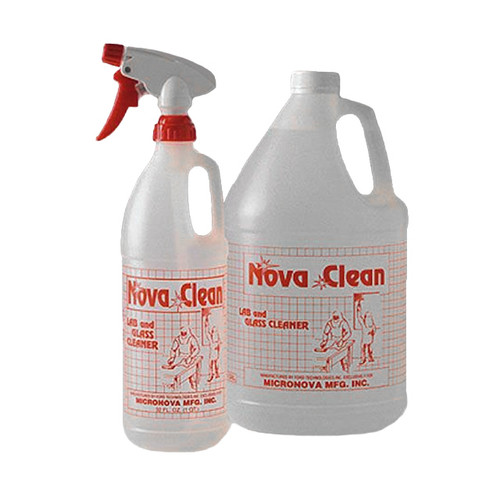
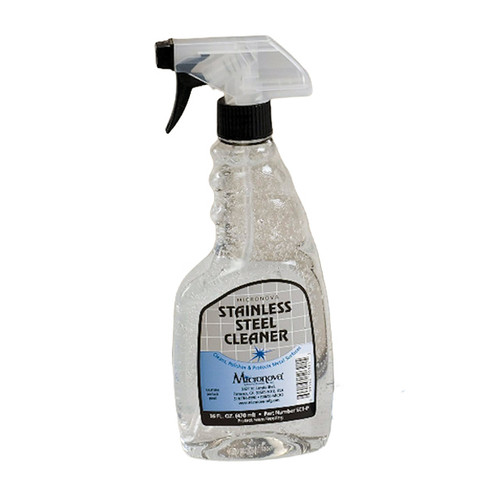
Product image shown is the SOSCleanroom listing thumbnail.
Practical solutions in a critical environment
Fast-dry surface cleaning is one of the most common “small problems that become big problems” in controlled environments:
streaked cleanroom windows that keep failing visual inspection, haze on acrylic isolator panels, vinyl softwalls that attract debris,
and stainless work surfaces that look clean but still carry a film that interferes with subsequent wipes or disinfectants.
NovaHol is a ready-to-use cleanroom cleaner that adds isopropyl alcohol to help accelerate dry time while maintaining fine filtration and low ionic characteristics.
SOSCleanroom (SOS) has been a proud distributor of Micronova for over 15 years supporting critical environments.
When customers need a dependable cleaner for routine wipe-downs (especially glass/acrylic and stainless), NovaHol is often selected to reduce dry-time bottlenecks and improve “first-pass” cosmetic results.
What this product is used for
- Routine cleaning of cleanroom hard surfaces where faster evaporation helps reduce streaking and rework.
- Cleaning glass and acrylic panels (isolators, containment cabinets, viewing windows) where a clear finish matters for daily operations.
- Wipe-down of stainless steel surfaces and equipment exteriors where visible residue can interfere with later steps (tack wiping, disinfectant contact time, or final inspection).
- Cleaning vinyl curtains and softwalls where a controlled, low-residue approach helps avoid smear patterns and attractant films.
- General controlled-environment cleaning programs spanning ISO 5 to ISO 9 areas (as stated by Micronova for this product family).
Why customers consider this product
- Fast-drying performance: formulated with isopropyl alcohol to help speed dry time on common cleanroom materials.
- Filtration and cleanliness intent: filtered to 0.1 micron with low non-volatile residue characteristics stated in Micronova product documentation.
- Controlled-environment positioning: designed for cleanrooms and controlled environments, including ISO 5 to ISO 9 areas.
- Supply-chain practicality: a gallon case format that supports routine wipe-down replenishment without frequent reordering.
- Traceability support: lot numbers printed on each case and each bottle, with Certificate of Analysis availability per Micronova documentation.
Materials, composition, and build
NovaHol is described by Micronova as a ready-to-use cleanroom surfactant with isopropyl alcohol for faster dry time, filtered to 0.1 micron,
and formulated with low non-volatile residue intent. The Micronova product specification lists the material of construction as a low ionic surfactant with 25% IPA.
The Safety Data Sheet identifies the hazardous component as propan-2-ol (isopropyl alcohol) at ≥20% to ≤25%, with the balance described as water (USP) in the SDS component listing.
This is a cleaner (detergent/surfactant-based) with alcohol added for evaporation behavior; it should not be treated as a disinfectant unless your site has validated it as part of a broader program and acceptance criteria.
Specifications in context
| Attribute |
NH1 (SOSCleanroom listing / manufacturer basis) |
| SOSCleanroom SKU |
NH1 |
| Manufacturer part number mapping |
NH1-G corresponds to 1 gallon refill bottle (Micronova documentation) |
| Format on SOSCleanroom page |
1 Gallon (4/Case); “Case Unit: 1 Gallon = 4 Bottles Per Case” |
| Filtration |
Filtered to 0.1 micron |
| IPA content |
25% IPA (product specification); SDS lists propan-2-ol ≥20% to ≤25% |
| pH |
7 at 20°C (SDS) |
| Appearance / odor |
Clear liquid; alcohol-like odor (SDS) |
| Flash point |
25.6°C / 78.1°F (SDS) |
| Evaporation / miscibility |
Evaporation rate > 1 at 20°C; fully miscible with water (SDS) |
| Availability (SOSCleanroom listing) |
7–10 business days (site listing) |
| Shipping weight (SOSCleanroom listing) |
19.00 lbs (site listing) |
| Autoclavable |
Not autoclavable (product specification) |
| Shelf life |
24 months (product specification) |
Practical note: Micronova states NovaHol is available in both quart spray bottles and gallon refill bottles. The SOSCleanroom listing provided here is the gallon case configuration.
Performance and cleanliness considerations
If your daily pain is “smear and streak,” the alcohol-assisted evaporation is the point—especially on glass/acrylic and stainless.
At the same time, NovaHol is still a surfactant-based cleaner; how you wipe matters as much as what you wipe with.
- Fine filtration: Micronova documents filtration to 0.1 micron, supporting controlled-environment expectations for routine cleaning solutions.
- Low residue intent: Micronova describes low non-volatile residue behavior; a “lighter” finish is typically achieved when the wipe method avoids re-deposit and over-wetting.
- Neutral pH basis: SDS lists pH 7 at 20°C, which is often helpful where harsh alkalinity/acidity is undesirable.
- Flammability and ventilation: SDS classifies the mixture as flammable (H226) and notes propan-2-ol content; plan use and storage accordingly.
- Not a disinfectant by default: treat as a cleaner that can remove residues/films; if your program requires microbial kill claims, that belongs to your validated disinfectant step.
Packaging, sterility, traceability, and country of origin
- Case configuration: 1 gallon bottles, 4 bottles per case (SOSCleanroom listing and Micronova product specification align).
- Packaging detail: Micronova specifies “4 bottles per poly-lined case” for NH1-G.
- Sterility / irradiation: Micronova product specification states “Not irradiated.” Sterility is not stated as provided for this product.
- Traceability: Micronova states lot numbers are printed on each case and on each individual bottle; Certificate of Analysis is provided with each order and/or available upon request.
- Country of origin: Micronova product specification states the product is manufactured at Micronova’s Torrance, California facility.
Best-practice use
The fastest way to get “clean but streaky” is to apply too much liquid and then re-wipe the same area with a saturated wiper.
The fastest way to get “clean and clear” is to control wetness, wipe direction, and the finishing pass.
Technique module: wipe-down for glass/acrylic, vinyl curtains, and stainless
- Stage and control ignition sources: NovaHol is classified as flammable; keep away from heat/sparks/open flames and ensure ventilation (per SDS).
- Choose a cleanroom-appropriate wiper: use a low-linting wipe that matches the surface (non-abrasive for acrylic and polished stainless). Avoid shop towels that shed or emboss.
- Apply with intent: for broad areas, wet the wipe rather than fogging the room with overspray. For tight targets, a light, controlled spray onto the wipe or directly onto the surface can work—then immediately wipe.
- One-direction strokes, overlap, then flip: wipe in a single direction with 20–30% overlap. Once the wipe face is loaded, flip to a clean face; do not “polish” with a dirty face.
- Finish pass for clarity: on glass/acrylic, use a final pass with a fresh dry (or lightly damp) low-linting wipe to eliminate edge streaks. On stainless, follow the surface grain where applicable.
- Vinyl curtains/softwalls: wipe top-to-bottom in controlled lanes. Avoid flooding seams and edges where fluid can wick and drip, causing “tide marks.”
- Document what matters: record lot number, area cleaned, and wipe method when the surface is part of a qualified process (inspection windows, isolator panels, critical workstations).
Common failure modes
- Streaking or haze: usually from over-wetting, re-wiping with a loaded wipe face, or letting cleaner dry unevenly on warm surfaces.
- Residue carryover into a disinfectant step: detergent films can interfere with later contact-time behavior if the wipe sequence is uncontrolled. Separate “clean” and “disinfect” steps when your program requires it.
- Material compatibility surprises: IPA-containing cleaners can haze or craze certain plastics (notably some polycarbonates) under stress. Spot-test and obtain internal approval before wide deployment.
- Safety drift: ignoring ventilation and ignition control is the fastest way to create an avoidable incident; the SDS classifies the product as flammable and an eye irritant.
Closest competitors
Competitive comparisons are most meaningful when the chemistry and intent are similar: a surfactant-based cleaner with alcohol to help speed drying on cleanroom surfaces.
- Contec Window Cleaning Solution: an IPA + surfactant blend positioned for cleanroom windows and hard surfaces (product family reference).
- Ecolab Klercide Neutral Detergent: a cleanroom-positioned neutral detergent option where alcohol content is not desired (site-dependent selection).
- 70% IPA surface cleaners: when a pure alcohol wipe-down is required rather than a detergent-cleaning step, IPA-only solutions are often specified (program-dependent and validation-dependent).
Critical environment fit for this product
- Cleanroom coverage claim basis: Micronova positions NovaHol for cleanrooms and controlled environments, including ISO 5 to ISO 9 areas.
- Where it fits best: routine “cleaning step” for visible soils, films, and smear patterns on common surfaces (glass, acrylic, vinyl curtains, stainless).
- Where it may not fit: if your area requires sterile, irradiated, or validated disinfectant usage, NovaHol may still be used as a cleaner—but only if your SOP sequence, controls, and acceptance criteria permit it.
- Quality-system alignment: use lot traceability and COA availability as part of receiving checks when surfaces are tied to qualified processes.
SOSCleanroom note about SOP's
The Technical Vault is written to help customers make informed contamination-control decisions and improve day-to-day handling technique.
It is not your facility’s Standard Operating Procedure (SOP), batch record, or validation protocol.
Customers are responsible for establishing, training, and enforcing SOPs that fit their specific risks, products, equipment, cleanroom classification, and regulatory obligations.
Always confirm material compatibility, cleanliness suitability, sterility requirements, and acceptance criteria using your internal quality system and documented methods.
If you adapt any technique guidance from this entry, treat it as a starting template. Your team should review and approve the final method, then qualify it for your specific surfaces,
solvents, cleanliness limits, inspection methods, and risk profile. In short: use these best-practice suggestions to strengthen your SOPs—not to replace them.
Source basis
- SOSCleanroom product page (NH1): https://www.soscleanroom.com/product/solutions/cleanroom-novahol-fast-drying-cleaner-novaclean-with-ipa/
- Manufacturer product page: https://micronova-mfg.com/products/detergents-cleaners/novahol-cleanroom-cleaner/
- Micronova Product Specification PDF (NovaHol NovaClean/IPA Cleanroom Detergent, Revision 001): https://micronova-mfg.com/media/1541/nh1-novahol-novaclean_ipa-cleanroom-detergent-1.pdf
- Micronova Safety Data Sheet (SDS) (NovaHol, Printing date 02/22/2024, Version 1): https://www.micronova-mfg.com/media/123324/nh1-g_q-novahol-us-english-us-rev001.pdf
- ISO (cleanroom classification reference portal): https://www.iso.org/standard/53394.html
- FDA: https://www.fda.gov/
- ASTM: https://www.astm.org/
- IEST: https://www.iest.org/
SOSCleanroom is the source for this Technical Vault entry.
Briefed and approved by the SOSCleanroom (SOS) staff.
If you have any questions please email us at Sales@SOSsupply.com
Last reviewed: January 8, 2026
© 2026 SOSCleanroom