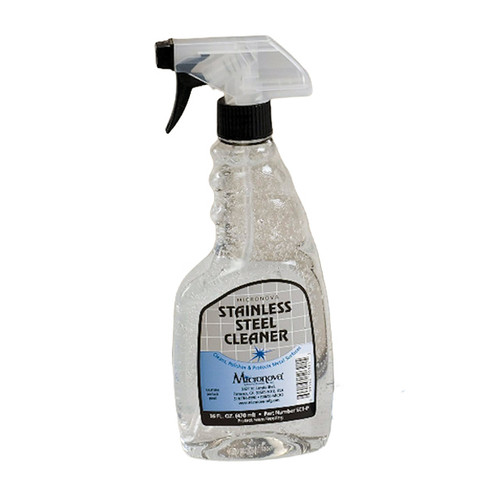
Product image shown is a manufacturer image for Stainless Steel Cleaner (SC1-P).
Practical solutions in a critical environment
Stainless is everywhere in cleanrooms: cart frames, pass-through doors, equipment skins, sink areas, gowning benches, and “high-touch” handles that show fingerprints within minutes.
The operational problem is rarely just appearance. Streaks and runs slow down room turnover, drips creep into seams and welds, and overspray can create a “mist radius” that operators have to chase down.
StainlessClean is a no-drip spray-gel cleaner designed to cling on contact, helping keep the chemistry on the metal instead of running down vertical panels or atomizing into the air.
SOSCleanroom (SOS) has been a proud distributor of Micronova for over 15 years supporting critical environments.
When customers need a stainless-focused cleaner for visible oxidation, residue build-up, and a controlled wipe-down finish, StainlessClean is frequently chosen for its gel behavior and documentation-friendly packaging.
What this product is used for
- Routine cleaning and polishing of stainless steel in controlled and support environments where drip control matters.
- Targeted removal of rust spots, oxidation, and residue build-up on stainless and other metal hard surfaces.
- Pre-treatment of seams, welds, corners, and crevices before wiping to improve cleaning efficiency.
- Vertical surfaces (doors, panels, carts, equipment sides) where thin liquids commonly run and leave streak trails.
- Controlled-environment cleaning programs across ISO 5 through ISO 9 areas (manufacturer positioning).
Why customers consider this product
- No-drip control: spray-gel clings on contact to reduce runs, drips, and overspray typical of thin liquid cleaners.
- Cleaner finish intent: designed to help reduce streaks on stainless when paired with controlled, unidirectional wiping technique.
- Indoor air quality awareness: positioned as non-atomized versus traditional liquids; helps minimize airborne “mist” during application.
- Program compatibility: designed for controlled environments (ISO 5 to ISO 9) and manufactured in an ISO 9001 certified facility.
- Traceability support: lot numbers on case and bottle, with Certificate of Analysis availability for quality documentation workflows.
Materials, composition, and build
StainlessClean is specified by Micronova as a biodegradable stainless steel gel cleaner built around a no-drip technology for routine stainless cleaning and for addressing oxidation, residue build-up, and rust.
Manufacturer documentation states the formulation contains no phosphorus and no VOCs, and is NSF rated, category A7 (metal polishes – nonfood contact).
The product specification lists the materials of construction as a gel cleanser supplied in a 16 oz spray bottle format.
The Safety Data Sheet classifies the mixture for eye irritation (Warning; “causes eye irritation”).
Operational note: stainless cleaners are typically used for soil/residue and cosmetic finish control. If your program requires microbial kill claims, that is managed through your validated disinfectant step and contact-time controls.
Specifications in context
| Attribute |
SC1-P (SOSCleanroom listing / manufacturer basis) |
| SOS SKU |
SC1-P |
| Product name (manufacturer) |
Stainless Steel Cleaner / StainlessClean™ Gel |
| Format |
No-drip spray gel stainless steel cleaner |
| Container size |
16 oz spray bottle |
| Case pack / packaging |
6 bottles per poly-lined case |
| Designed use environments |
ISO 5 through ISO 9 controlled environments (manufacturer positioning) |
| NSF rating |
NSF Category A7 (metal polishes – nonfood contact) |
| Manufacturing standards |
ISO 9001 certified facility (manufacturer documentation) |
| Autoclavability |
Not autoclavable |
| Traceability |
Lot numbers printed on each case and on each individual bottle |
| Certificates |
Certificate of Analysis provided with each order and/or available upon request |
| Availability (SOSCleanroom listing) |
7–10 business days |
| Shipping weight (SOSCleanroom listing) |
13.00 lbs |
Practical interpretation: the gel format is most valuable on vertical stainless and “detail areas” (handles, seams, welds) where liquids typically run, drip, and re-contaminate the work zone during wipe-down.
Performance and cleanliness considerations
StainlessClean is built for control: cling, glide, and wipe—without flooding the surface.
The “best” performance in cleanrooms is usually achieved when the gel stays in the lane you intend, and the wipe removes soils in a single direction rather than spreading a film.
- Non-atomized application intent: manufacturer documentation positions the gel as not atomized into ambient air, supporting cleaner application boundaries in busy rooms.
- Residue and finish: streaks often come from over-application and re-wiping with a loaded wipe face. Gel helps, but technique closes the loop.
- Surface sensitivity: polished stainless shows everything. Pair with a cleanroom-appropriate low-linting wipe or microfiber tool suited to your finish, and avoid abrasive materials that can scratch.
- Safety handling: SDS classifies eye irritation; treat this like any chemical in your cleaning program (PPE discipline, spill response readiness, and storage controls).
- Process sequencing: for validated programs, keep the “clean” step (soil removal) and “disinfect” step (microbial control) logically separated unless your SOP explicitly combines them and your qualification supports it.
Packaging, sterility, traceability, and country of origin
- Configuration: 16 oz spray bottles packed 6 per poly-lined case (manufacturer product specification and SOS listing context).
- Irradiation: manufacturer product specification states “Not irradiated.”
- Sterility: sterility is not stated in the SOS listing or manufacturer documents cited below.
- Traceability: lot numbers on case and bottle; Certificate of Analysis available (manufacturer documentation).
- Country of origin: manufactured at Micronova’s Torrance, California facility (manufacturer product specification).
Best-practice use
Stainless cleaning fails in predictable ways: too much product, circular “polishing” that redistributes film, and wiping seams last with a dirty wipe face.
A gel cleaner lets you control placement; use that advantage by controlling wipe direction and wipe face change-out.
Technique module: streak control on stainless doors, carts, and equipment skins
- Prep the lane: remove loose debris first (dry wipe or vacuum per your site practice). Grit is the fastest route to scratches on polished stainless.
- Apply intentionally: use a light, controlled spray-gel pass. For seams and crevices, apply directly into the feature so the gel can work where soils concentrate.
- Give it a short working window when needed: for oxidation spots and residue build-up, allow a brief dwell consistent with your SOP before wiping.
- Wipe unidirectionally with overlap: wipe in straight strokes with 20–30% overlap. For brushed stainless, follow the grain for best cosmetic results.
- Rotate wipe faces aggressively: fold the wipe into clean faces and rotate. If you re-wipe with a loaded face, you will polish film back onto the surface.
- Finish pass: on high-visibility stainless, a final pass with a fresh, cleanroom-appropriate wipe can remove edge streaks near handles and corners.
- Document traceability when it matters: record lot number and area cleaned when stainless surfaces are tied to qualification, audits, or customer inspection points.
Common failure modes
- Streak trails on vertical panels: typically caused by over-application or wiping downward with a saturated wipe face.
- Haze on polished stainless: often from circular wiping and re-wiping the same area with a loaded wipe face.
- Scratches: using abrasive wipes/pads, wiping across embedded grit, or using a wipe type not suited to the surface finish.
- Chemical creep into seams: flooding hinges, seams, and fastener pockets can trap chemistry and attract soils later; apply directly and sparingly where you need it.
- EHS drift: ignoring eye protection and handling guidance despite SDS eye-irritation classification.
Closest competitors
Stainless-specific cleaners and polishes are widely available. In controlled environments, the differentiators are usually drip control, residue behavior, application containment, and documentation support (lot/COA).
Common alternative product types facilities evaluate against gel stainless cleaners include:
- Stainless steel cleaner & polish aerosols: can produce broader overspray and room-air exposure; suitability depends on your EHS posture and contamination controls.
- Thin liquid stainless cleaners: can run and drip on vertical surfaces, increasing wipe rework and seam contamination risk.
- General-purpose cleanroom detergents: useful for broader soil removal, but may not provide the same stainless-focused finish behavior for oxidation and residue build-up; validate based on your acceptance criteria.
Critical environment fit for this product
- Where it fits best: stainless cleaning steps where visible streak control, drip control, and “contained application” matter (pass-through doors, carts, panels, equipment exteriors).
- Controlled-environment positioning: manufacturer positions for ISO 5 through ISO 9 cleanrooms and controlled environments.
- Documentation fit: lot marking and COA availability support receiving inspection and change-control workflows for regulated programs.
- Use discipline: if stainless surfaces are product-contact or have specific residue limits, qualify the method and any rinse/secondary wipe step per your quality system.
SOSCleanroom note about SOP's
The Technical Vault is written to help customers make informed contamination-control decisions and improve day-to-day handling technique.
It is not your facility’s Standard Operating Procedure (SOP), batch record, or validation protocol.
Customers are responsible for establishing, training, and enforcing SOPs that fit their specific risks, products, equipment, cleanroom classification, and regulatory obligations.
Always confirm material compatibility, cleanliness suitability, sterility requirements, and acceptance criteria using your internal quality system and documented methods.
If you adapt any technique guidance from this entry, treat it as a starting template. Your team should review and approve the final method, then qualify it for your specific surfaces,
solvents, cleanliness limits, inspection methods, and risk profile. In short: use these best-practice suggestions to strengthen your SOPs—not to replace them.
Source basis
- SOSCleanroom product page (SC1-P): https://www.soscleanroom.com/product/solutions/cleanroom-stainless-steel-cleaner/
- Manufacturer product page: https://micronova-mfg.com/products/detergents-cleaners/stainless-steel-cleaner/
- Manufacturer brochure / TDS PDF: https://micronova-mfg.com/media/12106/stainless-steel-cleaner-tds-micronova-1.pdf
- Manufacturer Product Specification PDF (Stainless Steel Cleaner, Revision 001, ©2019): https://micronova-mfg.com/media/1544/sc1-stainless-steel-cleaner-specification.pdf
- Manufacturer Safety Data Sheet (StainlessClean Gel, US/Canada): https://www.micronova-mfg.com/media/1912/sc1-p-stainlessclean-gel-sds-us-can-english-us.pdf
- ISO (cleanroom classification reference portal): https://www.iso.org/standard/53394.html
- FDA: https://www.fda.gov/
- ASTM: https://www.astm.org/
- IEST: https://www.iest.org/
SOSCleanroom is the source for this Technical Vault entry.
Briefed and approved by the SOSCleanroom (SOS) staff.
If you have any questions please email us at Sales@SOSsupply.com
Last reviewed: January 8, 2026
© 2026 SOSCleanroom