Peroxigen ST 9716: Sterile, double-bagged 6% hydrogen peroxide trigger spray for critical cleaning cycles
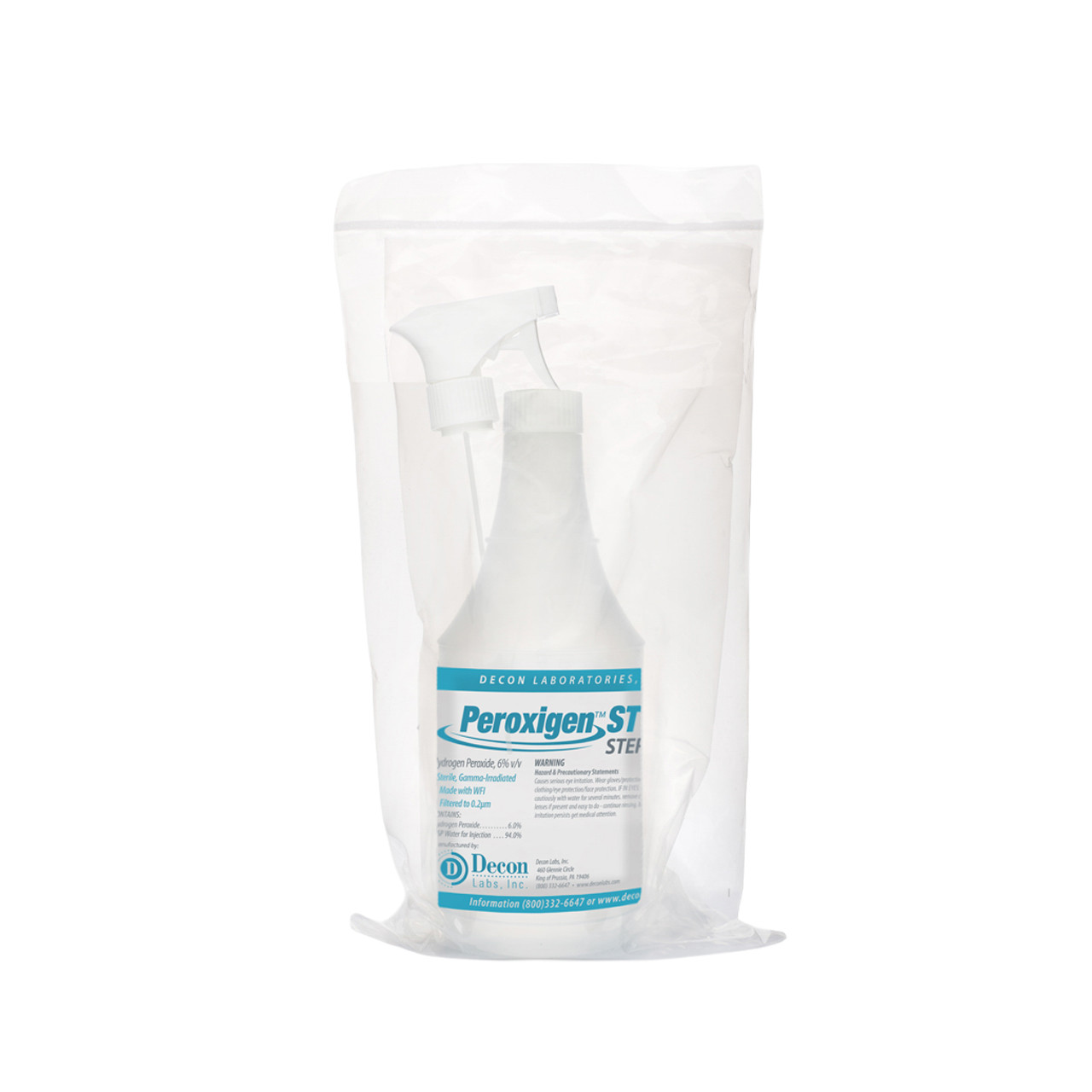
Receiving tip: use the image to confirm you received the double-bagged sterile trigger spray format before staging into higher-grade areas.
Practical solutions in a critical environment
When a surface-cleaning step is “routine” inside a cleanroom, the risk is that it gets treated like ordinary housekeeping. That is where preventable failures show up:
residue streaks that interfere with inspection, inconsistent wipe coverage around equipment seams, and re-contamination when a bottle is staged incorrectly.
Peroxigen ST is built for disciplined cleanroom execution — a sterile, ready-to-use 6% hydrogen peroxide solution made with Water for Injection (WFI), filtered to 0.2 microns,
double-bagged, and supported with lot documentation attached to every case.
SOSCleanroom has been a distributor of Decon for over 10 years supporting cleanrooms across the United States. The value for operators is straightforward: stable access to
cleanroom-intended chemistries with documentation you can file, reference, and match during receiving and QA release.
What this product is used for
- Cleaning hard, non-porous surfaces and equipment in cleanroom and controlled environments using a sterile hydrogen peroxide solution.
- Supporting cleaning/disinfection rotation programs where a low-residue oxidizing chemistry is desired and the method is validated by the facility.
- Wiping down small tools, carts, pass-through contact points, and exterior equipment panels where controlled application and consistent coverage matter.
Why customers consider this product
- Sterile, WFI-based formulation: 6% (v/v) hydrogen peroxide with 94% (v/v) USP Water for Injection (WFI).
- Cleanroom-intended processing: filtered to 0.2 microns; bottled and double-bagged within a CLASS 100 cleanroom.
- Sterility assurance you can document: gamma-irradiated to SAL 10^-6 and lot sterility tested via a USP 14-day sterility test.
- Receiving-friendly documentation: lot-specific documentation (QC, irradiation, sterility) attached to every case.
- Operational format: 16 oz (473 mL) trigger spray bottle; 12 bottles per case for predictable consumption planning.
Materials, composition, and build
Peroxigen ST is a 6% (v/v) hydrogen peroxide solution formulated with WFI. Hydrogen peroxide is an oxidizer; in practice, cleanroom teams often select it for
broad compatibility with validated cleaning programs and for the way it breaks down into water and oxygen after use when handled correctly.
The product is supplied as a trigger spray to support controlled application to wipes and to surfaces.
The most important “build detail” for a cleanroom operator is not the nozzle style — it is the contamination-control pathway: 0.2 micron filtration,
cleanroom bottling, double-bagging, irradiation, and lot-specific documentation so QA can trace what entered the room and when.
Specifications in context
Use the table below as a quick receiving/qualification checklist. If your internal method requires additional attributes (endotoxin, residue limits, TOC, microbial limits),
confirm them against your facility’s acceptance criteria and the lot documentation provided with the case.
| Attribute |
Value |
| Product name |
Peroxigen ST |
| Catalog number |
9716 |
| Active ingredient / concentration |
Hydrogen peroxide, 6% (v/v) |
| Diluent |
USP Water for Injection (WFI), 94% (v/v) |
| Presentation |
16 oz (473 mL) trigger spray bottle |
| Case pack |
12 bottles per case |
| Sterility and processing |
Filtered to 0.2 microns; bottled and double-bagged in a CLASS 100 cleanroom; gamma-irradiated (SAL 10^-6); lot sterility tested via USP 14-day sterility test |
| Shelf life |
2 years (expiration date on product) |
| SOSCleanroom availability |
21–30 business days (as listed on SOSCleanroom product page) |
| Shipping constraint |
Ground shipping only (ORM-D acknowledgment required on SOSCleanroom product page) |
Performance and cleanliness considerations
Hydrogen peroxide solutions are often selected for critical environments because they can be incorporated into validated cleaning and disinfection programs and
are typically viewed as “low residue” chemistries. Decon describes Peroxigen ST as breaking down into water and oxygen and not leaving residues when used appropriately.
In real use, residue performance is as much about technique as chemistry: over-application, under-wiping, and re-depositing soil can leave streaks that look like “residue”
even when the chemistry itself is designed to be clean.
From a contamination-control standpoint, the primary cleanliness value is the controlled production pathway (0.2 micron filtration, cleanroom bottling, sterility assurance,
and lot documentation). Use the lot packet as a receiving gate: match lot number(s), confirm sterilization/irradiation documentation is present, and file it in the same place
you store your disinfectant rotation and release records.
Packaging, sterility, traceability, and country of origin
- Packaging format: 16 oz (473 mL) trigger spray; 12 bottles per case; double-bagged.
- Sterility controls: filtered to 0.2 microns; bottled and double-bagged within a CLASS 100 cleanroom; gamma-irradiated to SAL 10^-6; lot sterility tested via USP 14-day sterility test.
- Traceability: lot-specific documentation attached to every case detailing QC, irradiation, and sterility.
- Shelf life: 2 years; expiration date printed on the product.
- Shipping: SOSCleanroom lists this item as a Consumer Commodity ORM-D shipment with ground shipping only.
- Country of origin: not published in the source basis. (Manufacturer address appears on SDS; COO is not stated.)
Best-practice use
The trigger spray format is convenient, but the best cleanroom outcomes come from disciplined application control. A practical technique that reduces variability:
apply the solution to the wipe (when your process allows) and then wipe the surface, rather than misting broadly into airflow and hoping coverage is uniform.
Use your validated contact time and application method — especially for regulated spaces.
Cleanroom-ready execution checklist (spray + wipe workflow)
- Stage and inspect: confirm outer bag integrity, then bring the item through your normal transfer process; verify lot documentation is present for the case.
- Control overspray: aim low and close; avoid spraying upward toward HEPA returns or directly into active airflow paths.
- Prefer “wet the wipe” for critical surfaces: spray the wipe until uniformly damp (not dripping) and wipe in consistent, overlapping strokes with one-directional coverage.
- Manage the wipe face: fold into clean quadrants; do not reintroduce a dirty face to a cleaned area; replace wipes before they become overloaded.
- Edge and hardware discipline: slow down at seams, fasteners, and handles; these are common skip zones during routine cleaning.
- Closeout: recap/secure the trigger head, store per site practice, and document the lot used when your quality system requires traceability at the room or batch level.
Material compatibility is always your responsibility: oxidizers can be incompatible with some metals, coatings, elastomers, or sensitive components depending on exposure.
Confirm compatibility and acceptance criteria using your internal quality system and documented methods.
Common failure modes
- “Cleaned” but not covered: spraying from too far away creates a fine mist and uneven deposition; wipe coverage becomes inconsistent and corners get missed.
- Re-contamination by nozzle contact: the trigger head touches a surface or glove and then becomes the next contamination source; treat the nozzle as a controlled surface.
- Over-wetting: excess liquid runs into seams and crevices, creating dry-down marks or pulling soil back onto a “clean” surface.
- Ignoring expiration dating: peroxide strength can drift with time and storage; do not use beyond labeled expiration.
- Unvalidated substitution: changing chemistry, concentration, or application method without a controlled change process undermines compliance and trending data.
Closest competitors
In the sterile 6% hydrogen peroxide space, customers typically compare based on sterility assurance pathway (filtration + environment + terminal sterilization),
packaging configuration (single vs. double/triple bagged), documentation discipline, and how the format fits the facility’s validated method.
- STERIS 6% Hydrogen Peroxide WFI Sterile Solution: sterile WFI-based 6% hydrogen peroxide offerings in cleanroom packaging formats.
- Ecolab Klercide Low Residue Peroxide (WFI blend): 6% hydrogen peroxide blended with WFI in sterile cleanroom-intended presentations.
- Veltek STERI-PEROX 6%: 6% hydrogen peroxide sterile solutions supplied for cleanroom rotation programs.
If your program depends on consistent receiving gates and documentation filing, Peroxigen ST’s “lot packet attached to every case” detail is operationally meaningful.
It reduces the chance that documentation gets separated from product during staging, quarantine, or stocking transitions.
Critical environment fit for this product
Peroxigen ST is positioned for pharmaceutical, biotechnology, and medical device cleanrooms where a sterile hydrogen peroxide solution is required for surfaces and equipment.
The processing details (0.2 micron filtration, cleanroom bottling, SAL 10^-6, and lot sterility testing) align with environments that treat cleaning as a controlled operation,
not a discretionary task. As always, the right “fit” is defined by your internal qualification: surfaces, residues, microbial strategy, contact time, and acceptance criteria.
Standards bodies and industry organizations (ISO and IEST) are commonly referenced when building contamination-control programs; regulated facilities may also align cleaning and
documentation expectations to FDA-facing quality systems. Use the Source basis links to ground your documentation package and cross-reference your internal procedures.
SOSCleanroom note about SOP's
The Technical Vault is written to help customers make informed contamination-control decisions and improve day-to-day handling technique.
It is not your facility’s Standard Operating Procedure (SOP), batch record, or validation protocol.
Customers are responsible for establishing, training, and enforcing SOPs that fit their specific risks, products, equipment, cleanroom classification, and regulatory obligations.
Always confirm material compatibility, cleanliness suitability, sterility requirements, and acceptance criteria using your internal quality system and documented methods.
If you adapt any technique guidance from this entry, treat it as a starting template. Your team should review and approve the final method, then qualify it for your specific surfaces,
solvents, cleanliness limits, inspection methods, and risk profile. In short: use these best-practice suggestions to strengthen your SOPs—not to replace them.
Source basis
- SOSCleanroom product page: https://www.soscleanroom.com/product/solutions/peroxigen-st-9716-is-a-sterile-double-bagged-ready-to-use-6-hydrogen-peroxide-solution-in-a-convenient-trigger-spray-bottle-16-oz/
- Manufacturer product page (Decon Labs): https://deconlabs.com/products/peroxigen-st/
- Technical Data Sheet (SOS-hosted PDF, primary stable copy): https://www.soscleanroom.com/content/Decon_pdf/Peroxigen%20ST%20Tech%20sheet.pdf (dated 12/21/2016 on the document)
- Technical Data Sheet (manufacturer PDF): https://deconlabs.com/tds/Peroxigen%20ST%20Tech%20sheet.pdf
- Safety Data Sheet (SOS-hosted PDF, primary stable copy): https://www.soscleanroom.com/content/Decon_pdf/Peroxigen%20ST_SDS.pdf (Date of Revision: 05/01/2018 on the document)
- Safety Data Sheet (manufacturer PDF): https://deconlabs.com/sds/Peroxigen%20ST_SDS.pdf
- ISO (cleanroom standards body reference): https://www.iso.org/standard/53394.html
- FDA (regulatory body reference): https://www.fda.gov/
- ASTM (standards body reference): https://www.astm.org/
- IEST (contamination-control guidance body reference): https://www.iest.org/
SOSCleanroom is the source for this Technical Vault entry.
Briefed and approved by the SOSCleanroom (SOS) staff.
If you have any questions please email us at Sales@SOSsupply.com
Last reviewed: January 8, 2026
© 2026 SOSCleanroom