The Technical Vault
Sterile Quat Disinfectant · EPA-Registered Claims · Contact-Time Discipline · ISO/USP/Annex 1 Mindset
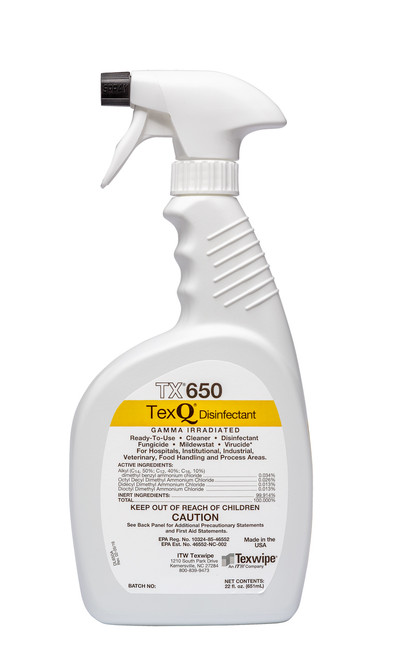
Texwipe TX650 TexQ® Sterile Disinfectant (Ready-to-Use) — 22 oz Trigger Spray (12/Case)
Texwipe TX650 TexQ® is a ready-to-use, sterile, gamma-irradiated quaternary ammonium (quat) one-step cleaner/disinfectant supplied in a
fully assembled 22 oz trigger-spray bottle. It is positioned for routine controlled-environment disinfection where repeatable application,
documented execution, and EPA label compliance (wet-contact time by organism) are required.
At-a-glance (published attributes)
- Part number: TX650
- Solution type: Quaternary Ammonium (Quat) disinfectant / cleaner (ready-to-use)
- Sterile: Yes (gamma irradiated; sterile validated per manufacturer guidance)
- Filtration: 0.2 µm filtered
- Format: Fully assembled 22 oz trigger spray bottle
- Case pack: 12 bottles per case
- EPA registration: EPA Reg. No. 10324-85
- Fragrance / dye: Fragrance free; dye free
- Active ingredients (per SDS excerpt on product page):
Quaternary ammonium compounds, benzyl-C12-16-alkyldimethyl, chlorides (≤0.3%); Dimethyldioctylammonium chloride (≤0.1%)
- Shelf life (manufacturer guidance on product page): 2 years (expiration date shown on label), including after opening/spraying
- Sales restriction: For sale only in the United States
1) Where TX650 fits in a contamination control strategy
Quat disinfectants are commonly used as a routine disinfectant step for hard, non-porous surfaces (equipment exteriors, worktables, carts,
racks, shelving, and touch points). TX650’s ready-to-use sterile format is typically selected to reduce variability associated with dilution/mixing and to
support controlled-environment handling where sterile packaged disinfectants are required by SOP.
Important scope note (accuracy-first)
A quat disinfectant is not automatically a sporicide. Many validated programs use quat chemistry for routine disinfection and add a
separate sporicidal step on a defined schedule based on risk assessment and facility CCS/SOPs.
2) Standards alignment (USP, ISO, Annex 1) — educational reference
In regulated cleanrooms, compliance is built on validated procedures, trained behavior, and documentation control.
USP <797> and USP <800> expect cleaning/disinfection activities to be governed by SOPs (agent selection, technique, frequencies, PPE),
and EU GMP Annex 1 emphasizes a contamination control strategy (CCS), validated disinfection processes, and disciplined operator practices.
ISO cleanroom operations guidance similarly supports an operations control program covering personnel practices, cleaning, and material movement.
Key compliance reality: standards do not “approve” a specific disinfectant brand. Facilities must select, qualify, and document disinfectants
and then execute exactly as validated (including dwell time and wipe technique).
3) What actually drives performance (EPA label discipline)
Disinfectants most often “fail” operationally due to missed wet-contact time, poor wiping technique (re-deposition), and weak documentation across shifts.
TX650 is positioned to reduce those variables with a ready-to-use format and a functional-use label concept (e.g., open date/initials) as part of a
documentation-driven program.
Best-practice use (audit-resilient technique)
- Confirm dwell time on the current EPA label/TDS: contact time varies by organism—your SOP must match the label.
- Spray-to-wipe for control: in sensitive zones, wet a sterile wiper (damp, not dripping) and wipe to reduce overspray/aerosolization.
- One direction + overlap: straight strokes with overlap; rotate to a fresh wipe face often to prevent re-depositing soils.
- Keep the surface visibly wet: if it dries early, re-apply per your SOP to maintain the validated wet-contact condition.
- Follow with sterile 70% IPA when required: many programs use IPA as a “finish” step to manage residues and standardize surface state (per SOP).
4) Donning discipline & PPE interface control
In critical environments, deviations commonly trace to touch events and interface gaps (adjusting eyewear/hoods, contacting non-controlled objects,
poor glove–sleeve overlap). Ensure personnel are fully gowned before introducing disinfectants into ISO-classified areas, and define glove sanitization,
re-entry, and “touch-event” recovery steps in SOPs.
5) System pairings (repeatable wipe-down discipline)
TX650 is typically paired with sterile, low-linting cleanroom wipers and a validated PPE system. Final selection must match your ISO class, surface set,
residue limits, and SOP validation.
6) Selection notes (why teams standardize TexQ RTU)
- Reduces dilution risk: ready-to-use chemistry supports consistent execution versus in-house dilution practices.
- Supports documentation discipline: lot traceability plus functional-use labeling concepts help standardize shift-to-shift control.
- Rotation-program fit: quat chemistry is commonly used as the routine disinfectant step within broader rotation strategies (per CCS/SOP).
- Controlled-environment handling: sterile, gamma-irradiated positioning supports aseptic programs requiring sterile-packaged disinfectants.
7) Surface compatibility (validate — don’t assume)
Even “mild” disinfectants can interact with certain labels, inks, adhesives, coatings, and plastics. Treat compatibility as a qualification activity:
test on representative materials, define acceptance criteria, and document outcomes in SOPs before broad deployment.
Disclaimer: This Technical Vault content is provided for educational and reference purposes only. It does not constitute regulatory, quality,
engineering, environmental health & safety, or legal advice. Disinfectant selection, EPA label compliance, required wet-contact time, application
technique, residue controls, rotation strategy, PPE requirements, and all related procedures must be defined, validated, and documented by the end user
in accordance with internal SOPs, risk assessments, and applicable standards and regulations. Always follow manufacturer instructions and the current
label/TDS/SDS.
© 2026 SOS Supply. All rights reserved.