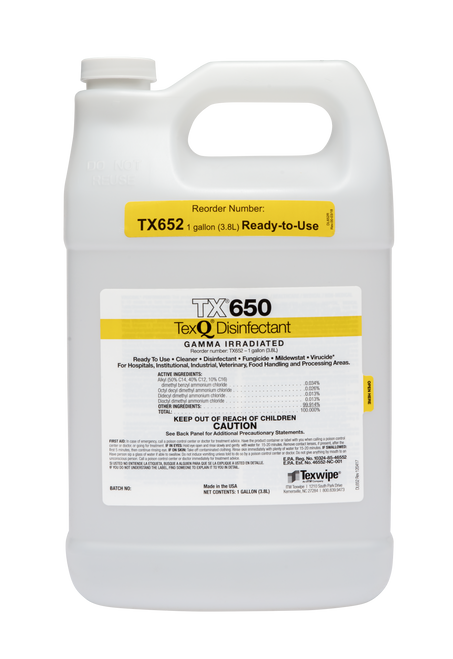
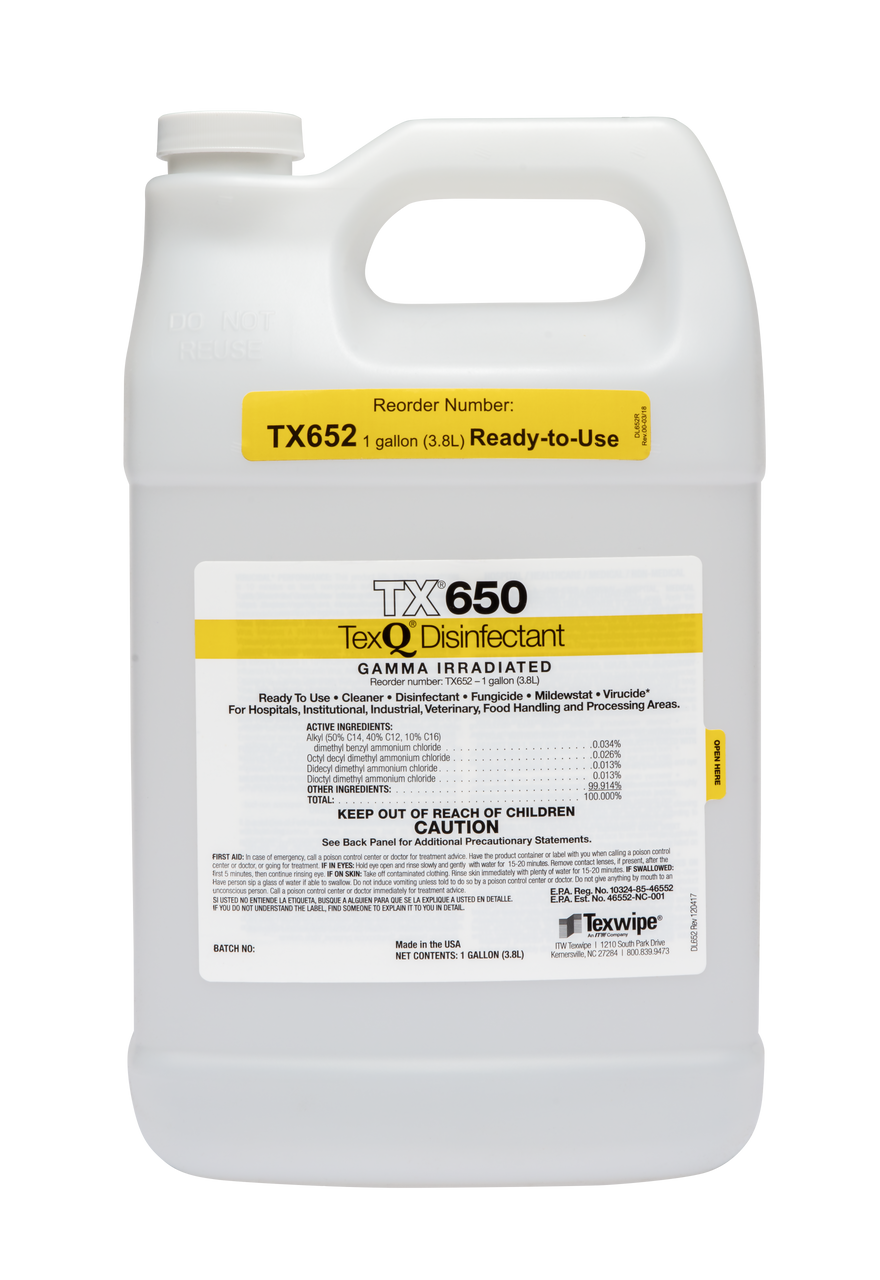
Texwipe TX652 TexQ Sterile Disinfectant Ready-to-Use (1 Gallon Bottle, 4/Case)

$235.61
(No reviews yet)
SKU:
TX652
Availability:
Stock Item
Shipping:
Calculated at Checkout
Quantity Option (Case):
Four (1 Gallon) Bottles Per Case
Solution Type:
Quaternary Ammonium
Sterile:
Yes

Texwipe TX652 TexQ Sterile Disinfectant Ready-to-Use — 1 Gallon Bottle (4/Case)

Texwipe TX652 is a sterile, ready-to-use TexQ® quaternary ammonium (Quat / QAC) cleaner-disinfectant supplied in a 1-gallon bottle format for higher-throughput cleaning and disinfection of hard, non-porous surfaces in controlled environments. TexQ is positioned as a one-step cleaner/disinfectant with broad-spectrum efficacy (61 kill claims) and mold/mildew control when used as directed. Each bottle is gamma irradiated to support sterile-use workflows and is packaged to help contamination-control teams standardize disinfection with consistent chemistry, controlled filtration, and documentation-friendly labeling.

Important: All TexQ products are now gamma irradiated. Follow the EPA label for required wet-contact time, application method, and approved surface types. This product is intended for sale only in the United States.

Specifications:
  • Part number: TX652
  • Product family: TexQ® Disinfectant (Ready-to-Use)
  • Solution type: Quaternary Ammonium (Quat / QAC)
  • Sterile: Yes (gamma irradiated)
  • Format: Ready-to-use (no dilution required)
  • Container size: 1 gallon bottle
  • Case pack: Four (1 gallon) bottles per case
  • Weight: 36.00 lbs (case)
  • Filtration (manufacturer literature): 0.2 micron filtered
  • Fragrance / dye: Free of dyes and fragrance
  • pH (manufacturer literature): Neutral pH
  • Efficacy positioning (manufacturer literature): 61 kill claims; broad spectrum bacteria/virus/fungi efficacy; mold and mildew control (includes an Aspergillus niger kill claim) when used as directed
  • Documentation aid: Functional use label on bottle to record date opened and operator initials
  • Regulatory positioning: EPA registered one-step cleaner/disinfectant (see TDS/SDS/label for details)
About the Manufacturer: 

TexQ® disinfectants are produced by ITW Texwipe, a worldwide leader in contamination-control products and critical cleanroom supplies. In the TexQ line, the manufacturer emphasizes a controlled, repeatable approach to surface disinfection: a defined quaternary ammonium formulation, 0.2 micron filtration, ready-to-use packaging, and gamma irradiation for sterile-use workflows, supported by technical documentation (TDS/SDS) and protocol materials used in pharmacy and controlled-environment programs.


For cleanroom operators, the one-gallon format is commonly selected when coverage-per-container matters: floors, walls, ceilings, carts, racks, shelving, and other hard, non-porous surfaces where you want consistent chemistry and fewer change-outs. Pair the solution with compatible low-linting cleanroom wipers (no wiper is truly “zero-lint” in every process condition) and disciplined wipe technique to reduce re-deposition and improve lot-to-lot cleaning consistency.

TexQ Features:
  • 61 kill claims: Proven efficacy against common bacteria, viruses, and fungi when used as directed
  • Gamma irradiated: Positioned for compliance with GMP and FDA sterilization requirements in sterile-use workflows
  • One-step cleaner/disinfectant: Cleans and disinfects in one step to reduce handling steps and simplify SOP execution
  • Complex formulation: Designed for uniform and complete disinfection of surfaces
  • Mold and mildew control: Includes an Aspergillus niger kill claim and inhibits mold/mildew odors when used as directed
  • Free of dyes and fragrance: Reduced risk of added scent/color contamination and respiratory irritation concerns
  • Functional use label: Easy documentation and usage control (record date opened and operator initials)
  • Neutral pH: Positioned as not aggressive on surfaces and safe for operations (verify compatibility to your materials)
  • EPA registered: Kill claims provide assurance of disinfection efficacy when used per label directions
TexQ Benefits:
  • Simplifies disinfection execution: Ready-to-use chemistry helps standardize results across operators and shifts and reduces dilution error risk.
  • Supports rotation programs: Commonly used as part of routine disinfectant rotation strategies in controlled environments (per site SOP).
  • Operationally practical at scale: One-gallon packaging reduces bottle-change frequency for larger surfaces and higher-consumption stations.
  • Documentation-friendly: Label space for date opened and initials supports traceability, audits, and day-to-day compliance habits.

Use-direction reminder: Disinfectant performance is label-driven. Confirm the required wet-contact time for your target organisms, keep the surface visibly wet for the full contact time, and follow site SOPs for wipe change-out frequency, re-entry timing, and residue management.

Common Applications:
  • Cleaning and disinfecting hard, non-porous surfaces
  • Cleaning and disinfecting small surfaces (tables, equipment, isolators, hoods)
  • Cleaning and disinfecting large surfaces (floors, walls, ceilings)
  • Controlled-environment wipe-down programs in biotechnology, hospitals, medical device manufacturing, pharmaceutical manufacturing, and pharmacies
Best-Practice Use:
  • Wet-contact time discipline: Apply enough solution to keep the surface visibly wet for the full label-required contact time for your target organisms.
  • Use straight-line wiping: Wipe in one direction with overlapping strokes; rotate to a clean wipe face frequently to avoid re-depositing soil.
  • Work from clean-to-less-clean zones: Sequence cleaning to reduce cross-contamination (e.g., higher surfaces and cleaner zones first, then lower/traffic surfaces).
  • Document opening and use: Use the bottle label to record the date opened and operator initials as part of routine compliance habits.
  • Compatibility check: Verify compatibility with plastics, coatings, elastomers, adhesives, and sensitive finishes before broad deployment; confirm any residue expectations and follow any required rinse/wipe-back steps per SOP.
Selection Notes (This 1 Gallon Sterile RTU Quat vs. Other Options)
  • 1 gallon vs. trigger spray: Choose 1 gallon when higher coverage per container and fewer change-outs matter; choose trigger spray when point-of-use control and fast deployment at benches/carts is the priority.
  • Ready-to-use vs. concentrates: Ready-to-use formats reduce dilution/handling variables and are easier to standardize across shifts; concentrates can be preferred when allowed by SOP and when on-site dilution controls are in place.
  • Where it fits in rotation: Many facilities rotate disinfectant chemistries; confirm your rotation plan, compatibility expectations, and residue management steps with QA and site SOPs.
Other Similar Products Available From SOSCleanroom.com

TexQ Disinfectants

  • TX650: TexQ Sterile Disinfectant Ready-to-Use (RTU), 22 oz trigger spray, 12 bottles/case
  • TX652: TexQ Sterile Disinfectant Ready-to-Use (RTU), 1 gallon bottle, 4 bottles/case
  • TX651: TexQ disinfectant concentrate, 1 gallon concentrate, 4 bottles/case (discontinued by manufacturer; see TX650 and TX652)

Notes: If you are standardizing a disinfectant rotation program, need guidance on wipe selection for Quat application, or want help mapping contact-time requirements to real operator technique, contact SOSCleanroom for practical selection support backed by responsive service and dependable supply.

SOSCleanroom.com supports contamination-control programs with cleanroom consumables in stock, fair pricing, and customer service that understands real cleanroom workflows.

Product page updated: Jan. 7, 2026 (SOS Technical Staff)

© 2026 SOS Supply. All rights reserved.

The Technical Vault Sterile Quat Disinfectant · 1-Gallon Throughput · Dwell-Time Discipline · ISO/USP/Annex 1 Mindset

Texwipe TX652 TexQ® Sterile Disinfectant (Ready-to-Use) — 1 Gallon Bottle (4/Case)

Texwipe TX652 is a sterile, ready-to-use TexQ® quaternary ammonium (Quat / QAC) one-step cleaner/disinfectant supplied in a 1-gallon (3.8 L) bottle format for higher-throughput cleaning and disinfection of hard, non-porous surfaces in controlled environments. The TexQ RTU line is positioned around repeatable execution: no on-site dilution, 0.2 µm filtration, gamma irradiation for sterile-use workflows, and a functional-use label designed to support practical documentation discipline (open date + operator initials).

At-a-glance (published attributes)
  • Part number: TX652
  • Product family: TexQ® Disinfectant (Ready-to-Use)
  • Solution type: Quaternary Ammonium (Quat / QAC)
  • Sterile: Yes (gamma irradiated; sterility assurance framework noted as SAL 10−6)
  • Format: Ready-to-use (no dilution required)
  • Container size: 1 gallon bottle (3.8 L)
  • Case pack: Four (1 gallon) bottles per case
  • Filtration (manufacturer literature): 0.2 µm filtered
  • Fragrance / dye: Dye free; fragrance free
  • pH (manufacturer literature): Neutral pH
  • Efficacy positioning (manufacturer literature): broad-spectrum bacteria/virus/fungi efficacy; 61 kill claims; mold/mildew control when used as directed
  • Contact time guidance: label/TDS lists organism-specific dwell times (examples vary; build SOP around your target organisms and required wet time)
  • Functional-use label: supports recording date opened and operator initials
  • Shelf life: 2 years (expiration date on label), including after opening/dispensing, per manufacturer TDS
  • Regulatory positioning: EPA-registered, one-step cleaner/disinfectant (follow the current label for claims, dwell times, and directions)
  • Country of origin (manufacturer literature): Made in USA
  • Sales restriction: Intended for sale only in the United States

1) Where TX652 fits in a contamination control strategy

Quat disinfectants are commonly selected as a routine disinfectant step for hard, non-porous surfaces (equipment exteriors, work tables, carts, racks, shelving, stainless, glass, and qualified plastics). The TX652 1-gallon format is typically used when programs scale: fewer bottle change-outs, steadier lot continuity, and fewer mid-shift substitutions that can create change-control noise.

Important scope note (accuracy-first)

A quat disinfectant is not automatically a sporicide. Many validated programs use quat chemistry for routine steps and add a separate sporicidal chemistry on a defined schedule as part of a documented rotation strategy (per CCS/SOP and risk assessment).

2) Standards alignment (USP, ISO, Annex 1) — educational reference

In regulated cleanrooms, performance is audited as process control: written procedures, trained behavior, and repeatable execution. USP <797> and USP <800> expect cleaning/disinfection activities to be governed by SOPs (agent selection, technique, frequencies, PPE). EU GMP Annex 1 emphasizes contamination control strategy (CCS), validated disinfection processes, and disciplined operator practices. ISO cleanroom operations guidance supports an operations control program covering personnel practices, cleaning, and material movement.

Key compliance reality: standards do not “approve” a specific disinfectant brand. Your facility must select, qualify, document, and train on the exact chemistry, dwell time, and wiping method used in your rooms.

3) 1-gallon format = dispensing discipline (define this in SOP)

Bulk containers help throughput, but they also create audit risk if teams “freestyle” how solution is dispensed. A strong program defines how TX652 is applied (direct pour to wiper, dispensing into qualified bottles, or controlled application tools) and prevents process drift.

Controls to include (common audit-grade practices)
  • Qualified containers only: if transferring, use cleanroom-appropriate, facility-qualified bottles/triggers rated for QAC chemistry.
  • No “top-off” behavior: do not refill partially used bottles unless your SOP allows it under validated controls.
  • Traceability: keep lot/expiration linkage from the original bottle to point-of-use containers (labels/logs per SOP).
  • Open-date discipline: use the functional label fields (open date + operator initials) as part of zone control and investigation readiness.
  • Return rules: define what happens if a bottle exits a higher-grade zone (return vs. discard) and how exterior contamination is managed.

4) What drives real performance: dwell time + wipe discipline

Disinfectants most often “fail” operationally due to missed wet-contact time, poor wipe technique (re-deposition), and uncontrolled overspray. Build your method around one defensible rule: keep the surface visibly wet for the full dwell time required by the current label/TDS claims relevant to your risk assessment.

Best-practice wiping method (repeatable, teachable)
  • Control overspray: in sensitive zones, many teams wet a sterile wiper and apply to the surface rather than spraying into airflow (follow label and facility policy).
  • One direction + overlap: straight-line strokes with overlap; rotate to a fresh wipe face frequently.
  • Clean-to-less-clean sequencing: top-to-bottom and inside-to-outside patterns reduce cross-contamination.
  • Residue control (if required): if your method includes a “finish” step, define and qualify it (many programs use sterile 70% IPA wipe-down per SOP).

5) Donning discipline & PPE interface control

In critical environments, deviations often trace to touch events and interface gaps (adjusting eyewear/hoods, contacting non-controlled objects, poor glove–sleeve overlap). Ensure personnel are fully gowned before introducing disinfectants into ISO-classified areas, and define glove sanitization, re-entry, and touch-event recovery steps in SOPs.

6) Suggested system pairings (consistent wipe-down discipline)

TX652 is most effective when paired with sterile, low-linting cleanroom wipers and a validated PPE barrier system. Final selection must match your ISO class, residue limits, and SOP validation.

7) Receiving & QA quick-checks (practical)

  • Confirm case count (4 bottles) and container integrity (caps, seals, no leakage).
  • Verify legible lot and expiration markings and file the current TDS/SDS/label revision per your documentation practice.
  • Train one standard wipe pattern and spot-check technique on the floor—most failures are behavioral, not chemical.

8) Safety and handling (non-negotiables)

SDS control + chemical sequencing

Always follow the current EPA label and current SDS for hazards, PPE, ventilation, spill response, and disposal guidance. Do not assume chemistry-to-chemistry compatibility; define any sequencing (e.g., follow-on sterile IPA finish step) in your SOP and qualify it on your real surface set.


Disclaimer: This Technical Vault content is provided for educational and reference purposes only. It does not constitute regulatory, quality, engineering, environmental health & safety, or legal advice. Disinfectant selection, EPA label compliance, organism-specific wet-contact time, application technique, residue controls, rotation strategy, transfer/dispensing controls, PPE requirements, and all related procedures must be defined, validated, and documented by the end user in accordance with internal SOPs, risk assessments, and applicable standards and regulations. Always follow manufacturer instructions and the current label/TDS/SDS.

© 2026 SOS Supply. All rights reserved.