Practical solutions in a critical environment
In HPLC-based cleaning validation, “bad data” is often created long before the vial hits the autosampler. Sampling failures usually come from preventable variables: inconsistent contact mechanics, inconsistent wetness, uncontrolled handling, and weak chain-of-custody discipline (late labels, open containers, or improvised transport). When residue limits tighten and reporting thresholds drop, the sampling system becomes part of the analytical method — meaning the kit, the swab head, the vial closure, and the technique can become the dominant source of variability.
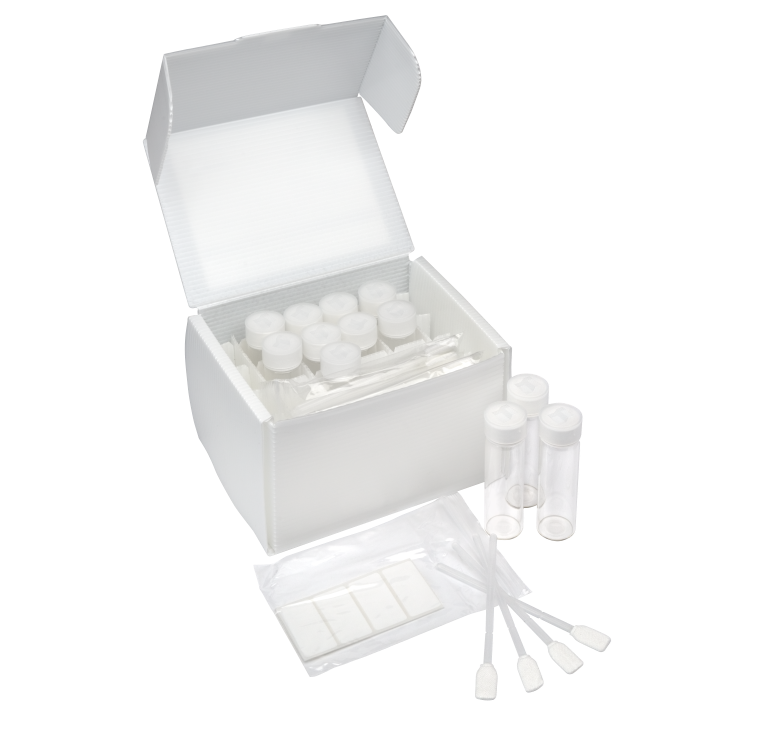
TX3360 is built to reduce those avoidable variables by standardizing the field sampling “system.” It combines pre-washed 40 mL borosilicate vials with bonded septa caps (with a protective polyethylene over-cap), cleanroom-compatible labels, and a validated sampling swab platform (TX718) packaged together in a double-bagged cleanroom-compatible polypropylene box. The goal is fewer handling events, fewer ad-hoc substitutions, and a cleaner line-of-sight from equipment ID to sample ID to lab result.
Low-linting outcomes remain technique-dependent. No swab is truly lint-free; sharp edges, surface roughness, solvent load, contact pressure, and stroke discipline determine what ends up in your extraction solvent and what shows up as background.
What is this kit used for
Texwipe TX3360 is used to collect surface samples for HPLC/UV-Vis cleaning validation and other surface and cleaning validation protocols where you need controlled recovery, controlled handling, and defensible sample traceability. The kit is designed for workflows that require quantification of a specific residue class (for example, an API, excipient, detergent component, disinfectant component, or processing chemical) using a validated or verified analytical method.
TX3360 also supports surface preparation and investigative sampling where very low background contribution is important. The kit format is particularly helpful when multiple sampling locations must be collected consistently across a batch, campaign, or shift and transported to a lab with minimal contamination risk.
Why should customers consider this kit
- System approach: vials, swabs, and labels are organized together to reduce handling errors and “mix-and-match” variability at the point of use.
- Pre-washed borosilicate vials with bonded septa caps and a protective polyethylene over-cap help protect the closure surface until analysis.
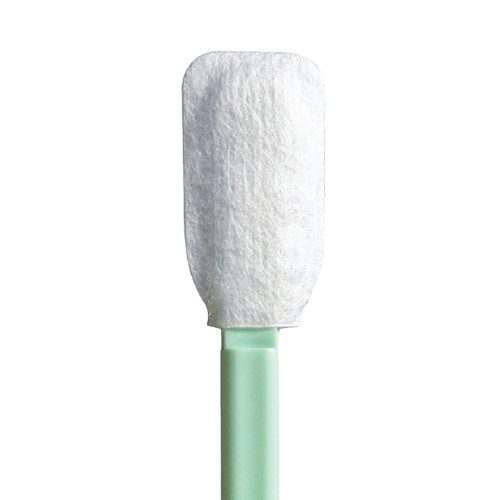
- TX718 knit polyester swab geometry supports flat, repeatable surface contact for defined-area sampling with controlled stroke overlap.
- Published contamination characteristics (typical ionic extractables and NVR) support realistic blank expectations during method development and troubleshooting.
- Double-bagged, cleanroom-compatible packaging reduces introduction risk and supports cleaner transfers into controlled areas.
- Lot-coded packaging and label discipline support investigations, deviations, and requalification work without guesswork.
Materials and construction
Sampling swab platform (TX718): polyester knit head; thermal head bond; 100% polypropylene handle; handle color: translucent; handle embossed “CleanTips® Sampling Swab.”
Vials: 40 mL clear borosilicate glass, pre-washed.
Caps/septa: one-piece cap-and-septum design; septum thickness 1.34 mm (0.053"); polyethylene protective over-cap.
Labels: cleanroom-compatible labels for sample identification and traceability.
Practical implication: your sampling system is only as clean as the highest-risk touchpoint. Treat vial openings, septa surfaces, and the “below-the-notch” handle zone as critical control points. If your process is residue-sensitive at low UV wavelengths or at trace levels, the right construction features help — but disciplined technique is what keeps backgrounds stable lot-to-lot and operator-to-operator.
Specifications in context
TX3360 performance is governed by contact mechanics (the TX718 head geometry and stiffness), wetness control (how much diluent is carried into the sampling area), and extraction discipline (solvent volume, agitation/sonication if used, and hold-time control). Use dimensional data as process inputs. A head that is too small drives more passes and more variability. A head that is too thick can bridge grooves and miss residues. A handle that flexes changes pressure and recovery. The goal is repeatable, auditable sampling — not maximum scrubbing force.
| Attribute |
TX3360 / TX718 |
| Kit components (per kit) |
12 vials (40 mL) with bonded septa caps; 30 TX718 sampling swabs; 12 blank vial labels |
| Packaging |
18 kits/case; double-bagged; cleanroom-compatible polypropylene box |
| Vial/septum feature |
One-piece cap-and-septum; septum thickness 1.34 mm (0.053"); polyethylene protective over-cap |
| Swab head material |
Polyester knit |
| Head width |
12.70 mm (0.500") |
| Head thickness |
4.20 mm (0.165") |
| Head length |
25.70 mm (1.012") |
| Handle material |
100% polypropylene |
| Handle length |
101.80 mm (4.008") |
| Total swab length |
127.50 mm (5.020") |
| Head bond |
Thermal |
| Handle color / marking |
Translucent; embossed “CleanTips® Sampling Swab” |
Cleanliness metrics
The values below are published analytical results and should be treated as typical background indicators — not per-unit acceptance specifications. Use them to set blank expectations during method development, spike-and-recovery work, and troubleshooting. If your method is sensitive at low UV wavelengths or your limits are near your detection threshold, qualify the full sampling workflow (swab + diluent + extraction vessel + agitation + hold times) so the sampling system does not dominate your baseline.
Typical ion extractables (µg/swab) — TX718
| Ion |
Value |
| Calcium | 0.0031 |
| Chloride | 0.0012 |
| Fluoride | 0.0066 |
| Magnesium | 0.0023 |
| Nitrate | 0.0041 |
| Phosphate | 0.0049 |
| Potassium | 0.0054 |
| Sodium | 0.0055 |
| Sulfate | 0.0035 |
Typical nonvolatile residue (NVR) (mg/swab) — TX718
| Extractant |
Value |
| IPA extractant | 0.0075 |
Operator takeaway: don’t let “very low background” become a license to over-wet or overwork the surface. Keep the head damp, keep strokes defined, and protect the vial closure surface. If blanks drift upward over time, investigate technique, environment, diluent handling, and hold times before blaming the chromatography.
Packaging, sterility and traceability
- Kit configuration: 12 vials (40 mL) with bonded septa caps; 30 TX718 swabs; 12 blank vial labels.
- Case pack: 18 kits/case.
- Packaging discipline: double-bagged kit; cleanroom-compatible polypropylene box supports controlled transport and introduction.
- Sterility: non-sterile. If sterile sampling is required, use a sterile system validated for your analyte, extraction solvent, and hold-time conditions; do not assume a direct one-for-one substitute.
- Shelf life and storage: 5 years from date of manufacture; store at ambient 59°F (15°C) to 86°F (30°C).
- Traceability cues: lot-coded packaging supports investigations; labels support chain-of-custody documentation from sampling site to lab.
Best-practice use
Treat sampling like a controlled manufacturing step: define the sampling map, define the area, define the wetness method, define the stroke pattern, and define discard triggers. The objective is reproducible recovery that is defendable in audits and investigations — not maximum “cleaning power” during sampling.
Operator-level swabbing technique module
- Area definition: Use templates or measured boundaries to control the sampled surface area. Sampling without a controlled area makes recovery calculations and trending difficult to defend.
- “Damp” diluent technique: Dampen the swab with the validated diluent — do not soak. You want a light, even wet track, not pooling. Over-wetting can spread residue, dilute recoveries, and increase background contribution.
- Stroke pattern discipline: Use overlapping strokes in a defined pattern (commonly parallel passes, then a perpendicular pass) per your procedure. Rotate or flip to a clean face early. Avoid circular scrubbing unless your SOP specifically calls for it.
- Notch and transfer control: Treat the notch as a contamination-control boundary. After sampling, snap at the notch and allow the swab head to fall into the vial with minimal handling; cap immediately and label immediately.
- Blank control: Run field blanks (opened, handled, capped, labeled) and method blanks (diluent and extraction only) so background signals can be separated from true residue signals.
- Chain-of-custody: Record location, equipment ID, solvent/diluent grade, sampling time, operator ID, and hold time to analysis. If samples are transported offsite, control temperature and transport conditions per protocol.
Common failure modes
- Over-wetting the swab head and flooding the surface, which spreads residue and destabilizes recovery.
- Inconsistent area, stroke count, or pressure between operators, creating wide recovery variance.
- Touching below the notch or contacting uncontrolled surfaces (gloves, sleeves, bench tops), raising blank backgrounds.
- Delayed capping/labeling that breaks chain-of-custody discipline or allows environmental pickup.
- Skipping spike-and-recovery qualification on representative surfaces and residues, resulting in “pass” data that is hard to defend.
Closest competitors
The closest alternatives are validation-focused polyester sampling swabs and “build-your-own” sampling systems (separate vials, caps, labels, transport containers) assembled under SOP control. In practice, differentiation hinges on: published background data, lot-to-lot documentation rigor, vial/closure design, and whether the full system is packaged to minimize handling errors.
- Contec CONSTIX® validation swab families (SV-focused formats): Often positioned for controlled sampling with emphasis on contamination control. Compare published background data, packaging discipline, and method suitability for your analyte and detection limits.
- Berkshire sampling and validation swab platforms: Broad portfolios that can fit multiple protocols. Evaluate contact mechanics, documentation depth, and whether the supplier’s background data and lot controls match your program expectations.
- Puritan validation-oriented polyester swab formats: Comparable form factors may be available. Confirm bond method, published cleanliness information, and packaging/traceability support appropriate to audit-driven programs.
Critical environment fit for this kit
TX3360 fits programs where residue limits are meaningful, method sensitivity is finite, and sampling must be controlled well enough to defend results. It is especially relevant for regulated or audit-driven environments where expectations align with FDA cGMP principles (including equipment cleaning and maintenance controls) and where analytical procedures must be demonstrably fit for purpose.
SOSCleanroom’s relationship with ITW Texwipe supports continuity of supply and documentation responsiveness — a practical risk reducer when your sampling system is embedded in validated work instructions. Avoiding last-minute substitutions helps preserve sampling contact mechanics and background contribution assumptions that your method and recovery studies are built on.
Operational support matters, too. Fast shipping and responsive customer service help keep validated instructions intact by preventing “make-do” material swaps when schedules tighten.
Source basis
- SOSCleanroom product page (TX3360): https://www.soscleanroom.com/product/swabs/texwipe-tx3360-hplc-cleaning-validation-kit-for-12-samples/
- Texwipe manufacturer product page (TX3360): https://www.texwipe.com/tx3360-cleaning-validation-kit
- Texwipe technical data sheet (TX3360): “TDS_TX3360_1.2” (kit components; vial/cap notes; TX718 physical characteristics; typical contamination characteristics; shelf life; storage): https://www.texwipe.com/images/uploaded/TDS_TX3360_1.2.pdf
- SOS-hosted copy of Texwipe TDS (TX3360): https://www.soscleanroom.com/content/texwipe_pdf/TDS_TX3360_1.2.pdf
- Texwipe guidance (A3): “Swab Sampling Proper Procedure” (wetting, sampling steps, snapping at notch, transfer discipline): https://www.soscleanroom.com/content/How%20To%20Guides/Swab%20Sampling%20Proper%20Procedure%20by%20Texwipe%20A3.pdf
- FDA inspection guide: “Validation of Cleaning Processes (7/93)”: https://www.fda.gov/inspections-compliance-enforcement-and-criminal-investigations/inspection-guides/validation-cleaning-processes-793
- eCFR: 21 CFR 211.67 “Equipment cleaning and maintenance”: https://www.ecfr.gov/current/title-21/chapter-I/subchapter-C/part-211/subpart-D/section-211.67
- ICH: Q2(R2) “Validation of Analytical Procedures” (final adopted Nov. 1, 2023): https://database.ich.org/sites/default/files/ICH_Q2%28R2%29_Guideline_2023_1130.pdf
- International Organization for Standardization (ISO) reference (ISO 14644-1:2015): https://www.iso.org/standard/53394.html
SOSCleanroom is the source for this Technical Vault entry.
Briefed and approved by the SOSCleanroom (SOS) staff.
Last reviewed: January 6, 2026
© 2026 SOSCleanroom