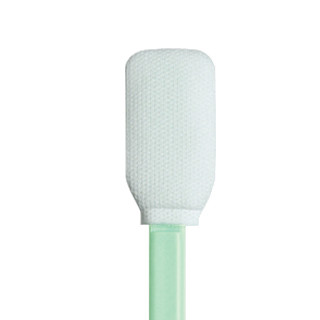
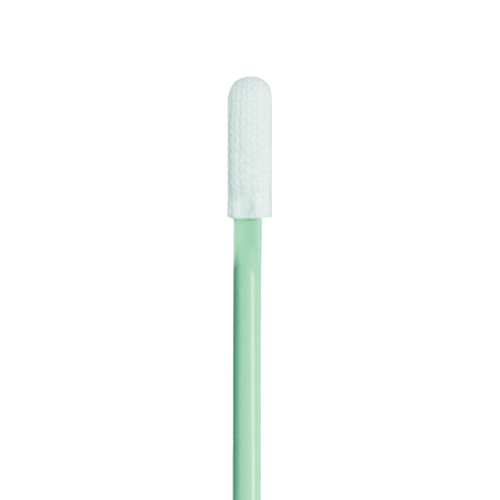
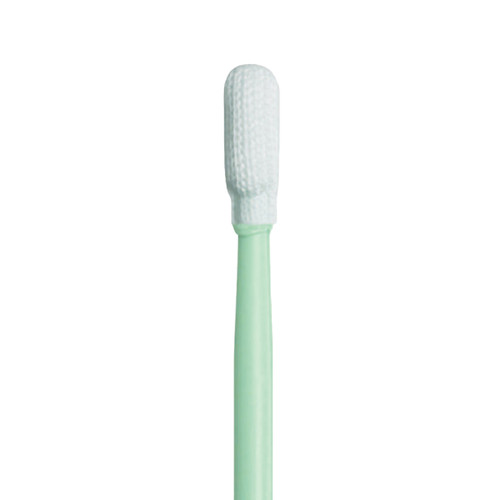
Texwipe TX701 Large Paddle Head Alpha Polyester Cleanroom Swab

$68.17
(No reviews yet)
SKU:
TX701 BAG
Availability:
Stock Item
Shipping:
Calculated at Checkout
Quantity Option (Bag):
100 Swabs Per Bag (4 Inner Bags of 25 Swabs)
Quantity Option (Case):
5 Bags of 100 Swabs Per Case
Type:
Dry Swab
Swab Family:
Alpha
Swab Material:
Polyester

Texwipe TX701 Large Paddle Head Alpha® Polyester Knit Cleanroom Swab (Extra-Large Swab, Thermal Bond, Silicone-Free/Amide-Free Bag)

Texwipe TX701 is an extra-large, paddle-head Alpha® polyester knit cleanroom swab built for critical cleaning and controlled solution application/removal when a standard swab does not provide enough contact area per pass. The double-layer 100% polyester knit head increases absorbency and mechanical pickup for thin films, light residues, and particulate on broader flats, tooling faces, fixture lands, wide slots, and gently contoured surfaces. A complete thermal bond construction eliminates adhesive at the head/handle interface (a common source of residue variability in solvent work), and the virgin polypropylene handle provides chemical resistance and clean handling. TX701 is cleanroom laundered for ultra-low background contribution and is supplied lot coded in a silicone-free and amide-free bag to support contamination investigations, process standardization, and repeatable line-side execution. Low-linting performance is process-dependent (no swab is truly ‘lint-free’ in every surface condition and technique).

Process-control note: TX701 is often selected as a “mini paddle wiper” when teams need broader coverage per stroke while still keeping swab-level control for grooves, edges, and localized wipe-downs where solvent wetness, stroke direction, and face rotation discipline drive yield.

Specifications:
  • SKU: TX701 BAG
  • Type: Dry swab (non-sterile)
  • Swab family: Alpha®
  • Swab material: Polyester (knit)
  • Head material: Knitted Alpha® polyester (double layer)
  • Handle material: 100% virgin polypropylene
  • Head bond: Thermal (complete thermal bond; no adhesive)
  • Handle color: Light green
  • Design notes: Flat large head; long handle (paddle-head geometry for wider contact patch)
  • Dimensions:
    • Head width: 25.30 mm (0.996")
    • Head thickness: 5.25 mm (0.207")
    • Head length: 35.5 mm (1.398")
    • Handle width: 10 mm (0.393")
    • Handle thickness: 3.80 mm (0.149")
    • Handle length: 91.5 mm (3.602")
    • Total swab length: 127.0 mm (5.000")
  • Packaging (bag): 100 swabs per bag (4 inner bags of 25)
  • Packaging (case): 5 bags of 100 swabs per case (500 swabs/case)
  • Packaging controls: Silicone-free and amide-free bag; lot coded for traceability and quality control
  • Autoclave compatibility: Autoclave safe in dry heat and steam (verify your cycle and facility limits)
  • Temperature guidance: Appropriate for use with temperatures less than 410°F (process-dependent)
  • Industries/use cases: Biologic, medical device, microelectronics, optics, pharmaceuticals, semiconductor
  • Country of origin: Made in the Philippines
About the Manufacturer: 

Texwipe (an ITW company) builds cleanroom swabs as engineered contamination-control tools—controlling substrate selection, laundering/cleanroom processing, thermal bonding (to eliminate adhesive contamination), and packaging chemistry aligned to critical cleaning realities. For Alpha® polyester knit swabs like TX701, the design intent is repeatability: consistent geometry, controlled absorbency, low background contribution (particles, ions, and non-volatile residue), and packaging discipline that supports line-side standardization.


SOSCleanroom (SOS) supports that manufacturing discipline with a close working relationship focused on continuity of supply, practical product selection support, and documentation-forward handling—so customers can keep validated cleaning steps stable over time and avoid uncontrolled substitutions that change process behavior.

TX701 Features:
  • Extra-large paddle head increases contact area for faster coverage per pass on flats, fixture lands, and tooling faces
  • Double-layer polyester knit head for enhanced absorbency and controlled wipe feel
  • Engineered to resist snagging and abrading to help reduce particle/fiber release in practical use
  • Complete thermal bond construction (no adhesive) to reduce bond-line residue variability in solvent cleaning
  • 100% virgin polypropylene handle for chemical resistance and clean handling
  • Cleanroom laundered for ultra-low levels of particles, typical ions, and typical NVR (method-dependent)
  • Lot coded for traceability and quality control (supports investigations and change control)
  • Packaged in a silicone-free and amide-free bag to reduce common transfer risks in film-sensitive work
  • Autoclave safe in dry heat and steam (confirm your validated cycle)
TX701 Benefits:
  • More area cleaned per stroke: Paddle-head geometry reduces the number of passes needed to achieve a clean result, supporting single-direction wipe discipline
  • Cleaner solvent performance pathway: Adhesive-free thermal bonding helps prevent hidden residue sources at the head/shaft interface during IPA and other compatible solvent work
  • Residue visibility control: Typical NVR is commonly reviewed for film-sensitive cleaning; TX701 typical NVR is 0.01 mg/swab (DI water extractant) and 0.03 mg/swab (IPA extractant) (typicals; method-dependent)
  • Ionic background awareness: Typical ionic values are reported as very low (example typials include sodium 0.16 µg/swab, chloride 0.12 µg/swab, sulfate 0.11 µg/swab), supporting applications where salts can drive haze, corrosion, or measurement noise
  • Packaging chemistry confidence: Silicone-free and amide-free bagging supports coating, optics, and surface-finish workflows sensitive to transfer contaminants
  • Traceability for investigations: Lot coding supports faster containment and root-cause separation when inspection shifts flag residue or fiber changes
Common Applications:
  • Precision spot cleaning of grooves, tracks, slots, channels, and other small spaces that still benefit from a broader contact patch
  • Cleaning broader flats: tooling faces, fixture lands, platen surfaces, gasket lands, and wide slots where a standard swab is inefficient
  • Applying and removing lubricants, adhesives, and process solutions in a critical clean environment
  • Solvent cleaning and wipe-down (IPA is common; verify compatibility to your chemistry and SOP)
  • Maintenance and inspection cleaning where low background contribution and repeatable technique matter
Best-Practice Use:
  • Think “paddle wipe,” not “swab scrub”: Align the long axis of the paddle with your stroke direction so the face stays flat and pressure stays distributed.
  • One-direction strokes with overlap: Use parallel, overlapping passes. Avoid circular scrubbing unless your written procedure explicitly requires it.
  • Wetness control: Damp lifts; over-wet spreads. Over-wetting increases pooling and can create dry-down rings or end-of-stroke residue lines.
  • Single-pass discipline with face rotation: Rotate the paddle face frequently. Do not rework the same area with a loaded face.
  • No re-dipping: Do not return a used swab into your solvent reservoir. Decant into a small working vessel and replace it frequently to prevent cross-contamination.
  • Pressure control near edges: Burrs and sharp features can snag any knit. Reduce pressure near edges, adjust stroke direction, and deburr hardware where feasible.
  • Standards awareness: Align classification, documentation, and cleaning verification expectations to your program (ISO: https://www.iso.org/standard/53394.html; FDA: https://www.fda.gov; ASTM: https://www.astm.org; IEST: https://www.iest.org).
Selection Notes (TX701 vs. Other Options)
  • Choose TX701 when coverage per pass is the constraint: The extra-large paddle head is built for broader flats and wider wipe zones where smaller swabs increase stroke count and variability.
  • Polyester knit vs. foam: Polyester knit is often preferred where snag resistance, low-linting behavior, and solvent versatility are primary drivers; foam may be preferred for different fluid-hold or “soft contact” behavior on certain geometries. Match head material to soil type, surface finish, and inspection method.
  • Non-sterile vs. sterile: TX701 is non-sterile. If your introduction protocol or critical zone requires sterile packaging controls, specify a sterile Alpha® swab configuration aligned to your SOP.
  • Packaging discipline matters: Use the inner 25-count bags as point-of-use packs to reduce repeated bag opening at the bench and to stabilize contamination direction control.

Link to Texwipe Technical Datasheet (SOS PDF):
Click Here
Texwipe.com PDF (Alpha® Polyester Knit Swabs TDS): Click Here

Notes: Need operator-level technique guidance for Texwipe TX701 (extra-large paddle head Alpha® polyester knit cleanroom swab), including wetness control, single-direction stroke patterns, and face rotation timing to prevent streaking and redeposition? Open the SOSCleanroom Technical Vault tab above for practical execution guidance that helps teams standardize broader-surface swabbing without adding process variability.

SOSCleanroom.com supports contamination-control programs with best-in-class cleanroom consumables, responsive technical support, and continuity of supply—so validated cleaning steps stay stable and procurement stays audit-ready.

Briefed and approved by the SOSCleanroom (SOS) staff.

Product page updated: Jan. 6, 2026 (SOS Technical Staff)

© 2026 SOS Supply. All rights reserved.

The Technical Vault
By SOSCleanroom
TX701 extra-large paddle head
Thermal bond (no adhesive)
Silicone-free / amide-free bag
Published ions + NVR
Texwipe TX701: The “Mini Paddle Wiper” Swab for Wide, Controlled Contact in Critical Cleaning
Texwipe TX701 large paddle head Alpha polyester knit cleanroom swab
TX701 paddle-head knit polyester swab (non-sterile). Larger contact patch, swab-level control.
1) Practical solutions in a critical environment

TX701 is the swab you reach for when the problem is not “can I touch it,” but “can I touch it the same way, every time.” Its extra-large, flat paddle head behaves like a miniature paddle wiper—useful when a standard swab under-covers the surface and drives operators to scrub, over-wet, or “chase” streaks. The double-layer Alpha® polyester knit head supports controlled pickup and controlled release for thin films, light residues, and particulate on broader flats, fixture lands, and wide wipe zones.

A practical cleanliness reality: results depend on surface condition, pressure, solvent load, and stroke discipline. Use “low-linting” language and technique controls—nothing is truly lint-free across every surface, edge condition, and operator method.

2) What is this swab used for
  • Precision cleaning of grooves, tracks, slots, channels, and recesses that still benefit from a broader, flatter contact patch.
  • Wipe-down of broader flats (tooling faces, platen surfaces, fixture lands, gasket lands) where smaller swabs increase stroke count and technique variation.
  • Controlled application and removal of lubricants, adhesives, and process solutions—especially where over-wet pooling creates dry-down rings or residue lines.
  • Solvent wipe-down (IPA is common; qualify compatibility to coatings, inks, plastics, and elastomers in your own program).
  • Maintenance/inspection cleaning where low background contribution and repeatable stroke geometry matter.
3) Why should customers consider this swab
  • More area per pass, less operator improvisation: the ~1-inch wide paddle head reduces “micro-scrubbing” and helps standardize overlap and stroke count.
  • Thermal bond construction: eliminates adhesive at the head/handle interface—a frequent residue variable in solvent-wet work.
  • Double-layer knit head: supports controlled solution pickup and mechanical pickup on smear-prone films without turning the head into a dripping reservoir.
  • Packaging controls: silicone-free and amide-free bag supports programs sensitive to slip additives and silicone transfer.
  • Audit-friendly baseline: published typical ions and NVR enable realistic background expectations for investigations and method development.
  • Line-side identity cues: trademarked light-green handle and “TEXWIPE” embossing help segregation and traceability when matched to approved sourcing and lot controls.
4) Materials and construction

Head: Alpha® polyester knit (double layer). The knit structure provides durability and solvent versatility, while the double layer improves absorbency and contact stability. Bond: complete thermal bond (no adhesive). Handle: 100% virgin polypropylene, light green, long easy-grip format.

Practical implication: the paddle face is meant to stay flat. The quickest way to create variability is to angle the head and concentrate pressure along one edge. Burrs and sharp features are a process risk for any knit—reduce pressure near edges, adjust stroke direction, and address snag points instead of “powering through.”

5) Specifications in context

TX701 is a 5-inch overall swab with a broad paddle head (25.30 mm wide). Use the head width to standardize overlap (for example, a consistent partial overlap per stroke) and use the head thickness to manage wetness—thicker heads can carry more fluid, which is helpful when controlled, and risky when over-wet.

Attribute TX701 (SKU: TX701 BAG)
Type / sterility Dry swab (non-sterile)
Swab family Alpha®
Head material Knitted Alpha® polyester (double layer)
Head width 25.30 mm (0.996")
Head thickness 5.25 mm (0.207")
Head length 35.5 mm (1.398")
Handle material 100% virgin polypropylene
Handle width / thickness 10 mm (0.393") / 3.80 mm (0.149")
Handle length 91.5 mm (3.602")
Total swab length 127.0 mm (5.000")
Head bond Thermal (complete thermal bond; no adhesive)
Handle color Light green
6) Cleanliness metrics

The tables below show typical published analyses—use them as a baseline for risk assessment, troubleshooting, and method development. In film-sensitive work (optics, coated parts) or analytical work (ion chromatography, residue checks), qualify the swab with your solvent, your surfaces, your stroke count, and your inspection method so the swab does not become the dominant background signal.

Typical ion extractables (µg/swab)
Ion TX701
Calcium0.07
Chloride0.12
Fluoride0.08
Magnesium0.03
Nitrate0.06
Phosphate0.06
Potassium0.06
Sodium0.16
Sulfate0.11
Typical NVR (mg/swab)
Extractant TX701
DIW extractant0.01
IPA extractant0.03
Operator takeaway: A large contact patch can hide a wetness problem. Keep the head damp, rotate faces early, and stop when drag increases. If you see a drying ring or end-of-stroke line, reduce solvent load and shorten the finish stroke so the end-of-stroke does not pool.
7) Packaging, sterility and traceability
  • Packaging (TX701): 100 swabs/bag (4 inner bags of 25); 5 bags/case; 500 swabs/case.
  • Packaging chemistry controls: silicone-free and amide-free bag; lot coded for traceability and quality control.
  • Sterility: non-sterile. If a sterile introduction protocol is required, specify a sterile Alpha® configuration aligned to your SOP and verify geometry and method impact (do not assume one-for-one equivalence).
  • Shelf life (series statement): non-sterile 5 years from date of manufacture; sterile 3 years from date of manufacture.
  • Traceability cues: lot coded packaging plus practical handle identifiers (trademarked light-green handle color and “TEXWIPE” embossing) support line segregation when paired with approved sourcing controls.
  • Country of origin (manufacturer statement): Non-sterile – Made in the Philippines; Sterile – Made in the Philippines, irradiated in the U.S.
8) Best-practice use

Treat TX701 like a miniature paddle wiper: the goal is controlled contact and controlled solvent delivery, not scrubbing. Define stroke count, overlap, and discard triggers so the process does not drift into rework with a loaded face.

Operator-level swabbing technique module
  • Set the stroke geometry first: align the long axis of the paddle with stroke direction; keep the face flat to distribute pressure.
  • One-direction passes with overlap: use parallel, overlapping strokes. Avoid circles unless your written procedure requires it.
  • Damp is the target: damp lifts; over-wet spreads. If needed, touch once to a controlled blot surface to remove excess so you lay down an even wet track, not a bead.
  • Single-pass discipline + face rotation: rotate the paddle face early and often. Do not rework the same zone with a loaded face.
  • No re-dipping: never return a used swab to the solvent reservoir. Decant into a small working vessel and refresh frequently.
  • Edge management: reduce pressure near burrs or sharp corners; adjust stroke direction to avoid dragging the knit across edges.
  • Define discard cues: increasing drag, visible soil loading, or fiber snagging are discard triggers—do not “push through” to finish a pass.
  • Standards awareness: align classification, documentation, and verification expectations to your program (ISO, FDA, ASTM, IEST references in Source basis).
9) Common failure modes
  • Over-wet pooling and dry-down rings: too much solvent on a large paddle head creates end-of-stroke lines and “tide marks.” Correct with damp technique and shorter finish strokes.
  • Re-deposit from rework: repeated passes with a loaded face smear residues across a wider area. Correct with single-pass discipline and aggressive face rotation.
  • Edge snagging on burrs: knit heads can snag on sharp features, increasing local fiber/particle release risk. Correct with edge pressure reduction and hardware deburr controls.
  • Cross-contamination via re-dipping: returning a used swab to solvent contaminates the reservoir and defeats cleanliness controls. Correct with decant-and-discard practice.
  • Technique drift between operators: paddle heads magnify angle and pressure differences. Correct with documented overlap, stroke count, and discard triggers.
10) Closest competitors

When comparing alternatives, focus on three things that affect your real-world background: (1) bond method (adhesive vs thermal), (2) published extractables/NVR, and (3) packaging chemistry and lot traceability controls.

  • Contec CONSTIX® SP-8 sealed polyester swab: large paddle geometry with knitted polyester head and thermal bonding; commonly positioned for solvent compatibility.
  • Berkshire Lab-Tips® LTP125 (large knitted polyester swab): flat head with internal paddle support for broad coverage in general cleaning/sampling.
  • Competitor selection note: if your work is film-sensitive or residue-sensitive, require documentation (typical ions, NVR, packaging description, and traceability details) before substituting.
11) Critical environment fit for this swab

TX701 fits best where operators need repeatable wide contact without graduating to a full wiper process: optics benches, fixture wipe zones, process tooling faces, and wide slots where a smaller swab increases stroke count and variability. It is also positioned by the manufacturer as NSF Certified as a cleaning swab (P1) for use in and around food processing areas, with the standard restriction of no direct food/potable water contact and use per manufacturer directions.

SOSCleanroom–ITW Texwipe program fit: In critical environments, the product is only half the control—the other half is continuity and documentation discipline. SOSCleanroom supports Texwipe programs with consistent availability expectations, lot traceability continuity, and the practical ordering rhythm teams need to keep methods stable (especially when a “paddle head” technique is written into a work instruction and re-qualification is expensive).

12) SOSCleanroom note about SOP's

The Technical Vault is written to help customers make informed contamination-control decisions and improve day-to-day handling technique. It is not your facility’s Standard Operating Procedure (SOP), batch record, or validation protocol.

Customers are responsible for establishing, training, and enforcing SOPs that fit their specific risks, products, equipment, cleanroom classification, and regulatory obligations. Always confirm material compatibility, cleanliness suitability, sterility requirements, and acceptance criteria using your internal quality system and documented methods.

If you adapt any technique guidance from this entry, treat it as a starting template. Your team should review and approve the final method, then qualify it for your specific surfaces, solvents, cleanliness limits, inspection methods, and risk profile. In short: use these best-practice suggestions to strengthen your SOPs—not to replace them.

13) Source basis
  • SOSCleanroom product page (TX701): https://www.soscleanroom.com/product/swabs/texwipe-tx701-large-paddle-head-alpha-polyester-cleanroom-swab/
  • Manufacturer product page (Texwipe TX701): https://www.texwipe.com/alpha-polyester-knit-extra-large-swab-tx701
  • Manufacturer technical data sheet (Alpha® Polyester Knit Swabs TDS; doc lists Rev. 09/21 on the PDF): https://www.texwipe.com/images/uploaded/documents/Swabs/Texwipe-AlphaPolyesterKnit-Swabs-TDS.pdf
  • SOS-hosted PDF copy (stable reference): Not published for TX701 at time of review (use the manufacturer PDF above).
  • Closest competitors reference (Contec CONSTIX SP-8): https://cleanroom.contecinc.com/product/1779528582
  • Closest competitors reference (Berkshire Lab-Tips LTP125.5): https://berkshire.com/shop/cleanroom-cleaning-swabs/polyester/ltp125/ltp125-5/
  • ISO (cleanroom standards reference page): https://www.iso.org/standard/53394.html
  • FDA: https://www.fda.gov/
  • ASTM: https://www.astm.org/
  • IEST: https://www.iest.org/
SOSCleanroom is the source for this Technical Vault entry.
Briefed and approved by the SOSCleanroom (SOS) staff.
If you have any questions please email us at Sales@SOSsupply.com
Last reviewed: Jan. 6, 2026
© 2026 SOSCleanroom