Practical solutions in a critical environment
Many residue and haze issues in controlled environments are not “hard-to-reach geometry” problems. They show up on small, sensitive surfaces where the cleaning chemistry is right, but the wetness control is not. Operators over-wet a swab from an open bottle, chase a streak with extra passes, or re-dip and cross-contaminate solvent. On optics, laser hardware, and polished or coated components, that drift shows up fast as smears, drying rings, or inconsistent film removal.
TX728 is designed to reduce those variables by standardizing the solvent load at point of use. It is a pre-wetted configuration that pairs two single-use Absorbond® swabs per metal-foil pouch, wetted with 100% reagent-grade methanol. The “two swabs per pouch” format is not a marketing detail; it is a practical control that helps reduce evaporation losses and reduces operator solvent exposure versus bench-top wetting practices.
Low-linting outcomes still depend on technique and surface condition. No swab is truly lint-free; sharp edges, surface roughness, solvent load, contact pressure, and stroke discipline determine what ends up on the part.
What is this swab used for
Texwipe TX728 is used for precision spot cleaning where methanol is the selected solvent and where open solvent containers are a process risk. The manufacturer positions it for cleaning sensitive optical surfaces, including residues on optical and laser components, and for precision cleaning tasks where consistent, repeatable wetting matters more than brute-force scrubbing.
Each pouch contains two pre-wetted swabs and (per the manufacturer) 0.5 mL of methanol, intended to deliver a consistent wet track without requiring the operator to wet the swab head from a bottle. The result is a more repeatable “solvent-on-part” approach, especially in residue-sensitive work where over-wetting and pooled solvent create visible marks after evaporation.
Bench reality check: why pre-wetted methanol can be a process control, not a convenience
- Removes the “how wet is wet” argument between operators and shifts.
- Reduces open-container time and evaporation-driven concentration drift at the bench.
- Supports a cleaner audit trail: defined pouch usage, defined discard logic, and lot-coded packaging.
Why should customers consider this swab
- Pre-wetted with 100% reagent-grade methanol to reduce variability from bottle wetting and bench-top solvent handling.
- Two swabs per metal-foil pouch helps reduce solvent evaporation and supports more consistent wetness level at point of use.
- No free liquid in the pouch (manufacturer statement), which supports handling discipline and reduces spill risk at the bench.
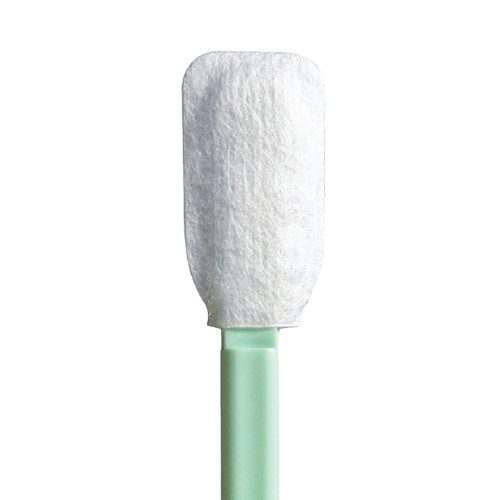
- Absorbond® hydroentangled nonwoven polyester head is designed for scratch-sensitive surfaces and controlled solvent capacity.
- Thermal-bond construction (no adhesive at the bond) reduces an avoidable residue variable in solvent-wet work.
- Red slider bag with GHS labeling supports segregation, storage, and quick identification of solvent-bearing consumables.
- Trademarked light-green handle with “TEXWIPE” embossed on the handle is a practical, line-level traceability and segregation cue.
Materials and construction
Head: Absorbond® 100% polyester (hydroentangled) nonwoven; double-layer head for softness and solvent capacity
Head bond: complete thermal bond construction (reduces adhesive-related contamination risk)
Handle: 100% virgin polypropylene; handle color: light green; “TEXWIPE” embossed (manufacturer traceability cue)
Solvent system: 100% reagent-grade methanol; 2 swabs per pouch; 0.5 mL methanol per pouch (manufacturer statement)
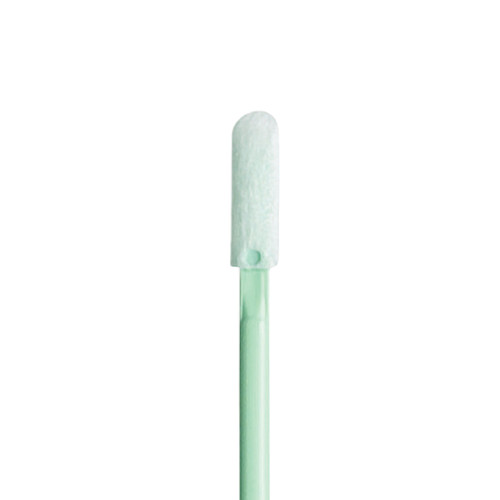
Practical implication: this is a “micro head” swab intended for tight features and residue-sensitive work. Treat burrs and sharp edges as a process risk; reduce pressure near edges, avoid snag points, and do not “power through” corners where fiber or particle release can increase.
Specifications in context
TX728 uses a micro Absorbond® swab geometry that is purpose-built for grooves, slots, and small cleaning zones where control matters more than coverage. In practice, the dimensions help you standardize the contact patch and define stroke count so the work does not drift into rework-and-scrub behavior. For optics and other film-sensitive surfaces, the most important “spec” is consistency: consistent wetness, consistent stroke direction, and consistent discard triggers.
| Attribute |
TX728 (swab geometry) |
| Head material |
Absorbond® 100% polyester (hydroentangled) nonwoven; double layer |
| Head width |
3.2 mm (0.126") |
| Head thickness |
1.5 mm (0.059") |
| Head length |
10.0 mm (0.394") |
| Handle material |
polypropylene |
| Handle width |
2.2 mm (0.087") |
| Handle thickness |
2.2 mm (0.087") |
| Handle length |
60 mm (2.362") |
| Total swab length |
70 mm (2.756") |
| Head bond |
thermal |
| Handle color |
light green |
| Solvent presentation |
100% methanol; 2 swabs per metal-foil pouch; 0.5 mL methanol per pouch |
Cleanliness metrics
The values below represent published typical analyses for the Absorbond® TX759B swab platform used in TX728, and they are not per-unit specifications. Use them as baseline information for risk assessment, method development, and troubleshooting.
For film-sensitive work (optics, polished metals, coated parts) or validated cleaning (TOC, HPLC/UV-Vis, ion chromatography), qualify the swab and the methanol-wet process in your environment so the swab and solvent do not become the dominant background signal.
Typical ion extractables (µg/swab) (Absorbond® TX759B platform)
| Ion |
Typical value |
| Calcium | 0.01 |
| Chloride | 0.16 |
| Fluoride | 0.01 |
| Magnesium | 0.01 |
| Nitrate | 0.01 |
| Phosphate | 0.01 |
| Potassium | 0.04 |
| Sodium | 0.06 |
| Sulfate | 0.41 |
Typical nonvolatile residue (NVR) (mg/swab) (Absorbond® TX759B platform)
| Extractant |
Typical value |
| DIW extractant | 0.07 |
| IPA extractant | 0.01 |
Operator takeaway: with methanol, evaporation is fast and technique is decisive. Use short, controlled strokes, rotate to a fresh face early, and stop when drag increases. If you see a drying ring or edge line, reduce dwell time and shorten the finish stroke so the end-of-stroke does not pool.
Packaging, sterility and traceability
- Packaging (TX728): 2 swabs/pouch; 50 pouches per red slider bag; 4 bags/case (400 swabs/case)
- Pouch format: metal-foil, single-use pouch; swabs packaged in pairs to reduce evaporation and support consistent wetness level
- Bag packaging controls: silicone-free and amide-free bag packaging; red slider bag designed for quick identification; GHS labeling on the back of the red slider bag
- Sterility: non-sterile (if sterility is required, qualify a sterile swab/solvent method rather than assuming a one-for-one substitution)
- Traceability cues: lot-coded packaging supports investigations; “TEXWIPE” embossed handle and light-green handle color support practical line segregation
- Availability note (manufacturer statement): currently available for sale in the USA; contact Texwipe for other geographical areas
- Storage framing: treat TX728 as a flammable, toxic solvent-bearing consumable. Follow your site EHS rules and the SDS; store cool and well ventilated, keep away from ignition sources, and keep pouches sealed until use.
Best-practice use
Treat TX728 as a controlled solvent-delivery tool. The goal is consistent wetting and consistent stroke discipline, not scrubbing. Define stroke count, define overlap, and define discard triggers so operators do not “chase” a film line by reworking it with a loaded face.
Operator-level swabbing technique module
- Open-and-use discipline: Open the foil pouch only when you are staged and ready. Methanol evaporates quickly; minimize time between pouch opening and first contact with the surface.
- Stroke logic: Use single-direction strokes. Start with 2–4 passes on a defined area, then stop and inspect. Rotate to a fresh face early. Discard when drag increases, the head shows visible loading, or streaking begins.
- Wetness control: TX728 is designed to remove the “over-wet from a bottle” variable. Do not add extra solvent unless your work instruction requires it and you have validated the effect on film formation and residues.
- Pressure guidance: Use the lowest pressure that keeps stable contact. Excess pressure can move dissolved residue into an edge line and can damage soft coatings.
- Compatibility framing: Validate methanol compatibility with the specific surface, coating, ink, adhesive, and polymer hardware in your process. If residue does not dissolve, change chemistry or dwell strategy rather than increasing pressure or stroke count.
- Contamination control: Do not re-dip and do not “save” a swab. Pre-wetted is a single-use control strategy; once the face is loaded, it becomes a redeposition risk.
- Safety discipline: Methanol is flammable and toxic. Use ventilation and PPE per your facility program and the SDS. Keep away from ignition sources and do not eat, drink, or smoke during use.
Common failure modes
- Opening pouches early and letting the swab dry down before contact, leading to inconsistent cleaning action across parts.
- Reworking the same area with a loaded face, causing streaks and redeposition.
- Scrubbing motion that smears mobilized films instead of lifting and capturing them.
- Using excessive pressure on edges or corners, creating an edge line and increasing snag/fiber risk.
- Ignoring methanol handling controls (ventilation, ignition sources, PPE), creating avoidable safety and compliance risk.
Closest competitors
The closest alternatives are pre-wetted solvent swab systems designed for residue-sensitive spot cleaning, especially in optics and microelectronics. Selection typically hinges on solvent grade and control (per-pouch volume and evaporation control), pouch construction (foil barrier performance), documentation depth (SDS/TDS availability and revision control), and whether published contamination baselines support investigations.
- Contec pre-saturated cleanroom swab formats (solvent-specific): Compare solvent control approach, pouch barrier design, and whether the supplier publishes extractables/NVR baselines and lot traceability practices that support audit work.
- Berkshire pre-wetted swab formats (solvent-specific): Evaluate wetness consistency, head material behavior on scratch-sensitive surfaces, and the supplier’s documentation package for regulated or investigation-heavy programs.
- Puritan solvent-wet cleanroom swab formats: Confirm head construction and bond method, then compare packaging, documentation, and repeatability in your inspection method (visual, particle, or analytical).
Critical environment fit for this swab
TX728 fits work where methanol is the chosen chemistry and where open solvent handling is a controllable source of variability. It is a strong choice for optics and laser cleaning tasks, and for tight-feature spot cleaning where the operator needs a small, consistent contact patch and a repeatable solvent load.
SOSCleanroom’s relationship with ITW Texwipe supports continuity of supply and documentation discipline, which reduces the risk of unplanned substitutions that change wetting behavior and background contamination. That matters in ISO-aligned cleanroom programs and in regulated environments where documentation expectations often track FDA quality systems and standards-driven methods associated with ASTM and IEST.
Operational support matters, too. Fast shipping and responsive customer service help keep validated work instructions intact by preventing “make-do” material swaps when schedules tighten.
Source basis
- SOSCleanroom product page (TX728): https://www.soscleanroom.com/product/swabs/texwipe-tx728-absorbond-polyester-swab-pre-wetted-100-methanol/
- Texwipe manufacturer product page (TX728): https://www.texwipe.com/pre-wet-methanol-absorbond-tx728
- Texwipe technical data sheet: “TX®728 100% Methanol Pre-Wetted” (US-TDS-066 Rev. 10/24): https://www.texwipe.com/images/uploaded/documents/Swabs/TDS_SpecialtySwab_TX728_Alt_2.0.pdf
- Texwipe technical data sheet: “Absorbond® Swab Series — Polyester Non-Woven” (US-TDS-063 Rev.09/21): https://www.texwipe.com/Images/uploaded/documents/Swabs/Texwipe-Absorbond-Swabs-TDS.pdf
- Texwipe SDS: “Texwipe® Pre-wetted Swabs with 100% Methanol” (Initial preparation date 07/21/2023): https://www.texwipe.com/images/uploaded/documents/Safety%20Data%20Sheets/Texwipe-pre-wetted-swabs-with-100_Methanol_US_SDS.pdf
- International Organization for Standardization (ISO) reference (ISO 14644-1:2015): https://www.iso.org/standard/53394.html
- FDA (Food and Drug Administration): https://www.fda.gov/
- ASTM (American Society for Testing and Materials): https://www.astm.org/
- IEST (Institute of Environmental Sciences and Technology): https://www.iest.org/
SOSCleanroom is the source for this Technical Vault entry.
Briefed and approved by the SOSCleanroom (SOS) staff.
Last reviewed: January 6, 2026
© 2026 SOSCleanroom