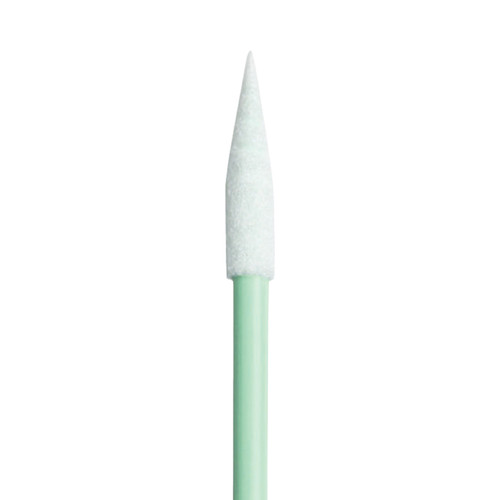
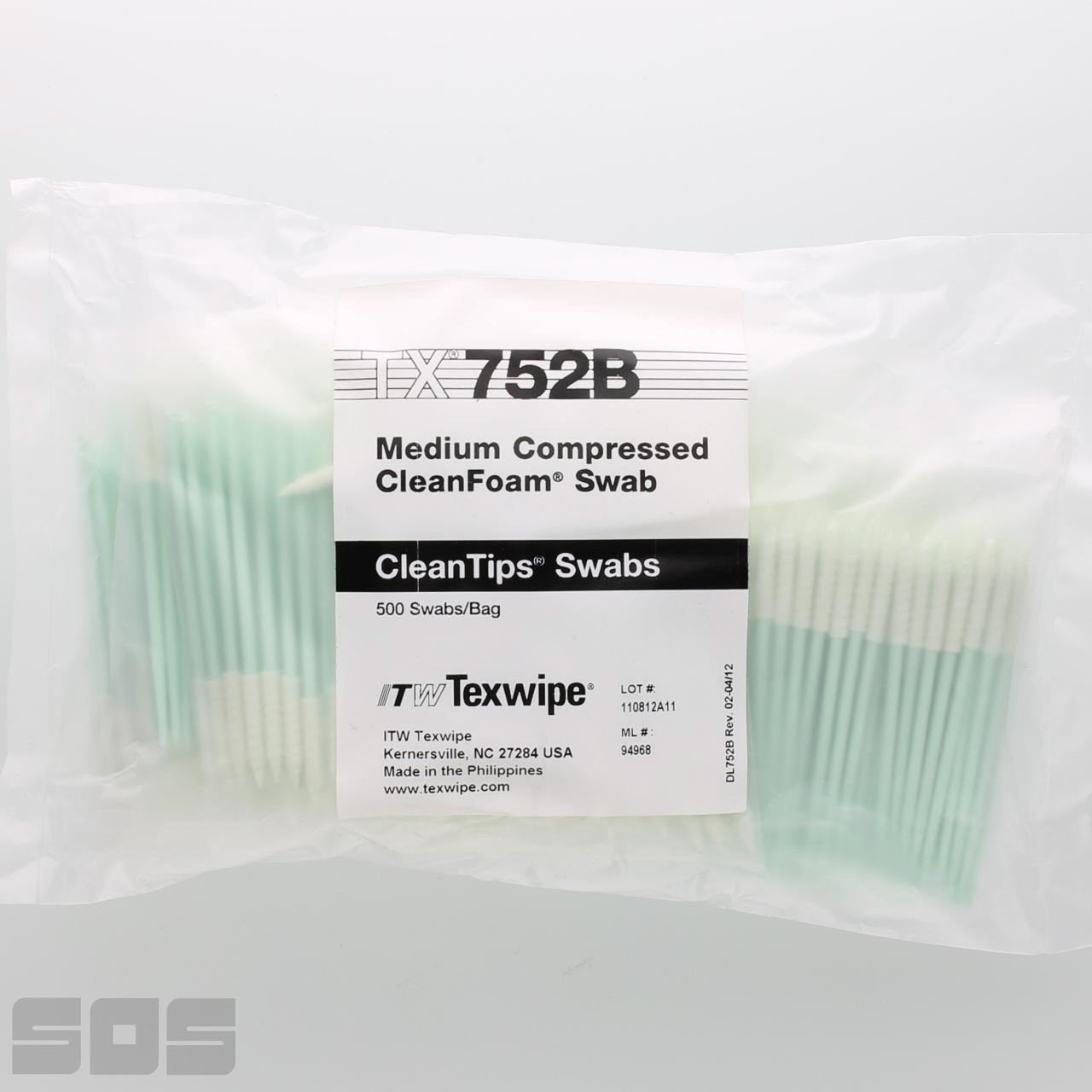
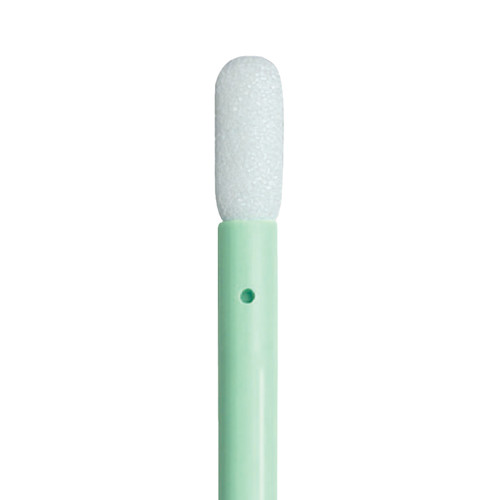
Product reference image (TX752B). Use lot code on inner packaging for traceability.
Practical solutions in a critical environment
When residue, films, and particulate control are real failure mechanisms (not theoretical), swab selection becomes a process control decision.
TX752B is built for controlled solvent carry into tight features: the compressed, pointed open-cell foam head can access seams, intersecting surfaces,
tracks, and recessed pockets while maintaining predictable contact and pickup.
In practical terms, this is the “slot-and-joint” swab: it is sized to work where wipes cannot reach, and where cotton buds can shed fibers, over-hold
liquids, or smear instead of lifting. It is designed for use with compatible solutions and solvents and for cleaning tasks in controlled environments.
What is this swab used for
- Applying and removing lubricants, adhesives, and process solutions in critical cleaning work.
- Scrubbing recessed areas and cleaning intersecting surfaces and joints.
- Removal of excess materials and debris, including fine powders when the process requires pickup.
- Solvent-aided cleaning where geometry control matters (slots, channels, grooves, edges).
- General critical-environment support across optics, microelectronics, semiconductor support, medical device assembly, pharma/biologics operations, and related controlled areas.
Why should customers consider this swab
- Compressed pointed tip for feature access: reaches grooves and seams while keeping the contact line predictable.
- Thermal bond construction: eliminates adhesive contamination pathways associated with glued heads.
- Published cleanliness metrics: typical ionic extractables and NVR values are provided per swab, supporting qualification and investigations.
- Packaging engineered for clean introduction: silicone-free and amide-free bags; inner-bag segmentation supports controlled staging.
- Program traceability: lot-coded packaging and trademarked light-green handle with “TEXWIPE” embossing support identification discipline.
- Autoclave safe (process-specific): can be autoclaved in dry heat and steam when your internal method validates material compatibility and bioburden expectations.
Materials and construction
TX752B uses 100 ppi polyurethane CleanFoam® on a virgin polypropylene handle. The head is thermally bonded (not glued), which is a meaningful
control point when you are trying to prevent extractable contribution from adhesive systems.
This family is cleanroom processed and positioned for low levels of ions and non-volatile residue, and it is packaged in silicone-free and amide-free bags.
Like all swab and wipe materials, “low-linting” is the correct engineering language; nothing is truly lint-free. The practical objective is to select a
material that does not introduce fibers or residues at levels that challenge your acceptance criteria.
Specifications in context
TX752B is a compact, 70 mm class swab with a medium-length compressed head. In practice, the geometry supports both precision cleaning and controlled
application: the pointed tip can “index” into joints, while the side profile helps maintain edge contact without rolling the head.
| Attribute |
TX752B |
| Head material |
100 ppi CleanFoam® polyurethane foam (open-cell family) |
| Head width |
3.4 mm (0.134") |
| Head thickness |
3.4 mm (0.134") |
| Head length |
20.0 mm (0.787") |
| Handle material |
Polypropylene |
| Handle width / thickness |
2.5 mm / 2.5 mm (0.098" / 0.098") |
| Handle length |
50.0 mm (1.969") |
| Total swab length |
70.0 mm (2.756") |
| Head bond |
Thermal |
| Handle color |
Light green |
| Design notes |
Precision pointed tip; side ridges; compact handle |
Temperature note (application guidance): this family is positioned as appropriate for use with temperatures less than 350°F (177°C). Confirm compatibility with your solvent, surface, and method before use.
Cleanliness metrics
The values below are typical analyses reported by the manufacturer (per swab) and are intended to support qualification logic, process comparisons, and investigations.
They are not presented as specification limits. If your program has acceptance criteria, tie swab selection to your internal method and documented thresholds.
Typical ion extractables (µg/swab)
| Ion |
TX752B (typical) |
| Calcium | 0.01 |
| Chloride | 0.03 |
| Fluoride | 0.01 |
| Magnesium | 0.01 |
| Nitrate | 0.01 |
| Phosphate | 0.01 |
| Potassium | 0.01 |
| Sodium | 0.05 |
| Sulfate | 0.01 |
Typical NVR (mg/swab)
| Extractant |
TX752B (typical) |
| DI water (DIW) |
0.07 |
| Isopropyl alcohol (IPA) |
0.03 |
Packaging, sterility and traceability
- Packaging configuration (TX752B): 500 swabs per outer bag (5 inner bags of 100 swabs); 5 bags per case; 2,500 swabs total per case.
- Bag controls: packaged in silicone-free and amide-free bags; designed for controlled staging and introduction.
- Traceability discipline: lot-coded packaging; trademarked light-green handle with “TEXWIPE” embossed on the handle as an identification cue.
- Sterility status: TX752B is non-sterile. Sterile swabs in this family are available upon request; confirm sterile part numbers, packaging layers, and SAL requirements in your purchase specification.
- Shelf life (manufacturer guidance): non-sterile swabs are listed with a 5-year shelf life from date of manufacture (sterile variants are listed with a 3-year shelf life from date of manufacture).
- Country of origin (manufacturer statement): non-sterile – made in the Philippines. (The manufacturer also states: sterile – made in the Philippines, irradiated in the USA.)
Best-practice use
TX752B is most effective when “damp” is controlled and repeatable. Open-cell foam can carry more chemistry than closed-cell foam; that is a benefit
only when your method intends that carry and controls it to prevent flooding, streaks, and capillary migration into joints.
Operator-level swabbing technique module
- Meter the solvent: wet the foam, then “meter down” on a designated low-shed blot pad until the head is uniformly damp with no free liquid transfer.
- One-direction strokes: use single-direction strokes with overlap (often ~50% overlap). Avoid back-and-forth scrubbing that redistributes films.
- Rotate early: rotate to a fresh face after 2–4 strokes, or sooner if drag marks appear. Once a face is loaded, additional strokes become redeposition.
- Use the geometry intentionally: keep the handle angle stable for slots/channels and let the pointed tip index into corners. Use the side ridges as an “edge guide” to maintain contact along seams.
- Pressure control: apply enough force for full contact, but avoid compressing the head into burrs or sharp edges (a primary driver of foam abrasion and particulate generation).
- Compatibility gate: verify solvent compatibility with the surface/coating/adhesive system. Open-cell foam can increase solvent delivery; confirm this is desirable for your method.
- Staging discipline: open inner bags only when needed; close promptly; avoid staging swabs in turbulent airflow zones; avoid re-dipping a used swab into a shared solvent container.
- Stop conditions: if the swab begins to chatter, snag, or smear, stop and reassess. Change the swab, change the solvent load, or change the stroke plan rather than “powering through.”
Common failure modes
- Over-wetting and flooding: open-cell foam carries liquid into joints and creates tide marks after evaporation.
- Back-and-forth scrubbing: redistributes films and can create a polished-looking smear that passes casual visual checks but fails under angled light or functional test.
- Too many strokes per face: the head becomes a redistribution tool once loaded; rotate early and discard after use.
- Foam abrasion on sharp edges: burrs and rough coatings can tear foam and generate particulates; reduce pressure and shorten stroke length near edges.
- Cross-contamination from staging: open inner bags left exposed, poor glove discipline, or re-dipping into shared solvent containers.
- Assuming “autoclaved” equals “qualified”: autoclave compatibility does not automatically satisfy your sterility or residue expectations—validate the full method and packaging pathway.
Closest competitors
For a compact, pointed open-cell foam swab, the meaningful comparison is mechanism-based: bond method, foam structure, published contamination data,
packaging controls, and traceability—not just head size.
- Berkshire Lab-Tips® (open-cell foam pointed-tip families): evaluate whether contamination metrics are published in the per-swab format your qualification requires and whether packaging segmentation supports your area entry method.
- Foamtec cleanroom foam swabs (reticulated/open-cell PU families): compare foam behavior in your solvent (carry, release, streak risk) and confirm availability of lot-coded traceability and published ions/NVR.
- Puritan PurSwab foam swabs (foam-on-polypropylene families): selection should hinge on documented contamination controls, bond method, and geometry match for your target feature.
Critical environment fit for this swab
TX752B fits programs where absorbency is required but must be controlled: optics-adjacent cleaning, microelectronics and semiconductor support,
medical device assembly, and regulated operations that treat residue and ionic transfer as measurable risk. The manufacturer also positions this family
as NSF certified for use as a Cleaning Swab (P1) in and around food processing areas, with the requirement that the product not have direct contact with food
or potable water and that use follows the manufacturer’s directions.
SOSCleanroom supports controlled-environment programs built on continuity of supply and documentation discipline. In practice, that means stable product identification,
support for lot-based investigations when anomalies occur, and customer service that helps teams match swab geometry to solvent choice and inspection method.
The operational objective is consistency: operators should not have to improvise with mismatched materials when production schedules tighten.
SOSCleanroom note about SOP's
The Technical Vault is written to help customers make informed contamination-control decisions and improve day-to-day handling technique.
It is not your facility’s Standard Operating Procedure (SOP), batch record, or validation protocol.
Customers are responsible for establishing, training, and enforcing SOPs that fit their specific risks, products, equipment, cleanroom classification, and regulatory obligations.
Always confirm material compatibility, cleanliness suitability, sterility requirements, and acceptance criteria using your internal quality system and documented methods.
If you adapt any technique guidance from this entry, treat it as a starting template. Your team should review and approve the final method, then qualify it for your specific surfaces,
solvents, cleanliness limits, inspection methods, and risk profile. In short: use these best-practice suggestions to strengthen your SOPs—not to replace them.
Source basis
- SOSCleanroom product page (TX752B): https://www.soscleanroom.com/product/swabs/texwipe-tx752b-medium-compressed-cleanfoam-swab-open-cell/
- Manufacturer product page (TX752B): https://www.texwipe.com/medium-compressed-cleanfoam-tx752b
- SOS-hosted PDF copy (stable reference): CleanFoam® Series B technical data sheet (includes TX752B): https://www.soscleanroom.com/content/texwipe_pdf/740b%20741b%20742b%20751b%20752b%20757b.pdf
- Texwipe.com manufacturer PDF (secondary reference): “CleanFoam® Swab Series” (US-TDS-051 Rev. 09/21): https://www.texwipe.com/images/uploaded/documents/Swabs/Texwipe-Cleanfoam-Swabs-TDS.pdf
- ISO reference portal (ISO 14644-1 cleanroom classification page): https://www.iso.org/standard/53394.html
- FDA reference portal: https://www.fda.gov/
- ASTM reference portal: https://www.astm.org/
- IEST reference portal: https://www.iest.org/
SOSCleanroom is the source for this Technical Vault entry.
Briefed and approved by the SOSCleanroom (SOS) staff.
If you have any questions please email us at Sales@SOSsupply.com
Last reviewed: January 6, 2026
© 2026 SOSCleanroom