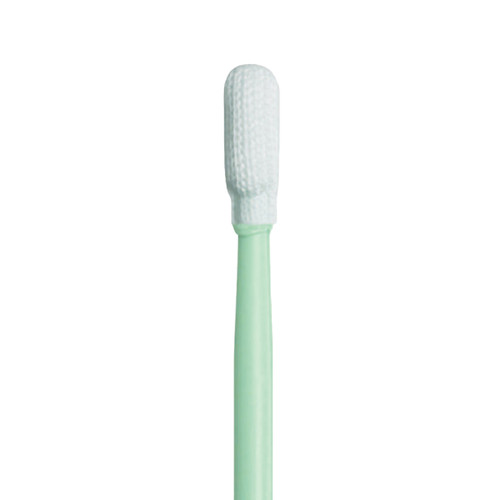
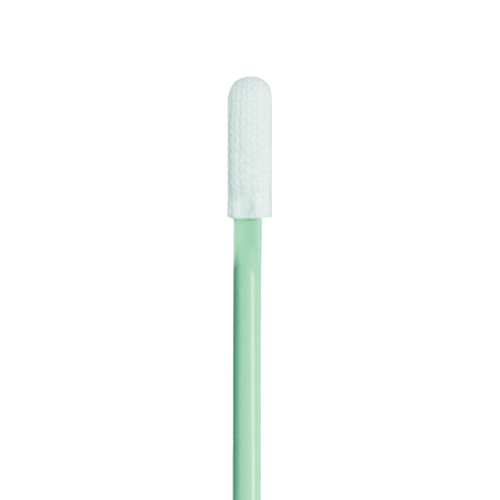
Texwipe TX761PM Alpha Polyester Knit Swab with Flexible Angled Head

$45.30
(No reviews yet)
SKU:
TX761PM BAG
Availability:
Stock Item
Shipping:
Calculated at Checkout
Quantity Option (Bag):
100 Swabs Per Bag
Quantity Option (Case):
10 Bags of 100 Swabs Per Case
Type:
Dry Swab
Swab Family:
Alpha
Swab Material:
Polyester

Texwipe TX761PM Alpha® Polyester Knit Cleanroom Swab with Flexible Angled Head (Long Handle)

Texwipe TX761PM is a precision-cleaning cleanroom swab engineered for the geometry problems that defeat straight swabs—tracks, slots, grooves, gear teeth, hinge lines, and other tight features where approach angle and contact mechanics determine whether you clean or just smear. It uses a cleanroom-laundered, double-layer knitted Alpha® polyester head for low-linting performance (no swab is truly ‘zero-lint’ in every process condition) and controlled sorbency, paired with a long, light-green polypropylene handle and an internal flexible paddle that supports an angled approach. Complete thermal bond construction (no adhesive at the head/handle interface) helps reduce extractables variability in solvent-heavy workflows, and the flexible angled head is designed to help operators maintain stable contact without snagging, side-loading, or over-scrubbing in recessed features.

Precision-access note: TX761PM is widely selected when teams need controlled contact at an angle—especially for maintenance, inspection, and spot cleaning of moving parts and tight mechanical features where solvent pooling, streaking, and redeposit risk increase with poor entry angles.

Specifications:
  • SKU: TX761PM BAG
  • Type: Dry swab (non-sterile)
  • Swab family: Alpha®
  • Head material: Knitted Alpha® polyester (double-layer knit)
  • Head width: 6.8 mm (0.268")
  • Head thickness: 2.8 mm (0.110")
  • Head length: 16.8 mm (0.661"); 45-degree angle at 8.4 mm
  • Angled head range: 45–90 degree flexible angled head (flexible internal paddle support)
  • Handle material: Polypropylene
  • Handle width: 3.2 mm (0.126")
  • Handle thickness: 3.2 mm (0.126")
  • Handle length: 145.5 mm (5.728")
  • Total swab length: 162.3 mm (6.390")
  • Head bond: Thermal (no adhesive)
  • Handle color / ID: Light green; trademarked handle with embossed “TEXWIPE” name
  • Packaging: Bag-Within-A-Bag®; 100 swabs/bag (1 inner bag of 100)
  • Case pack: 10 bags/case (1,000 swabs/case)
  • Autoclave: May be sterilized by autoclave (dry heat and steam)
  • Shelf life: 5 years from date of manufacture
  • Storage conditions: Ambient 59°F (15°C) to 86°F (30°C)
  • Use environments: Commonly used for precision spot cleaning in ISO-class cleanrooms and controlled areas (final suitability depends on your surface, solvent, and SOP)
  • Country of origin: Non-sterile — Made in The Philippines
Typical Cleanliness Metrics (from Texwipe testing)

These values represent typical analyses (not specifications). For residue-sensitive cleaning and inspection workflows, many teams trend by lot and align technique (wetness, pressure, stroke count) to avoid turning a clean swab into a particle generator in-use.

Typical ion extractables (µg/swab) TX761PM (typical)
Chloride 0.01
Sulfate < 0.01
Nitrate < 0.01
Phosphate < 0.01
Fluoride < 0.01
Potassium 0.01
Calcium < 0.01
Sodium 0.01
Magnesium 0.01
Typical NVR (mg/swab) TX761PM (typical)
IPA extractant 0.02
About the Manufacturer: 

Texwipe (an ITW company) builds cleanroom swabs as engineered contamination-control tools, where head construction, bonding method, and packaging discipline directly influence real-world outcomes. In tight geometries, cleaning success is rarely about “more solvent”—it is about controlled contact, controlled wetness, and a swab that resists snagging and abrasion events that can shed particles or redeposit residue.


TX761PM pairs a cleanroom-laundered, double-layer knitted polyester head with a supported flexible angled paddle so operators can approach surfaces at an angle without levering the tip into edges. SOSCleanroom (SOS) supports that manufacturing discipline with a close working relationship focused on continuity of supply, documentation consistency, and practical application support—helping customers standardize a repeatable swabbing process with fewer substitutions and fewer workflow surprises.

TX761PM Features:
  • Flexible angled head designed for access in spaces difficult to reach with a flat swab
  • 45–90 degree flexible angled head geometry for controlled entry into tight features
  • Cleanroom-laundered, double-layer knitted Alpha® polyester tip for low-linting performance and enhanced absorbency
  • Flexible internal paddle head support for stable contact and improved control
  • Thermally bonded head (no adhesive) to reduce contamination pathways and improve consistency in solvent-heavy use
  • Engineered to resist snagging and abrading while remaining soft and nonabrasive
  • Excellent chemical compatibility with a variety of solutions
  • Long, light green polypropylene handle; trademarked handle with embossed “TEXWIPE” name for authenticity/traceability
  • May be sterilized by autoclave (dry heat and steam) when your workflow requires it
  • Nested Bag-Within-A-Bag® packaging supports cleaner staging and transfer into controlled areas
TX761PM Benefits:
  • Better access + better mechanics: Angled approach helps maintain contact in slots, tracks, grooves, and moving hardware without forcing awkward wrist angles that increase pressure spikes and snag events
  • Controlled solvent technique: Double-layer knit supports a more consistent “damp” approach for IPA and other solvents, reducing pooling that can dry into streaks, haze, or redeposited film
  • More stable background behavior: Thermal bond construction (no adhesive) helps reduce a common source of extractables variability
  • Reduced shedding risk in-use: Resists snagging/abrading and helps limit particle/fiber release when geometry would otherwise side-load the head
  • Process repeatability: Consistent dimensions and packaging support standard work across shifts and sites
Common Applications:
  • Precision spot cleaning of grooves, tracks, slots, channels, rails, and other small spaces
  • Cleaning, maintenance, and inspection of gears and other moving parts in controlled environments
  • Solvent use such as IPA for controlled application and removal in tight geometry features
  • Applying and removing lubricants, adhesives, and other process solutions in critical clean environments
  • Optics, semiconductor tooling, microelectronics fixtures, aerospace assemblies, and data storage mechanisms where access and residue control are gating concerns
Best-Practice Use:
  • Work “damp,” not flooded: Pre-wet the head to a controlled damp condition for solvent cleaning. In tracks and slots, excess solvent pools and can redeposit residues as it flashes off.
  • Use the angle to avoid scrubbing: Let the angled head ride the surface. Use straight, one-direction strokes with overlap; avoid circular scrubbing that increases abrasion and shedding risk.
  • Control pressure and side-load: Use light, consistent pressure. Do not lever the tip into edges or corners—side-loading is a primary trigger for snagging and particle release.
  • Rotate and retire: Rotate the swab face as it loads and replace it when the head becomes visibly soiled or starts to drag/streak.
  • Autoclave only if your SOP requires it: If you autoclave, validate post-sterilization handling and packaging integrity to maintain cleanliness at point of use.
Selection Notes (TX761PM vs. Straight Swabs)
  • Choose TX761PM when geometry is the problem: If the feature forces awkward entry angles (tracks, slots, hinges, gear teeth), the angled head can improve contact control and reduce snag/shed events compared with straight-tip swabs.
  • Solvent workflows: TX761PM is commonly used with IPA and similar solvents. For stronger solvents, treat compatibility as a qualification activity based on your contact time and substrate sensitivity.
  • Residue and inspection sensitivity: When streaks, haze, or film lines trigger rework, control wetness and pressure first—the angled head is designed to make that discipline easier to execute consistently.

Link to Texwipe Technical Datasheet:
Click Here
Texwipe.com PDF: Click Here

Notes: Looking for technique guidance for angled-head swabbing in tracks, grooves, and moving hardware (wetness control, stroke discipline, pressure control, and change-out triggers)? Open the SOSCleanroom Technical Vault tab above for practical operator guidance and selection context aligned to real cleanroom workflows.

SOSCleanroom.com supports contamination-control programs with cleanroom consumables in stock, fair pricing, and responsive technical support—backed by customer service that understands real controlled-environment maintenance and precision cleaning.

Product page updated: Jan. 6, 2026 (SOS Technical Staff)

Briefed and approved by the SOSCleanroom (SOS) staff.

© 2026 SOS Supply. All rights reserved.

The Technical Vault
By SOSCleanroom
Angle-control swab for tracks, grooves, and moving parts
Last reviewed: January 6, 2026
SKU focus: TX761PM
Texwipe TX761PM Alpha® polyester knit cleanroom swab with flexible angled head: controlled contact in slots and tracks when straight swabs smear, snag, or flood
Selection snapshot (what makes TX761PM different)
  • Primary advantage: a supported, flexible angled head (45–90°) that keeps the contact patch stable inside grooves, tracks, slots, gear teeth, hinge lines, and tight mechanical interfaces.
  • Material platform: cleanroom-laundered, double-layer Alpha® polyester knit with thermal bonding (no adhesive at the head/handle interface).
  • Best-fit users: semiconductor tool PM, optics/photonics support cleaning, microelectronics rework benches, inspection-driven manufacturing, and any controlled environment where technique repeatability matters.
  • Sterility note: non-sterile supply; the manufacturer notes it may be sterilized by autoclave, but that step must be validated for your sterility/bioburden requirements and handling controls.
Practical solutions in a critical environment

Many cleaning failures in controlled environments are not caused by “hard-to-reach” geometry alone. They happen because the contact mechanics are unstable: a straight swab forces a wrist twist, the head side-loads, solvent pools in a slot, and a mobilized film becomes a streak line when it dries. The defect may present as haze, smearing, a drying ring, or residue trapped at the end of the stroke where the swab finally lifts.

TX761PM is built to reduce those variables. The long handle improves reach (keeping gloves and sleeves out of the work zone), while the flexible internal paddle and angled head help the tip “ride” a surface in tracks, grooves, and moving interfaces rather than levering into edges. The Alpha® polyester knit head is thermally bonded to a polypropylene handle, eliminating adhesive at the bond line—a common hidden contributor to inconsistent background residues in solvent-wet work.

Low-linting outcomes depend on technique and surface condition. No swab is truly lint-free; edge sharpness, surface roughness, solvent load, contact pressure, and stroke discipline govern what you see on the part.

What is this swab used for

Texwipe TX761PM is used for precision spot cleaning in confined geometries where a standard straight swab creates side-loading, poor entry angles, or uneven wetting. It is commonly selected for grooves, tracks, slots, rails, gear teeth, hinge lines, seams, and other tight features where the ability to approach at an angle determines whether you clean or simply smear.

Typical use includes controlled solvent work (such as IPA, where compatible) and the application/removal of lubricants, adhesives, and other process solutions in critical clean environments. It is also positioned for cleaning, maintenance, and inspection tasks on moving parts and tight mechanical interfaces where snag resistance and controlled contact reduce the risk of localized particle generation.

Why should customers consider this swab
  • Flexible angled head (45–90°) supports controlled entry and stable contact in tracks/slots where straight swabs encourage wrist twist and edge digging.
  • Cleanroom-laundered, double-layer Alpha® polyester knit supports a repeatable “damp” technique and predictable solution pickup/release for film-prone residue work.
  • Thermal bond construction eliminates adhesive at the head/handle interface, reducing a residue variable in solvent-wet cleaning and investigation workflows.
  • Published extractables baselines (typical NVR and typical ion extractables) help set realistic background expectations for troubleshooting and method development.
  • Bag-Within-A-Bag® packaging supports cleaner staging and transfer into controlled areas with fewer “outer surface” contact risks.
  • Trademarked light-green handle with embossed “TEXWIPE” is a practical point-of-use identification and segregation cue for line control.
  • Country-of-origin transparency supports program documentation: non-sterile supply is manufacturer-stated as Made in The Philippines.
Materials and construction

Head: Alpha® polyester knit (double layer; cleanroom-laundered)

Head support: flexible internal paddle; angled approach geometry (manufacturer frames a 45–90° flexible angled head)

Head bond: thermal bond (no adhesive at the bond)

Handle: polypropylene; long format; handle color: light green; “TEXWIPE” embossed

Practical implication: use the angle to keep the head riding flat on the target surface rather than twisting the handle and side-loading the knit. Treat burrs and sharp edges as a process risk; reduce pressure near edges, avoid dragging the knit across sharp corners, and do not “power through” snag points that can create localized particle/fiber release.

Specifications in context

TX761PM’s value is not just “long handle.” It is long reach plus an angled, supported head that helps the contact patch ride along a wall, under a lip, or into a track without forcing a wrist twist that spikes pressure. Use head width and head length to standardize overlap and stroke count. Use head thickness to manage wetness: knit heads can hold solvent, so a controlled damp technique is essential to avoid pooling and drying rings in confined geometry.

Attribute TX761PM
Head materialKnitted Alpha® polyester (double layer)
Head width6.8 mm (0.268")
Head thickness2.8 mm (0.110")
Head length16.8 mm (0.661"); 45° angle at 8.4 mm
Handle materialpolypropylene
Handle width3.2 mm (0.126")
Handle thickness3.2 mm (0.126")
Handle length145.5 mm (5.728")
Total swab length162.3 mm (6.390")
Head bondthermal
Handle color / IDlight green; embossed “TEXWIPE”
Design notesflexible angled head; long handle
Storage conditionsambient 59°F to 86°F (15°C to 30°C)
Shelf life5 years from date of manufacture
Cleanliness metrics

The values below represent published typical analyses and are not per-unit specifications. Use them as baselines for risk assessment, method development, and troubleshooting. If you run film-sensitive work (optics, polished metals, coated parts) or measurement-driven work (TOC, HPLC/UV-Vis, ion chromatography), qualify the swab with your solvent, your surfaces, your stroke count, and your inspection method so the swab does not become the dominant background signal.

Typical ion extractables (µg/swab)
Ion TX761PM (typical)
Chloride0.01
Sulfate< 0.01
Nitrate< 0.01
Phosphate< 0.01
Fluoride< 0.01
Potassium0.01
Calcium< 0.01
Sodium0.01
Magnesium0.01
Typical nonvolatile residue (NVR) (mg/swab)
Extractant TX761PM (typical)
IPA extractant0.02

Operator takeaway: angled access can mask an over-wetting problem because pooled solvent is “hidden” in a track. Keep the head damp, rotate faces early, and stop when drag increases. If you see a drying ring, reduce solvent load and shorten the finish stroke so the end-of-stroke does not pool.

Packaging, sterility and traceability
  • Packaging (TX761PM): Bag-Within-A-Bag®; 100 swabs/bag (1 inner bag of 100)
  • Case pack: 10 bags/case; 1,000 swabs/case
  • Sterility: non-sterile (manufacturer notes it may be sterilized by autoclave; qualify the cycle, post-cycle handling, packaging strategy, and sterility/bioburden expectations in your program)
  • Shelf life (manufacturer statement): 5 years from date of manufacture
  • Storage conditions: ambient 59°F to 86°F (15°C to 30°C)
  • Traceability cues: lot-coded packaging supports investigations; embossed “TEXWIPE” and light-green handle color support point-of-use identification and segregation
  • Country of origin (manufacturer statement): Non-sterile – Made in The Philippines
Best-practice use

Treat TX761PM as a mechanics-control swab. The goal is stable contact and controlled solvent delivery in confined geometry, not scrubbing. Define stroke count, overlap, and discard triggers so operators do not chase a film line by reworking it with a loaded face.

Customer SOP disclaimer
This Technical Vault entry provides practical, standards-aware guidance to help you select and use cleanroom consumables more consistently. It is not a replacement for your site SOPs, validated work instructions, or quality system requirements. Always validate material compatibility, solvent selection, technique (wetness/pressure/stroke count), and acceptance criteria in your process before adopting changes.
Operator-level swabbing technique module
  • Angle-first approach: Start with the head already aligned to the track wall or surface plane. Use the angle to maintain full-face contact. Avoid twisting the handle mid-stroke (twist = side-load + snag risk).
  • “Damp” solvent technique: Wet the head, then reduce to damp, not dripping. A practical check is one controlled touch to a blot surface to remove excess. In slots and grooves, excess solvent pools out of sight and dries into rings and film lines.
  • Stroke-count logic: Use single-direction strokes with overlap. Start with 2–4 passes on a defined segment, then stop and inspect. Rotate to a fresh face early. Discard when drag increases, the knit shows loading, or the work starts to streak.
  • Pressure guidance: Apply enough pressure to maintain contact, then reduce slightly. Excess pressure increases snagging on edges and can squeegee dissolved residue into an end-of-stroke line.
  • Snag control: Treat burrs as a process defect. Do not force the head through a snag point. Reposition, reduce pressure, or address the edge condition before continuing.
  • Solvent compatibility framing: IPA is common. Validate compatibility with the surface, coating, ink, and adhesive systems. If residue does not dissolve, change chemistry or dwell strategy rather than increasing pressure or stroke count.
  • Handling discipline: Stage only what you need. Open one inner bag at the bench and keep remaining bags closed. Do not re-dip a used swab into a shared solvent reservoir; decant to a small working vessel and refresh it often.
Common failure modes
  • Over-wetting in confined geometry, leading to hidden pooling and visible drying rings once solvent flashes off.
  • Twisting the handle mid-stroke and side-loading the head, increasing snagging and local particle generation.
  • Reworking the same feature with a loaded face, causing streaks and redeposition.
  • Using excess pressure to “make contact,” which can abrade edges and smear mobilized films into a residue line.
  • Cross-contaminating solvent by re-dipping or using a shared reservoir without decant-and-refresh discipline.
Closest competitors

The closest alternatives are polyester swabs intended for low-background precision cleaning in recessed features. Selection typically hinges on head construction (knit vs sealed or other builds), bond method (thermal vs adhesive), mechanical compliance in tight geometry, and the depth of published contamination and traceability controls. Compare wetting behavior (flooding risk), snag resistance, and whether baseline extractables/NVR data and lot coding support investigations.

  • Contec CONSTIX® sealed polyester swab class (SP series): Often positioned for controlled surface contact with sealed construction approaches. Compare bond mechanism, durability under solvent-wet wiping, and documentation depth.
  • Berkshire Lab-Tips® polyester knit swab class: Knit-based intent for critical cleaning. Evaluate snagging behavior in your geometry and whether the supplier provides enough baseline cleanliness and traceability support for your program.
  • Puritan long-handle / specialty-head polyester formats: Comparable form factors may be available. Confirm thermal-bond versus adhesive interfaces, published cleanliness information, and lot coding that supports repeatable qualification.
Critical environment fit for this swab

TX761PM is a strong fit when access and contact mechanics are the primary risk: tracks, slots, grooves, and moving interfaces where straight swabs encourage wrist twist, side-loading, snagging, and inconsistent wetness. It is especially relevant in inspection-driven workflows where small artifacts trigger rework, and in residue-sensitive cleaning where baseline background matters.

SOSCleanroom’s relationship with ITW Texwipe supports continuity of supply and documentation discipline, reducing the risk of unplanned substitutions that change wetting behavior and background extractables. That matters in ISO-aligned cleanroom programs and in regulated environments where documentation expectations often track FDA quality systems and standards-driven methods associated with ASTM and IEST.

Operational support matters, too. Fast shipping and responsive customer service help keep validated work instructions intact by preventing “make-do” material swaps when production schedules tighten.

Source basis
  • SOSCleanroom product page (TX761PM): https://www.soscleanroom.com/product/swabs/texwipe-tx761pm-alpha-polyester-knit-swab-with-flexible-angled-head/
  • Texwipe manufacturer product page (TX761PM): https://www.texwipe.com/alpha-polyester-knit-tx761pm-cleanroom-swab-with-long-handle-non-sterile
  • SOS-hosted Texwipe technical data sheet: “TX®761PM Alpha® Swab with Angled Head” (US-TDS-066 Rev. 9/25): https://www.soscleanroom.com/content/texwipe_pdf/TDS_AlphaSeries_TX761PM.pdf
  • International Organization for Standardization (ISO) reference (ISO 14644-1:2015): https://www.iso.org/standard/53394.html
  • FDA (Food and Drug Administration): https://www.fda.gov/
  • ASTM (American Society for Testing and Materials): https://www.astm.org/
  • IEST (Institute of Environmental Sciences and Technology): https://www.iest.org/
SOSCleanroom is the source for this Technical Vault entry.
Briefed and approved by the SOSCleanroom (SOS) staff.
Last reviewed: January 6, 2026
If you have any questions please email us at Sales@SOSsupply.com
© 2026 SOSCleanroom

Videos Hide Videos Show Videos