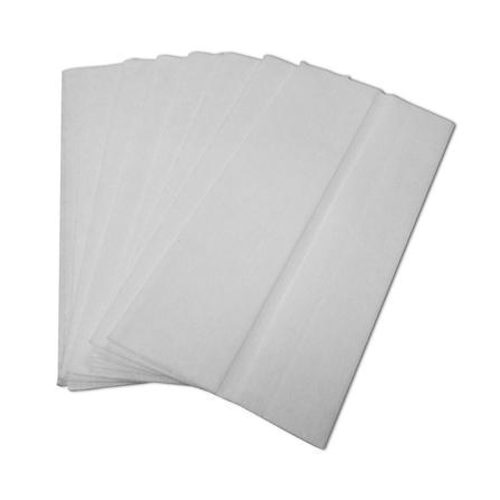
Grab-EEZ Cleanroom Wipes (GE-NT1-712): C-folded 7" x 12" poly/cellulose refills for controlled, one-wipe-at-a-time handling

Shown: Grab-EEZ wipe refills in 7" x 12" format (GE-NT1-712).
1) Practical solutions in a critical environment
When you are trying to keep benches, fixtures, tools, and staging areas clean, the wipe itself is only half the control. The other half is how it is handled.
Grab-EEZ refills are designed around a practical contamination-control problem: preventing “grabbed” stacks, re-touching, and casual countertop exposure that can quietly
introduce fibers, skin oils, and cross-contact residue into otherwise stable processes.
These 7" x 12" refills are intended for a Grab-EEZ-style dispenser workflow where operators withdraw a single folded wipe at a time—useful when gloved hands
are working around sensitive parts, microscopes, optical tooling, assembly fixtures, or QA sampling stations.
2) What is this wiper used for
- General cleanroom wiping of benches, pass-through shelves, carts, and stainless surfaces.
- Controlled wipe withdrawal for line-side cleaning (one wipe at a time to reduce waste and re-touching).
- Routine removal of light residues and handling marks (fingerprints, tape adhesive haze, light oils) when paired with your approved solvent system.
- Spill pickup and “catch wipe” tasks where absorbency and wet strength matter.
- Wiping tools and non-product-contact surfaces before entry into more critical zones.
3) Why should customers consider this wiper (bullets)
- Dispensing discipline: supports one-wipe withdrawal so you are not “fanning” or stacking wipes on a tabletop.
- Poly/cellulose balance: typically chosen when you want good absorbency with practical durability for everyday cleaning.
- Operator-friendly format: 7" x 12" is large enough for folded wiping paths (edge control) without feeling bulky.
- Waste control: reducing accidental multi-wipe grabs can lower consumption without changing your cleaning chemistry.
- Low-linting approach: positioned for low-linting use; note that no wipe is truly lint-free in real operations.
4) Materials and construction
GE-NT1-712 is specified by SOSCleanroom as a Nova-Tech low-linting wipe in a poly/cellulose construction that is commonly described as hydro-entangled (spunlace) nonwoven.
In practical terms, hydro-entangling mechanically interlocks the fibers to create a uniform sheet with decent wet strength—useful when the wipe is dampened with approved solvents
and you need the sheet to stay intact through multiple passes.
Because the base material is a blend, it often behaves differently than a 100% polyester knit wipe: it can feel “grabbier” on some surfaces (good for pickup),
but it can also load faster on tacky residues. Your best results usually come from short, controlled wiping paths and disciplined fold management.
5) Specifications in context (include a table: Attribute vs SKU)
| Attribute |
GE-NT1-712 (Grab-EEZ Cleanroom Wipes 7" x 12") |
| SOSCleanroom SKU / Item |
GE-NT1-712 |
| Wipe size |
7" x 12" |
| Material |
Polyester/Cellulose nonwoven (poly/cellulose blend) |
| Construction |
Hydro-entangled (spunlace) nonwoven (noted at a material-family level) |
| Cleanroom positioning |
ISO Class 6 (Class 1000) listed on SOSCleanroom page |
| Format / dispensing |
Designed for Grab-EEZ dispenser workflow; controlled withdrawal |
| Sterility |
Not stated in SOS source basis (treat as non-sterile unless your documentation specifies otherwise) |
| Edge type |
Not stated in SOS source basis |
Practical note: if your process is sensitive to fibers or solvent residues, your “wipe spec” is not just the sheet—it's the whole system (how it’s dispensed, where it sits,
and whether operators can keep a clean face/dirty face discipline without thinking about it every time).
6) Cleanliness metrics (include: “Typical ion extractables” table and “Typical NVR” table)
For many facilities, the most important “metric” is repeatability: a wipe that behaves the same shift-to-shift when paired with your approved solvent and inspection method.
Where quantitative cleanliness metrics (ions/NVR) are required for documentation, they should be sourced from the manufacturer’s technical data for the exact material and configuration.
If those values are not published for this refill configuration in the sources below, document them through your internal qualification.
Typical ion extractables
| Ion |
Typical value (GE-NT1-712) |
Notes |
| Sodium / Potassium / Chloride (and related ions) |
Not published in SOS/source basis for this configuration |
Manufacturer material-family pages emphasize low chemical extractables, but do not provide ion tables for GE-NT1-712 in the sources listed here. |
Typical NVR (nonvolatile residue)
| Metric |
Typical value (GE-NT1-712) |
Notes |
| NVR (by solvent extract) |
Not published in SOS/source basis for this configuration |
If NVR is a release requirement, qualify the wipe/solvent combination using your internal acceptance criteria and validated method. |
7) Packaging, sterility and traceability
- Pack size (SOS listing): 200 wipes per bag; 12 bags per case.
- Intended use format: refill for 7" x 12" Grab-EEZ dispenser workflow (controlled dispensing).
- Cleanroom positioning: ISO Class 6 (Class 1000) listed on SOSCleanroom page.
- Sterility: not stated in SOS source basis; if your application requires sterile wipes, treat this as non-sterile unless supported by supplier documentation for the lot you receive.
- Lot traceability: not explicitly stated on the SOS listing; if your QA program requires lot-to-lot documentation, request the supplier documentation you need at time of order.
- Country of origin (manufacturer statement): not stated for GE-NT1-712 on the SOS product page. (Related manufacturer material-family pages may include “Made in the USA” tags for certain Nova-Tech lines; confirm COO for your exact configuration through documentation tied to your order.)
8) Best-practice use
The most common wipe-related defects come from technique, not the wipe: too much surface area per fold, reusing a loaded face, and wiping “in circles” that re-deposits
what you just picked up. The dispenser format helps, but your operators still need a simple, repeatable method.
Operator-level wiping technique module (practical, repeatable)
- Withdraw one wipe, then step back: do not “hover” over the dispenser opening while wiping down parts—reduce the chance of drip-back and re-touching.
- Fold for control: fold into quarters (or a manageable rectangle) so you can present a clean leading edge and rotate faces deliberately.
- Wipe directionally: one direction, overlapping passes, from clean-to-less-clean. Avoid circular wiping unless your SOP specifically calls for it.
- Short paths beat long paths: if you feel drag increase or see streaking, rotate to a fresh face. Don’t “push through” a loaded face.
- Solvent control: if you dampen wipes, use only your approved chemistry and apply the minimum needed to wet the surface (over-wetting increases streak risk and dry-down residue issues).
- Single-use discipline: treat the wipe as a consumable tool—once it has picked up residue, discard it. Do not reinsert wipes into dispensers.
9) Common failure modes
- Cross-contact: using the same wipe face across multiple areas (bench → tool → fixture) transfers residues and defeats the “clean-to-dirty” intent.
- Streaking or haze: often caused by too much solvent, wiping too large an area per face, or not allowing proper evaporation time per your SOP.
- Fiber/particle complaints: frequently a handling issue (torn edges from aggressive scrubbing, snagging on burrs, or wiping rough surfaces without matching wipe type).
- Dispenser contamination: leaving the dispenser open, parking used wipes nearby, or reaching in with contaminated gloves can negate the benefit of controlled dispensing.
- Process mismatch: if your critical surface is ultra-sensitive (high-gloss optical surfaces, coated parts, precision sensors), a different wipe construction (e.g., sealed-edge knit polyester) may be the better control.
10) Closest competitors
For poly/cellulose nonwoven cleanroom wipes, competitors typically differentiate on packaging format (flat, pop-up, dispenser refills), cleanliness documentation depth,
and how the wipe is converted and packed for controlled environments.
- Berkshire nonwoven cleanroom wipes (polycellulose / spunlace families): broad nonwoven wipe portfolio for controlled environments; evaluate based on your required format and documentation.
- Contec cleanroom wipes (cellulose/polyester nonwoven and related families): broad sterile and non-sterile wipe families; choose based on cleanroom grade, chemistry pairing, and format.
11) Critical environment fit for this wiper
GE-NT1-712 is a practical “daily-driver” wipe choice when your environment benefits from controlled dispensing and you want a poly/cellulose nonwoven that can handle routine
wipe-down, spill pickup, and light residue removal without feeling overly delicate. The refill workflow is the differentiator: single withdrawal reduces waste and helps
prevent the glove-touch habits that create surprise contamination events.
SOSCleanroom can support continuity of supply for standard consumables and help you standardize ordering units (bag/case) so your team is not mixing similar-looking wipes
with different behaviors. If your QA group needs traceability or documentation, align the requirement to the packaging label and lot ID you receive and keep that linkage
in your internal records.
12) SOSCleanroom note about SOP's
The Technical Vault is written to help customers make informed contamination-control decisions and improve day-to-day handling technique.
It is not your facility’s Standard Operating Procedure (SOP), batch record, or validation protocol.
Customers are responsible for establishing, training, and enforcing SOPs that fit their specific risks, products, equipment, cleanroom classification, and regulatory obligations.
Always confirm material compatibility, cleanliness suitability, sterility requirements, and acceptance criteria using your internal quality system and documented methods.
If you adapt any technique guidance from this entry, treat it as a starting template. Your team should review and approve the final method, then qualify it for your specific surfaces,
solvents, cleanliness limits, inspection methods, and risk profile. In short: use these best-practice suggestions to strengthen your SOPs—not to replace them.
13) Source basis
- SOSCleanroom product page (GE-NT1-712): https://www.soscleanroom.com/product/wipers/grab-eez-cleanroom-wipes-7-x-12-polyester-cellulose/
- Manufacturer material-family page (Nova-Tech NT1 nonwoven wipes): https://high-techconversions.com/product/nova-tech-1000-lint-free-nonwoven-cleanroom-wipes/
- Manufacturer overview PDF (cleanroom wiping solutions; includes Grab-EEZ/Nova-Tech families): https://high-techconversions.com/wp-content/uploads/2023/11/Cleanroom_Wiping_Solutions.pdf
- Standards/regulatory bodies (context references): https://www.iso.org/standard/53394.html ; https://www.fda.gov/ ; https://www.astm.org/ ; https://www.iest.org/
SOSCleanroom is the source for this Technical Vault entry.
Briefed and approved by the SOSCleanroom (SOS) staff.
If you have any questions please email us at Sales@SOSsupply.com
Last reviewed: January 7, 2026
© 2026 SOSCleanroom