The Technical Vault
By SOSCleanroom
Small Format, Sterile Control: Why STX1004 Is a High-Confidence 4" × 4" Wiper for Aseptic and Compounding Workflows
Last reviewed: Jan. 2, 2026 | Audience: sterile compounding, cleanroom operations, contamination control, quality
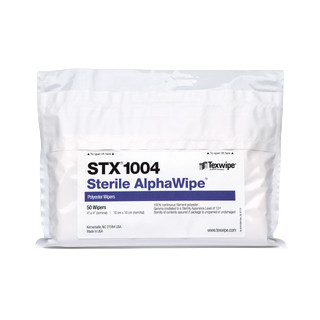
Texwipe STX1004 Sterile AlphaWipe (4" × 4") is a dry, knitted polyester cleanroom wiper designed for
small-area wiping where sterility validation, predictable low-linting behavior, and abrasion tolerance
matter more than maximum coverage per wipe. The “control feature” is not only the substrate; it is the sterile presentation and the
reduced handling burden of a small-format wipe that operators can deploy without over-folding or overworking a single face.
In aseptic and compounding environments, many excursions trace to technique drift: too much wiping force, too many re-passes on one face,
inconsistent wipe wetness, or “making do” with a non-sterile wipe late in a shift. STX1004 is intended to keep that failure chain short by
delivering a sterile, cleanroom-manufactured polyester wipe that behaves consistently on abrasive surfaces and around tight features.
What it’s for
STX1004 is best used for spill control, cleaning, and solution application/removal in controlled environments
where the work area is small and the wipe may contact abrasive surfaces, edges, or hardware. The 4" × 4" footprint is a practical fit for
wipe-down of small tools, fixture points, transfer items, glovebox/isolator touch surfaces, and localized cleaning steps where a larger wipe
becomes a handling variable.
Decision drivers
STX1004 typically earns its place when sterile presentation and small-area control are the top constraints:
- Sterility validation: gamma-irradiated and sterile validated to a 10−6 SAL (per AAMI guidance), supporting aseptic workflow expectations.
- Endotoxin posture: described as tested for endotoxins—a meaningful screen when pyrogen risk management is in scope.
- Substrate and durability: 100% polyester knit with a cut edge, intended to resist snagging/abrasion on rough surfaces and hardware.
- Cleanliness framework: positioned as cleanroom manufactured/laundered and packaged to support low extractables expectations (ions/NVR), supporting qualification discussions.
- Small-format handling control: 4" × 4" reduces “excess wipe” contact, over-folding, and accidental cross-contact in tight areas.
- Program stability through SOSCleanroom: consistent sourcing, lot continuity, and practical application support reduce the likelihood of late-shift substitutions.
Materials and construction – explained like an engineer
“Polyester wipe” is not specific enough for sterile work. What matters is continuous-filament knit behavior under wiping force.
A stable knit structure is selected to reduce unraveling and to tolerate folding, corner work, and contact with fasteners or brushed stainless.
STX1004 is positioned for abrasive surfaces specifically because the wipe is designed to avoid easy snagging that can generate particles and fibers.
The cut edge is appropriate for many applications, but edge-driven releasables are still a known mechanism. If your process history points to edge “stringers”
or fibers at corners, the technical step-up is often a sealed-edge/sealed-border architecture—not “wiping harder” or reusing a face longer.
Cleanliness and performance metrics
In sterile programs, the wipe decision typically collapses into three risk buckets: releasables (particles/fibers), residues (NVR/extractables),
and bioburden/pyrogen controls (sterility assurance, endotoxin screening, and transfer discipline). STX1004 is positioned to address those categories with sterile validation,
endotoxin testing, and cleanroom laundering/packaging controls.
Treat published performance claims and typical values as a qualification starting point. In validation-sensitive environments, confirm suitability in your actual solvent/disinfectant set,
your wiping force window, and your acceptance criteria (visual, particulate, residue, or microbial endpoints as applicable).
Why 4" × 4" matters operationally
Small wipes reduce two common sterile-workflow problems: over-handling and overuse. A larger wipe often invites repeated folding, more touches, and
longer face life because it “still looks usable.” The 4" × 4" format encourages single-area intent—clean a defined feature, rotate/discard, and move on—especially useful
at pass-throughs, small staging zones, and tool wipe-down points where cross-contact risk is higher.
Best-practice use
STX1004 performs best when operators use a tight technique loop: define the surface, control the stroke, and change faces early.
- Face discipline: quarter-fold (or half-fold) to create clean faces; treat each face as single-pass for critical wipe-downs.
- Stroke control: use straight, overlapping, single-direction strokes; avoid back-and-forth scrubbing unless an SOP explicitly requires it.
- Wetness control: if used with solvent/disinfectant, target damp rather than wet; over-wetting increases pooling, wicking into seams, and residue after dry-down.
- Corner strategy: use lighter pressure at edges/fasteners; if snagging occurs, stop and switch architecture rather than forcing the wipe through a rough feature.
- Sterile handling: treat bag presentation, staging time, and “touch count” as contamination controls—not administrative steps.
Common failure modes — and how STX1004 helps
A sterile wipe still becomes a contamination source in predictable ways: reusing a loaded face too long, wiping with excessive force on textured surfaces, inconsistent solvent loading,
and poor sterile presentation discipline. STX1004’s sterile validated presentation and abrasion-tolerant knit help reduce the “snag-and-shed” failure path; the remaining controls are procedural:
face rotation, directional strokes, and controlled wetness.
Closest comparators
The most defensible comparisons are to other sterile polyester wipe programs intended for similar ISO ranges and aseptic handling expectations.
Contec sterile wipe programs (sterile wipe families across polyester/nonwoven architectures) are commonly evaluated when teams want multiple sterile substrate options
and a broad selection matrix (sterile vs. nonsterile, low endotoxin tiers, and presaturated options).
Berkshire sealed-edge sterile knit options are the appropriate comparator class when edge-driven releasables are the dominant risk. Sealed-edge knits are often selected
when the process has demonstrated sensitivity to edge fibers during folding, corner work, or higher wiping forces.
Rule of thumb: When edge control becomes the acceptance driver, sealed-edge/sealed-border is typically the next control step.
When wetness repeatability is the constraint, consider a controlled pre-wetted system. When endotoxin limits are the governing gate, specify a defined low-endotoxin tier.
Where STX1004 fits in a cleanroom wiping program
STX1004 fits best as a small-area sterile “daily driver” wipe for ISO-class controlled environments where teams need a reliable 4" × 4" polyester knit
for localized wipe-downs, solution application/removal, and spill control—especially around abrasive surfaces and tight features. Keep the program mature by defining escalation paths:
sealed-edge sterile knits when edge releasables dominate, and controlled pre-wetted sterile systems when solvent loading variability becomes the primary failure mode.
Terminology note: STX1004 is engineered for low-linting performance; no wiper is truly “lint-free” in every process condition.
Source basis
- SOSCleanroom product page: “Texwipe STX1004 Sterile AlphaWipe 4" × 4" Polyester Cleanroom Wiper” (SKU positioning, ISO range listing, sell-pack presentation as shown on SOSCleanroom).
- ITW Texwipe product information: “AlphaWipe® STX1004 Dry Cleanroom Wipers, Sterile” (sterile validation method/SAL, endotoxin testing note, intended use, ISO Class 4–8 and EU Grade A–D positioning, USP <797>/<800> note, and published packaging configuration).
- Contec Cleanroom product listings: wipes portfolio including sterile wipe categories (sterile program breadth and category framing for comparisons).
- Berkshire product information: sealed-edge knit wipe family used as a comparator class when edge-driven releasables become the dominant risk.
Source: SOSCleanroom Technical Vault | Last reviewed: Jan. 2, 2026
© 2026 SOS Supply. All rights reserved.