The Technical Vault
By SOSCleanroom
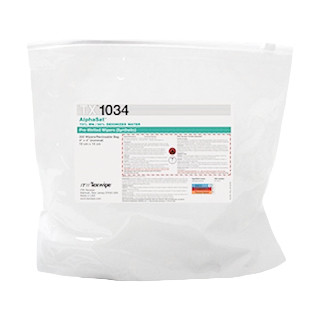
STX1034 sterile AlphaSat® 4" x 4": repeatable 70% IPA delivery for small-area wipe points in ISO 4–8 operations
Last reviewed: Jan. 4, 2026 | Audience: contamination control, cleanroom operations, EHS, quality
A sterile, pre-wetted wiper earns its place when you need the same outcome across operators and shifts: consistent solvent delivery, controlled evaporation, and auditable packaging/traceability. Texwipe STX1034 AlphaSat® is built around that reality—4" x 4" format for tight wipe points, a cut-edge polyester substrate engineered for low-linting performance, and pre-wetting intended to reduce the process drift that shows up when teams rely on spray-and-wipe or ad-hoc wetting.
STX1034 is pre-wetted with 0.2 µm-filtered, USP-grade 70% IPA / 30% DI water and sterilized by gamma irradiation to a 10-6 sterility assurance level (SAL). It is commonly positioned for ISO Class 4–8 (Class 10–100,000) workflows and EU Grade A–D cleaning programs where documentation discipline matters as much as wipe count.
What it’s for
STX1034 is typically selected for sterile, small-area wiping where the 4" x 4" geometry prevents over-contact: glove fingertip wipe-downs, tool handles entering critical space, touchpoints on carts and equipment, spot cleaning on stainless steel, and transfer/disinfection steps that require consistent wetness without managing open solvent bottles. It is also used as a controlled wipe for wiping phones, notebooks, and other items entering the cleanroom when your SOP allows and the item can tolerate IPA.
Decision drivers
Treat “pre-wetted sterile” as a process control choice: you are buying repeatability (wetness + handling + traceability), not just a fabric square.
- ISO range and format fit: Designed for ISO Class 4–8 work, with a 4" x 4" size that supports precision wiping without dragging excess fabric across unintended surfaces.
- Solvent repeatability: Pre-wetted with 0.2 µm-filtered, USP-grade 70% IPA / 30% DI water to reduce operator-dependent wetting variability and improve consistency across shifts.
- Sterility assurance and documentation: Gamma irradiated to 10-6 SAL, with sterile program documentation expectations (e.g., certificates and lot/expiry markings) that support audit trails.
- Edge strategy for low releasables: Cleanroom laundered polyester with a cut edge is selected when you need strong solvent compatibility and controlled releasables without the cost/rigidity of sealed borders.
- Packaging that protects wetness: Recloseable/slider bag packaging is intended to reduce evaporation and keep each wipe closer to the same wetness level through the bag’s use life.
- EHS and shipping reality: 70% IPA systems introduce flammability and exposure controls—expect ground-transport constraints and plan storage/dispensing accordingly.
Materials and construction
STX1034 uses a 100% continuous-filament polyester knit (AlphaWipe® material) selected for solvent wiping in controlled environments: polyester resists abrasion, holds together on rougher wipe points, and tolerates common cleaning chemistries used in cleanrooms (including IPA). The "cut edge" strategy keeps handling simple while relying on laundering/process controls to maintain low releasables.
The practical takeaway: a cut-edge polyester wipe can be an excellent choice when you need reliable wipe strength and chemical compatibility—but you still have to control technique (folding, pressure, single-pass behavior) to prevent re-deposition and edge scuffing from becoming the dominant contamination mechanism.
Specifications in context
Size: 4" x 4" (10 cm x 10 cm) is a deliberate control choice for high-touch points and critical small surfaces—operators are less likely to “over-wipe” into adjacent zones.
Wiper edge: Cut edge (cleanroom laundered) supports strong wiping with controlled releasables when used with a disciplined fold-and-wipe method.
Sterility: Sterile product, gamma irradiated to 10-6 SAL; sterile validation documentation and related certificates are commonly used for qualification packages.
Pre-wet chemistry: 70% IPA / 30% DI water, 0.2 µm filtered, USP-grade solvent system to reduce wetness variability and improve repeatability.
ISO environment: Positioned for ISO Class 4–8 (Class 10–100,000) and EU Grade A–D applications.
Cleanliness and performance metrics
Published “typical” contamination metrics are best treated as a qualification starting point (baseline), then verified against your surfaces, solvents, and technique. For STX1034’s AlphaWipe® substrate family, manufacturer data sets commonly reference IEST-RP-CC004 and ASTM E2090 frameworks for releasables testing.
Typical releasables and extractables (examples from manufacturer PDFs):
• LPC ≥0.5 µm: 8.4 x 10⁶ particles/m2
• Fibers >100 µm: 2,000 fibers/m2
• Particles 0.5–5.0 µm: 10 x 106 particles/m2
• Particles 5.0–100 µm: 200,000 particles/m2
• NVR (IPA extractant): published typicals in the ~0.04–0.06 g/m2 range (document revision dependent)
• NVR (DI water extractant): published typicals in the ~0.01–0.02 g/m2 range (document revision dependent)
• Extractable ions (examples): Sodium ~0.15–0.22 ppm; Potassium ~0.03–0.06 ppm; Chloride ~0.05–0.10 ppm (document revision dependent)
Absorbency behavior (AlphaWipe® substrate typicals): Sorptive capacity ~530 mL/m2; sorptive rate published as sub-second (<0.3 s to ~0.5 s depending on revision); basis weight ~158 g/m2.
Sterility, solvent control, and evaporation management
The operational value of STX1034 is not simply “it has IPA.” It’s that each wipe is delivered at a controlled saturation level and packaged to protect that level during use, which improves repeatability and reduces VOC spikes versus open spray bottles. For sterile programs, the combination of gamma sterilization (10-6 SAL), lot coding, and expiration dating supports traceability and reduces ambiguity during investigations.
Rule of thumb: If the bag is open, evaporation is active—stage wipes in the smallest practical working quantity, reseal immediately, and do not “leave the bag cracked” on the bench.
Best-practice use
Technique is the difference between contaminant removal and contaminant redistribution. If your facility has a validated wiping SOP, follow it; if not, the practices below are widely used as a controlled starting point for qualification.
- Fold for clean faces: Fold to create multiple usable faces (e.g., quarters). Use one face per pass on critical surfaces; rotate to a clean face before you see streaking or soil loading.
- Single-pass with overlap: Wipe in one direction with modest overlap; avoid scrubbing back-and-forth, which increases re-deposition risk and can elevate edge scuffing on sensitive surfaces.
- Clean-to-dirty pathing: Start at the cleanest zone and move toward the dirtiest, changing wipes at zone boundaries to prevent cross-contamination.
- Pressure control: Use only the pressure needed to maintain contact. Excess force increases frictional particle generation and can squeeze solvent out faster than intended.
- Do not assume “wipe = disinfection”: For microbial control, follow your validated chemistry and contact time requirements; IPA is commonly used for wipe-down and residue removal, but disinfection claims depend on your program validation.
- EHS handling: Treat used wipes as solvent-contaminated waste per your site rules. Keep away from ignition sources and manage eye/skin exposure per SDS guidance.
Common failure modes
Evaporation drift: Leaving the pouch open drives down wetness consistency and increases streaking—stage small quantities and reseal promptly.
Re-deposition from overuse: Using the same wipe face too long converts removal into smearing—rotate faces and change wipes at defined triggers (visible soil, streaking, boundary changes).
Cross-contamination: Carrying a wipe from “dirty” touchpoints back into critical space defeats the sterile intent—maintain clean-to-dirty flow and discard at zone boundaries.
Technique-induced particles: Aggressive scrubbing increases frictional generation and can elevate edge interaction—use controlled passes and appropriate pressure.
Program mismatch: Using a 4" x 4" wipe for large surfaces encourages over-handling and reusing—step up to a larger format when the surface area demands it.
Closest competitors
Contec PROSAT® Sterile wipes (70% IPA/30% DI water, gamma sterilized): Often built on nonwoven substrates (cellulose/polyester blends) designed for convenience and repeatable solvent application; mechanism difference is substrate structure (nonwoven vs knit polyester), which can change abrasion behavior, absorbency feel, and releasables profiles depending on the surface and wiping force.
Berkshire sterile pre-saturated wipe families (70/30 IPA solutions): Commonly offered across multiple substrate constructions (nonwoven blends and sealed-edge polyester options). The key mechanism trade is edge strategy and fabric architecture—sealed edges can reduce edge fray risk, while knit polyester can improve durability on rough wipe points; your process sensitivity and surface type should drive the selection.
Where it fits in a cleanroom wiping program
STX1034 fits as a “precision solvent control” wiper for sterile and controlled wipe points—especially when you want standardized wetness, strong traceability, and reduced dependence on operator-controlled spray volumes. In a tiered wiping program, it commonly sits between (1) dry sterile wipes used for final wipe/drydown steps and (2) larger-format pre-wetted wipes selected for broad surface coverage. When the failure mechanism is variability (wetness, technique, or documentation gaps), pre-wetted sterile systems can reduce investigation noise and improve repeatability.
Terminology note: Engineered for low-linting performance; no wiper is truly “lint-free” in every process condition.
Source basis
- SOSCleanroom product page (STX1034): https://www.soscleanroom.com/product/wipers/texwipe-stx1034-sterile-alphasat-4-x-4-polyester-cleanroom-wiper-pre-wet-70-ipa-stx1034/
- Manufacturer PDF (SOS-hosted stable copy) — AlphaWipe® Wipers TX1034/TX1036/TX1039 (Effective: December 2012): https://www.soscleanroom.com/content/texwipe_pdf/1034%201036%201039.pdf
- Manufacturer PDF (Texwipe.com) — AlphaWipe® Technical Data Sheet (TEX-LIT-TDS-004 Rev.00-02/17): https://www.texwipe.com/images/uploaded/documents/Wipers/Texwipe-AlphaWipe-TDS-ENG.pdf
- Manufacturer product page (STX1034): https://www.texwipe.com/sterile-alphasat-with-alphawipe-stx1034
- Safety Data Sheet (Texwipe® Wipers pre-wetted with 60%–70% IPA): https://www.texwipe.com/images/uploaded/documents/Safety%20Data%20Sheets/2023%20wipe%20sds%20us-can-mex/60-70/TX1034_US_CA_SDS_ENG_May_31_2023.pdf
- Competitor reference — Contec PROSAT® Sterile wipes datasheet (example PDF): https://www.contecinc.com
- Competitor reference — Berkshire sterile pre-saturated wipes category: https://berkshire.com/product-category/presaturated-cleanroom-wipes/sterile-wipes/
Source: SOSCleanroom Technical Vault | Last reviewed: Jan. 4, 2026
© 2026 SOS Supply. All rights reserved.