The Technical Vault
By SOSCleanroom
Sterile Spill Control Without the Guesswork: Why STX609 TechniCloth Is a Practical Control for USP <797>/<800> Wipe-Downs
Last reviewed: Jan. 2, 2026 | Audience: contamination control, cleanroom operations, EHS, quality
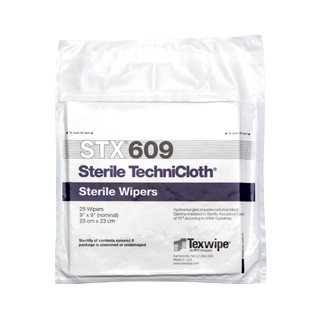
In sterile or aseptic-facing workflows, “wipe selection” is rarely about comfort or preference. It is about controlling variables that drive deviations: inconsistent absorbency during spill pickup, changing residue behavior when solutions are applied and removed, and avoidable risk from introducing non-sterile consumables into controlled steps. Texwipe STX609 TechniCloth (9" × 9") is engineered for that middle ground—high-absorbency wiping and spill control—while maintaining a sterile, traceable presentation aligned to USP <797> and USP <800> expectations.
Operational reliability matters as much as the substrate. Standardizing STX609 through SOSCleanroom helps programs sustain continuity of supply and documentation discipline (lot traceability, case-level paperwork, and consistent replenishment), reducing the risk of last-minute substitutions that quietly shift absorbency, releasables, and sterility controls.
What it’s for
STX609 is best used for wiping and cleaning surfaces, equipment, and parts where a high-absorbency wiper is needed, including spill control and application/removal of solutions such as disinfectants, lubricants, adhesives, and residues. It is commonly selected where sterile presentation is required (or strongly preferred) to support aseptic discipline and reduce handling-driven contamination risk during routine wipe-downs and response cleaning.
Decision drivers
STX609 earns its place when the program needs absorbency and sterility—without turning wiping into a new variability source:
- Substrate balance for real-world wiping: a cellulose/polyester nonwoven blend targets fast wet-out and fluid hold while improving wet strength versus all-cellulose options.
- Sterile assurance and documentation posture: gamma-irradiated sterile product positioning supports controlled introduction; case documentation supports investigation and audit readiness.
- Published contamination framework: typical values for particles/fibers, nonvolatile residue (NVR), extractable ions, and absorbency support placement decisions and qualification discussions.
- Chemistry compatibility: positioned for compatibility with common solvents and disinfectants used in controlled cleaning (verify with your chemistry set and surface sensitivity).
- Packaging that supports clean technique: sterile packaging format encourages staged access and face-control behaviors (fresh wipe, fresh face, early discard), reducing redeposit risk.
- ISO placement context: positioned for ISO Class 5–8 environments, with final suitability dependent on the step risk and the wiping method used.
Materials and construction – explained like an engineer
“Absorbent sterile wipe” is still too broad to be actionable. What matters is how the wipe behaves once it is wet and under wiping force. STX609 uses a 45% polyester / 55% cellulose nonwoven construction with a cut edge. Cellulose drives rapid wet-out and fluid capture (spill response and solution handling), while polyester supports tensile strength and reduces the tendency of the wipe to collapse when damp.
In practice, this blend is a pragmatic control for routine wipe-downs and spill response where you want absorbency and speed—without relying on improvised, non-sterile alternatives that can introduce uncontrolled fibers, residues, or handling risk.
Specifications in context
Format: 9" × 9" (23 cm × 23 cm). This size is a practical “control format” for folding into stable quarters, creating multiple usable faces, and maintaining consistent contact area without overreaching into adjacent zones.
Packaging (sterile): commonly supplied as 100 wipers per bag (organized as 4 packs of 25) with 5 bags per case. Treat the received case label and the SOSCleanroom SKU configuration as the governing control for kitting, staging, and incoming inspection.
Shelf life (sterile): plan around a recommended 3-year shelf life from date of manufacture, and manage FIFO/FEFO per your quality system and storage controls.
Cleanliness and performance metrics
For most users, the qualification conversation collapses to three technical categories: releasables (particles/fibers), residues (NVR), and ions—plus whether absorbency is stable enough to prevent “spill control” from becoming “spill spread.” STX609’s published typical values provide a defensible starting point for placement.
- Absorbency: typical sorptive capacity is 360 mL/m² with a sorptive rate of <0.3 seconds. Translation: fast wet-out and strong spill pickup—useful when slow wetting forces multiple passes and widens the contamination footprint.
- Particles/fibers: typical LPC (≥0.5 µm) 72 × 106 particles/m²; typical fibers (>100 µm) 55,000 fibers/m². Translation: appropriate for many ISO 5–8 wiping tasks, but not the same edge-control posture as sealed-edge polyester knits used for the most defect-sensitive finishing steps.
- NVR: typical 0.01 g/m² (IPA), 0.03 g/m² (DI water), 0.01 g/m² (ethanol). Translation: if haze or streaking appears after dry-down, technique levers (wetness control, face rotation, early discard) usually move the needle more than added pressure.
- Ions: typical extractables include sodium 12 ppm, potassium 1 ppm, chloride 10 ppm. Translation: for corrosion-sensitive assemblies or high-impedance electronics, ions are a defect mechanism—validate wiping steps where ionic background is the acceptance driver.
Terminology note: STX609 is engineered for low-linting performance; no wiper is truly “lint-free” in every process condition.
Sterility, packaging discipline, and traceability
Sterile wipes fail programs less often due to “sterility” and more often due to handling and staging behavior: opening too early, setting wipes on uncontrolled surfaces, reusing a wipe beyond its effective life, and losing lot traceability when investigations start. STX609’s sterile posture is designed to reduce those failure modes when paired with disciplined technique.
- Sterility assurance: sterile products in this family are gamma irradiated to a stated SAL of 10−6 per AAMI guideline framing.
- Case documentation: case-level documentation (compliance/analysis/irradiation paperwork) supports investigations and audit defense when trends shift.
- Lot traceability: individually lot coded for quality control and change-control workflows.
- Workflow gate: “sterile” is not the same as “aseptic technique.” Your controls still depend on bag presentation, staging time limits, and clean transfer behaviors.
Best-practice use
STX609 performs best when technique prevents the wipe from becoming a redistribution tool:
- Fold for face control: quarter-fold to create multiple clean faces; treat each face as single-pass for higher-risk wipe-downs.
- Directional strokes: use controlled, overlapping, single-direction passes; avoid back-and-forth scrubbing unless an SOP requires it.
- Control wetness: damp is usually the control target. Over-wetting increases pooling, seam wicking, and residue after dry-down.
- Spill logic: blot/pickup first, then finish with fresh faces and controlled strokes to avoid spreading.
- Discard early: once the face is loaded or near saturation, change the wipe—especially in sterile or aseptic-facing steps.
Common failure modes — and how STX609 helps
The predictable failure modes in sterile wipe-down programs are (1) reusing a loaded face too long, (2) over-wetting and pooling, (3) wiping “wide” and contaminating adjacent areas, and (4) losing traceability during investigations. STX609 helps by pairing strong absorbency with a sterile, documented, lot-traceable posture—while the remaining controls stay procedural: face rotation, directional strokes, wetness discipline, and staging controls appropriate to the area.
Closest comparators
The most defensible comparisons are to other sterile, high-absorbency nonwoven wipe programs intended for ISO 5–8 environments and USP-facing workflows.
Contec sterile nonwoven wipe programs are often evaluated when documentation depth and sterile presentation are the primary drivers. Compare packaging discipline, lot paperwork posture, and how the wipe behaves across your disinfectant set and dwell-time practices.
Berkshire sterile wipe programs (nonwoven and knit families) are appropriate comparators when facilities are balancing absorbency needs with releasables control, and when they may need to step up into different architectures for more defect-sensitive finishing steps.
Rule of thumb: Use sterile nonwoven blends like STX609 when absorbency and speed drive the task under sterile discipline. When edge-driven releasables become the acceptance driver, sealed-edge polyester knit is often the technical step-up. When wetness repeatability is the constraint, consider a controlled pre-wetted sterile system.
Where STX609 fits in a cleanroom wiping program
STX609 is a strong fit for the sterile, absorbency-driven tier of controlled cleaning: spill response, solution application/removal, and routine wipe-downs where sterile presentation and traceability reduce handling risk and support USP-facing expectations. Keep the program mature by clearly separating (1) spill/routine wiping, (2) residue- or defect-sensitive finishing (often polyester knit, sometimes sealed-edge), and (3) validation-sensitive sampling consumables where the wipe becomes part of the measurement system.
Source basis
- SOSCleanroom product page: “Texwipe STX609 Sterile TechniCloth 9" × 9" Cellulose/Polyester Cleanroom Wiper” (SKU configuration, positioning, packaging presentation).
- ITW Texwipe technical data sheet (September 2016): “TechniCloth® — Dry | Pre-Wetted | Sterile” (composition; applications; ISO Class 5–8; USP <797>/<800> statement; shelf life; sterile gamma irradiation/SAL statement; typical particles/fibers, NVR, ions, absorbency; packaging table including STX609).
Source: SOSCleanroom Technical Vault (soscleanroom.com) | Last reviewed: Jan. 2, 2026
© 2026 SOS Supply. All rights reserved.