Texwipe TX1045 TechniSat 6" x 8" Cellulose/Polyester Cleanroom Wiper Pre-Wetted 70% IPA

$34.59
SKU: TX1045 BAG 7-10 Business Days
(No reviews yet)
Availability:
7-10 Business Days
Shipping:
Calculated at Checkout
International Shipping:
Restricted to U.S. destinations only
Type:
Pre-Wet Wiper
Family:
TechniSat
Material:
Cellulose/Polyester
Wiper Size:
6" x 8"
Wiper Edge:
Cut Edge
ISO Class:
ISO 5 (Class 100) - ISO 8 (Class 100,000)
Country of Origin:
Made in USA

Texwipe TX1045 TechniSat® 6" x 8" Cellulose/Polyester Cleanroom Wipers - Pre-Wetted 70% IPA / 30% DIW - 100/Bag - 1,200/Case

Texwipe TX1045 TechniSat® is a non-sterile, pre-wetted cleanroom wiper manufactured from a hydroentangled nonwoven blend of 55% cellulose and 45% polyester. Designed for routine cleaning and wiping in controlled environments, TX1045 combines the liquid sorption characteristics of cellulose with the added strength of polyester to support effective removal of compatible surface residues, handling contamination, and light processing soils.

Each 6" x 8" wiper features a cut-edge construction and is pre-wetted with a factory-prepared solution of 70% isopropyl alcohol (IPA) and 30% deionized water (DIW), filtered to 0.2 µm. The ready-to-use presentation reduces the need for manually diluting alcohol, wetting dry wipers, or applying free liquid with spray bottles at the point of use.

The compact 6" x 8" format is especially useful for controlled wiping of smaller work surfaces, equipment housings, tools, fixtures, and cleanroom accessories. The soft, absorbent cellulose/polyester substrate helps provide consistent surface contact while its hydroentangled structure supports strength during ordinary cleaning activities.

TX1045 is supplied in a reclosable slider bag containing 100 pre-wetted wipers. Each manufacturer case contains 12 bags, totaling 1,200 wipers. The resealable package helps limit IPA evaporation and supports controlled dispensing when properly closed after use.

Texwipe identifies TX1045 for ISO Classes 5 through 8 and EU GMP Grades B through D. Product suitability depends on the facility's cleaning procedures, required cleanliness levels, surface compatibility, and contamination-control requirements.

Compact Cleaning Advantage: TX1045 combines a 55% cellulose / 45% polyester nonwoven substrate with controlled 70% IPA / 30% DIW pre-wetting. Its 6" x 8" size and 100-count reclosable slider bag make it a practical choice for consistent point-of-use cleaning without unnecessary solvent preparation or oversized wiping materials.

Specifications:
  • Manufacturer: Texwipe, an ITW company
  • Manufacturer Part Number: TX1045
  • Brand: TechniSat®
  • Substrate Family: TechniCloth®
  • Product Type: Non-Sterile Pre-Wetted Cleanroom Wiper
  • Material Composition: 55% cellulose / 45% polyester
  • Construction: Hydroentangled nonwoven
  • Edge Treatment: Cut edge
  • Color: White
  • Nominal Size: 6" x 8" (15 cm x 20 cm)
  • Wetting Solution: 70% isopropyl alcohol / 30% deionized water
  • Solution Filtration: 0.2 µm
  • IPA Grade Documentation: Confirm with Texwipe when a specific grade is mandatory for the process
  • Presentation: Pre-wetted and ready to use
  • Sterility: Non-sterile
  • Cleanroom Classification: ISO Classes 5-8
  • Traditional Cleanroom Classes: Class 100-100,000
  • EU GMP Environment: Grades B-D, subject to facility requirements
  • Packaging Format: Reclosable slider bag
  • Wipers per Bag: 100
  • Bags per Manufacturer Case: 12
  • Total Wipers per Case: 1,200
  • Purchase Options: Individual bag or full manufacturer case
  • Manufacturer Lot Identification: Lot coded
  • Published Shelf Life: 3 years from date of manufacture
  • Country of Manufacture: USA
  • Manufacturer Quality System: ISO 9001:2015
  • Primary Application: General controlled-environment surface cleaning
  • Use Classification: Disposable, single-use wiper
  • Disinfectant Status: No independently established registered disinfectant or sporicidal claim
  • Manufacturer Technical Reference: US-TDS-003 Rev. 4/23
Packaging and Case Configuration:

TX1045 is supplied in reclosable slider bags designed to support controlled dispensing and limit solution evaporation. The current manufacturer packaging is 100 pre-wetted wipers per bag and 12 bags per case.

Purchase Configuration Packaging Total Wipers
Individual Bag 1 reclosable slider bag 100
Manufacturer Case 12 reclosable bags 1,200

The reclosable slider bag is intended to protect the remaining pre-wetted wipes during dispensing. Keeping the bag closed between uses helps reduce solvent evaporation and unnecessary exposure to environmental contamination.

Packaging Confirmation: TX1045 is supplied as 100 wipers per reclosable slider bag, with 12 bags per manufacturer case. This is the current manufacturer configuration and should not be confused with older references to a canister presentation or with the 50-count flexpack used for TX1065.

About the Manufacturer:

Texwipe, an ITW company, manufactures cleanroom wipers, swabs, cleaning-validation consumables, and contamination-control products for pharmaceutical manufacturing, biotechnology, semiconductor processing, medical devices, laboratories, and other controlled environments.

Texwipe's TechniCloth® material combines cellulose and polyester in a nonwoven substrate designed to provide absorbency, mechanical strength, and controlled particle and extractables performance. TechniSat® applies factory-prepared IPA/DIW wetting solutions to this substrate for convenient ready-to-use cleaning.

SOSCleanroom is an authorized Texwipe distributor, providing manufacturer product documentation, application assistance, packaging information, and procurement support for cleanroom supplies and contamination-control programs.

TX1045 Features:
  • 55% cellulose / 45% polyester substrate
  • Hydroentangled nonwoven construction
  • 6" x 8" compact wiping format
  • Cut-edge construction
  • Soft and absorbent wiping material
  • Factory pre-wetted with 70% IPA / 30% DIW
  • 0.2 µm filtered wetting solution
  • Ready-to-use cleaning presentation
  • Non-sterile supply
  • ISO Classes 5-8 manufacturer positioning
  • EU GMP Grades B-D environmental positioning
  • Manufactured for low particle and extractables contribution
  • Controlled wetness for repeatable cleaning procedures
  • Reclosable slider bag packaging
  • Reduced need for separate alcohol bottles and manual dilution
  • Manufacturer lot identification
  • Three-year manufacturer-published shelf life
  • 100 wipers per bag
  • 12 bags per case
  • 1,200 wipers per manufacturer case
TX1045 Benefits:
  • Compact Cleaning Coverage: The 6" x 8" dimensions are convenient for small work surfaces, equipment components, and routine wipe-down tasks.
  • Effective Liquid Sorption: Cellulose contributes useful liquid pickup characteristics for general cleaning.
  • Added Material Strength: Polyester helps support the substrate during ordinary wiping operations.
  • Consistent Wetting Chemistry: Factory-prepared IPA/DIW reduces variation from manual solution mixing.
  • Reduced Solvent Handling: Pre-wetted wipes minimize the need for separate squirt bottles, solvent containers, and direct spray application.
  • Convenient Point-of-Use Dispensing: Reclosable slider bags allow controlled access to wipes during cleaning.
  • Evaporation Control: Proper resealing helps preserve wetness between dispensing events.
  • Standardized Cleaning: Defined wiper dimensions and wetting chemistry support consistent procedures across operators.
  • General Surface Compatibility: The soft blended substrate is practical for cleaning appropriately qualified surfaces.
  • Low Particle Design: Intended for general controlled-environment cleaning where material performance meets facility limits.
  • Traceability: Lot identification supports inventory management and quality documentation.
  • Flexible Purchasing: Individual bags and full cases suit different consumption volumes.
Common Applications:
  • Routine cleaning of controlled-environment work surfaces
  • Wiping laboratory benches and equipment exteriors
  • Cleaning production tools and accessories
  • Wiping fixtures, carts, and material-handling equipment
  • Removal of compatible handling residues and light soils
  • Cleaning small production components
  • General wipe-downs in qualified ISO Classes 5-8 areas
  • Pharmaceutical and biotechnology equipment support cleaning
  • Medical device manufacturing surface cleaning
  • Semiconductor and electronics support-area wiping where appropriate
  • Cleaning compatible items before controlled-area introduction
  • Light spill cleanup where IPA is appropriate for the material and surface
  • Cleaning of high-touch support surfaces under approved procedures
  • Standardized wipe-downs between manufacturing tasks or process steps
Cellulose/Polyester Material Construction:

TX1045 uses the TechniCloth® hydroentangled cellulose/polyester nonwoven substrate. This blend differs from 100% polypropylene and sealed-edge 100% polyester wipers in absorbency, fiber release, mechanical behavior, and residue characteristics.

  • 55% Cellulose: Provides liquid sorption characteristics useful for compatible wiping and residue collection.
  • 45% Polyester: Adds strength and durability to the nonwoven substrate.
  • Hydroentangled Construction: Mechanically entangles fibers to form the wiping material.
  • Soft Surface Contact: Supports controlled wiping of compatible surfaces.
  • Cut Edges: Do not provide the same fiber containment as sealed-border polyester wipers.
  • Liquid Pickup: The blend is useful where absorption and retention of cleaning liquid are important.
  • Residue Requirements: Evaluate extractables and material shedding where cleaning acceptance limits are especially restrictive.
  • Critical Surfaces: Consider an appropriately qualified sealed-edge polyester material when tighter fiber and particle requirements apply.
  • Surface Suitability: Confirm that both the wipe substrate and IPA/DIW chemistry are compatible with the equipment being cleaned.

Material Selection Guidance: Cellulose/polyester blends provide useful absorbency and general wiping performance, but they should not be assumed equivalent to sealed-edge polyester in stringent fiber, particle, or residue-control applications. Select the wiper according to actual surface requirements and approved cleaning procedures.

70% IPA / 30% DIW Wetting Chemistry:

TX1045 is pre-wetted with 70% IPA and 30% DIW using a manufacturer-controlled solution filtered to 0.2 µm. This helps provide a defined cleaning solution without requiring operators to prepare their own alcohol mixture.

  • 70% IPA: Supports removal of compatible handling contamination, lubricants, and processing residues.
  • 30% DIW: Provides the water component of the prepared wetting formulation.
  • Manufacturer Solution Preparation: Helps standardize chemical concentration across supplied wipes.
  • 0.2 µm Filtration: Used in preparing the wetting solution.
  • Non-Sterile Supply: Filtered wetting chemistry does not make the finished wipe sterile.
  • Controlled Wetness: Factory-prepared wipes reduce variability associated with manual wetting.
  • Solvent Evaporation: Open bags and exposed wipes can lose IPA and moisture.
  • Surface Compatibility: Test sensitive plastics, adhesives, coatings, labels, and finishes before use.
  • Disinfection: The 70% IPA concentration alone does not establish product-specific antimicrobial efficacy or contact time.
  • Sporicidal Activity: TX1045 is not a substitute for a qualified sporicidal product.
  • IPA Grade: Confirm the exact manufacturer IPA grade when required by the facility's material specification.

Chemistry Guidance: TX1045 uses a verified 70% IPA / 30% DIW formulation. Where a process requires a particular IPA grade, request confirmation against the current manufacturer specification and relevant lot documentation. A non-sterile wipe containing 70% IPA does not independently qualify as a sterile disinfectant or sporicide.

Best-Practice Wiping Procedure:

TX1045 supports consistent point-of-use cleaning when paired with a controlled wiping procedure. Good dispensing practices and appropriate wipe replacement help reduce evaporation, contamination transfer, and redeposition of collected residues.

  1. Confirm Product Suitability: Verify TX1045 is approved for the surface and controlled-area requirements.
  2. Inspect the Bag: Confirm product identification, lot, expiration, and packaging condition.
  3. Prepare the Work Area: Follow the prescribed cleaning sequence and contamination-control procedure.
  4. Use Appropriate Gloves: Wear suitable gloves and protective equipment required by the task.
  5. Open the Slider Bag: Open only as much as needed to remove a wiper.
  6. Dispense Carefully: Avoid touching the remaining wipes with contaminated gloves.
  7. Reseal Immediately: Close the slider bag to help preserve the wetness of unused material.
  8. Fold When Appropriate: Create manageable wiping faces according to the approved SOP.
  9. Wipe in Controlled Strokes: Use overlapping straight-line passes in the prescribed direction.
  10. Maintain Consistent Pressure: Avoid unnecessary scrubbing or excessive abrasion.
  11. Rotate Clean Faces: Use a clean portion of the wiper when moving to another area.
  12. Replace as Needed: Discard wipes that become soiled, damaged, tacky, or inadequately wetted.
  13. Do Not Reuse: Never return a used wipe to the original package.
  14. Document the Activity: Complete any required cleaning and lot-use records.

Wiping Guidance: Factory pre-wetting reduces the need for manual solvent preparation, but consistent results still depend on controlled wipe handling, stroke direction, surface coverage, wipe replacement, and prompt bag closure.

Reclosable Slider Bag and Evaporation Control:

TX1045 is packaged in a reclosable slider bag to support controlled dispensing and help limit solution evaporation. Correct opening and storage practices are important for preserving the manufacturer-prepared wipe condition.

  • Open Only as Required: Limit unnecessary exposure of unused wipes.
  • Close the Slider Fully: Verify that the bag is resealed after each dispensing event.
  • Protect the Opening: Prevent contact with contaminated gloves, splashes, or uncontrolled surfaces.
  • Limit Heat Exposure: Avoid conditions that accelerate IPA evaporation.
  • Inspect Wipe Wetness: Do not use dried or compromised wipes when consistent wetness is required.
  • Follow In-Use Limits: Apply the facility's approved procedures for opened bags.
  • Maintain Lot Identification: Keep packaging identification available when required for traceability.
  • Use Proper Storage: Store in accordance with manufacturer instructions and the applicable Safety Data Sheet.

Dispensing Guidance: Reclosable packaging helps reduce IPA loss but does not eliminate evaporation. If wipes become progressively drier, inspect bag closure, storage conditions, and handling practices before continuing use.

Typical Particle, Fiber and Extractables Performance:

Texwipe publishes typical laboratory data for the TechniCloth® cellulose/polyester substrate family. These values can assist in product selection but do not represent guaranteed, lot-specific TX1045 cleanliness limits.

Typical Characteristic Manufacturer-Reported Value
Particles ≥0.5 µm 72 x 106 particles/m²
Fibers >100 µm 55,000 fibers/m²
NVR - IPA Extractant 0.01 g/m²
NVR - DIW Extractant 0.03 g/m²
NVR - Ethanol Extractant 0.01 g/m²
Typical Sodium 12 ppm
Typical Potassium 1 ppm
Typical Chloride 10 ppm
Sorptive Capacity 360 mL/m²
Sorptive Rate Less than 0.3 seconds
Basis Weight 69 g/m²

The values are manufacturer-reported typical analyses under defined testing methods. Actual cleanliness and wiping performance depend on handling, wetting chemistry, surface condition, and the facility's cleaning procedure.

Performance Data Guidance: Typical particle, fiber, and extractables values are not formal lot-specific product acceptance limits. For critical surfaces, qualify the wipe under the applicable contamination-control and surface-cleanliness requirements.

Selection Notes: TX1045 vs. Other TechniSat® Wipers:

Texwipe offers multiple TechniSat® sizes and packaging formats. All use the cellulose/polyester substrate family, but wiper dimensions, wetting concentration, and package quantities vary.

Product Size Wetting Solution Manufacturer Packaging
TX1045 6" x 8" 70% IPA 100/bag; 12 bags/case; 1,200 wipes
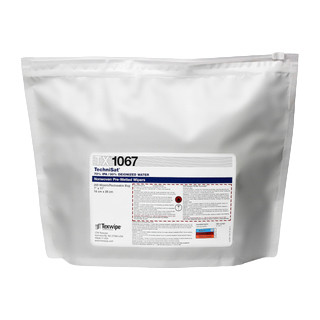
TX1067 7" x 11" 70% IPA 200/bag; 4 bags/case; 800 wipes
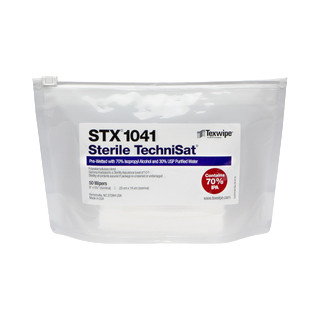
TX1041 9" x 11" 70% IPA 70/bag; 12 bags/case; 840 wipes
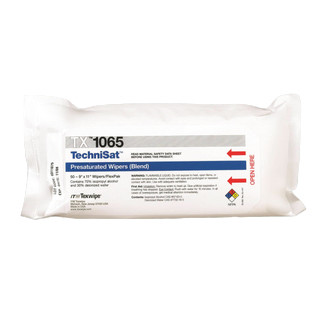
TX1065 9" x 11" 70% IPA 50/flexpack; 20 packs/case; 1,000 wipes
TX1048 8" x 5" 6% IPA 210/refill; 12 refills plus 1 tub
TX8488 9" x 11" 6% IPA 300/bag; 3 bags/case; 900 wipes
  • Choose TX1045: When a compact 6" x 8" wiper is appropriate for the cleaning task.
  • Choose TX1067: For a larger 7" x 11" wiper and high-count slider bags.
  • Choose TX1041: For a 9" x 11" wiper supplied in 70-count reclosable bags.
  • Choose TX1065: For a larger 9" x 11" wiper supplied in 50-count flexpacks.
  • Choose TX1048 or TX8488: When a qualified procedure specifically calls for a 6% IPA formulation rather than 70% IPA.
  • Verify Substitutions: Match size, solvent concentration, packaging, and material cleanliness requirements before changing an approved cleaning consumable.

Selection Guidance: TX1045 is the compact 6" x 8" TechniSat® format with 70% IPA and 100-count slider bags. Larger TechniSat® models provide different surface coverage and case configurations. The 6% IPA variants should not be treated as direct chemistry substitutes for 70% IPA cleaning procedures.

Safety and Chemical Compatibility:

TX1045 contains isopropyl alcohol, a flammable solvent. Appropriate chemical safety, ventilation, surface compatibility, storage, and waste-handling practices are required.

  • Flammability: Keep away from ignition sources, sparks, flames, and excessive heat.
  • Ventilation: Follow appropriate workplace controls for IPA vapor exposure.
  • Personal Protective Equipment: Use gloves, eye protection, and other protection required by the task and current SDS.
  • Material Compatibility: Evaluate coatings, adhesives, plastics, labels, and sensitive finishes before use.
  • Electronic Equipment: Follow the equipment manufacturer's approved cleaning procedure.
  • Surface Residues: Evaluate cleaning effectiveness and any remaining residue according to the approved process.
  • Non-Sterile Status: Do not substitute TX1045 for a sterile wiper where sterile consumables are required.
  • Disinfection: Do not infer validated microbial efficacy solely from the 70% IPA formulation.
  • Sporicidal Requirements: Use a qualified sporicide when the cleaning program requires sporicidal treatment.
  • Hazardous Drug Applications: Do not assume IPA wiping alone provides validated hazardous-drug deactivation or decontamination.
  • Shipping: Follow current applicable hazardous-material classification and carrier requirements for alcohol-containing products.
  • Disposal: Follow facility requirements for used solvent-containing wipes and contaminated materials.

Safety Guidance: Confirm that both the cellulose/polyester material and 70% IPA chemistry are compatible with the intended process. TX1045 is non-sterile and should not be presented as a registered disinfectant, validated sporicide, or suitable for every sensitive surface without qualification.

Shelf Life, Storage and Disposal:
  • Manufacturer Part Number: TX1045
  • Wipers per Reclosable Bag: 100
  • Manufacturer Case: 12 bags / 1,200 wipers
  • Supplied Sterility: Non-sterile
  • Published Shelf Life: 3 years from manufacture
  • Expiration: Follow manufacturer package labeling
  • Traceability: Record manufacturer lot identification where required
  • Storage Environment: Follow manufacturer recommendations and the applicable product SDS
  • Ignition Control: Keep away from flames, sparks, and heat
  • Bag Integrity: Inspect for leakage or damage before use
  • Dispensing: Protect unused wipers from contamination
  • Evaporation Prevention: Close the slider bag after every dispensing event
  • In-Use Limits: Follow the facility's approved opened-bag procedures
  • Wiper Condition: Discard dried, damaged, soiled, or compromised material
  • Reuse: Single use only
  • Waste Disposal: Follow applicable solvent-containing waste requirements
Manufacturer Technical Documents:

Texwipe TX1045 Official Manufacturer Product Information: Click Here

Texwipe TechniCloth® / TechniSat® Technical Data Sheet - US-TDS-003 Rev. 4/23 (PDF): Click Here

Texwipe TX1045 Safety Data Sheet: View Manufacturer Technical Downloads

SOSCleanroom TX1045 Product Information: Click Here

Other Similar Products Available From SOSCleanroom.com

TechniSat® Pre-Wetted and TechniCloth® Dry Wipers

Notes: Need assistance selecting a compact pre-wetted cleanroom wiper, comparing TechniSat® sizes and packaging, or confirming a specific manufacturer IPA-grade requirement? SOSCleanroom can help with product selection, manufacturer documentation, and procurement requirements.

SOSCleanroom.com supports pharmaceutical, biotechnology, medical device, semiconductor, laboratory, and other controlled environments with cleanroom wipers, pre-wetted cleaning products, protective apparel, and contamination-control supplies.

Product description updated: October 28, 2026 (SOS Technical Staff)

© 2026 SOS Supply. All rights reserved.

The Technical Vault By SOSCleanroom
ISO Class 5–8 EU GMP Grades B–D Nonsterile 55% Cellulose / 45% Polyester 70% IPA / 30% DIW 0.2 µm Filtered Solution 6" × 8" Cut Edge 100 Wipers / Bag 1,200 Wipers / Case

Texwipe TX1045 TechniSat®: compact 6" × 8" pre-wetted cleanroom wipers for controlled IPA cleaning and contamination management

Texwipe TX1045 TechniSat® Pre-Wetted Cleanroom Wipers are nonsterile, disposable cleaning wipers made from a hydroentangled nonwoven blend of 55% cellulose and 45% polyester. They are pre-wetted with a 0.2 µm-filtered 70% isopropyl alcohol (IPA) and 30% deionized water (DIW) solution.

The compact 6" × 8" (15 × 20 cm) format supports controlled wiping of smaller work surfaces, equipment exteriors, tools, fixtures, and other compatible items. The cellulose/polyester construction combines liquid sorption with fabric strength for general cleaning in contamination-sensitive manufacturing environments.

TX1045 is supplied in reclosable bags containing 100 wipers each. A full manufacturer case contains 12 bags, totaling 1,200 wipers. The reclosable format supports controlled dispensing and helps reduce solvent evaporation between uses.

Texwipe identifies TX1045 for ISO Classes 5–8 / Classes 100–100,000 and EU GMP Grades B–D, subject to the facility's approved cleaning procedures and material qualification requirements.

Operations takeaway: TX1045 combines a compact wiping format, absorbent cellulose/polyester construction, factory-prepared 70% IPA solution, and reclosable dispensing. Its performance depends on appropriate surface selection, consistent wiping technique, package closure, and contamination-control discipline.


ISO-first context: cleanroom wiping and operational control

ISO 14644-5 addresses cleanroom operations through documented controls for personnel, equipment, cleaning, material transfer, maintenance, and contamination management.

Cleaning materials directly interact with environmental and equipment surfaces. Wiper construction, particle release, solvent chemistry, packaging, and operator technique can influence the cleanliness achieved during routine production support.

Pre-wetted wipers help reduce variation associated with mixing alcohol, filling spray bottles, and manually applying liquid to dry materials. They do not remove the need for documented wiping patterns, surface compatibility assessment, or appropriate cleaning verification.

Control point: Manufacturer identification for ISO Class 5–8 use does not independently qualify TX1045 for every surface or application in those environments. Actual selection must consider sterility, particles, fibers, extractables, chemistry, and the facility's contamination-control strategy.


Specifications (SKU controls for RFQs, SOPs, and receiving)
  • Product: Texwipe TechniSat® Pre-Wetted Nonwoven Cleanroom Wiper
  • Manufacturer: Texwipe, an ITW company
  • Manufacturer part number: TX1045
  • Product family: TechniSat®
  • Underlying substrate family: TechniCloth®
  • Product category: Pre-wetted cleanroom wiper
  • Sterility: Nonsterile
  • Material: 55% cellulose / 45% polyester
  • Construction: Hydroentangled nonwoven
  • Edge: Cut edge
  • Nominal dimensions: 6" × 8" (15 × 20 cm)
  • Wetting solution: 70% IPA / 30% DIW
  • Solution filtration: 0.2 µm
  • IPA purity grade: Confirm against current manufacturer-controlled product or lot documentation
  • Cleanroom environment: ISO Classes 5–8
  • Legacy classification: Classes 100–100,000
  • EU GMP environment designation: Grades B–D
  • Packaging format: Reclosable bag
  • Wipers per bag: 100
  • Bags per case: 12
  • Total wipers per case: 1,200
  • Lot traceability: Manufacturer lot coded
  • Published shelf life: Three years from manufacture
  • Country of origin: USA
  • Manufacturer TDS: TechniCloth® / TechniSat® Technical Data Sheet, US-TDS-003 Rev. 4/23

Ordering control: TX1045 = 100 wipers per reclosable bag × 12 bags per case = 1,200 wipers per case. The current manufacturer product listing and technical data sheet identify the reclosable bag configuration.


55% cellulose / 45% polyester: material construction

TX1045 uses the TechniCloth® hydroentangled nonwoven substrate. Hydroentanglement mechanically interlocks fibers to create a durable wiping material without relying on a traditional woven or knitted construction.

  • Cellulose content: Contributes liquid sorption and pickup of compatible residues.
  • Polyester content: Helps reinforce the fabric during general wiping.
  • Hydroentangled structure: Combines the two fiber types in a nonwoven sheet.
  • Cut edge: The perimeter is not described as laser-sealed or ultrasonically sealed.
  • Soft material: Suitable for controlled contact with appropriately compatible surfaces.
  • Absorbency: Supports collection of light liquid residues and incidental soils.
  • Low-linting design: Intended to reduce, not completely eliminate, particle and fiber generation.
  • Single-use cleaning: Used wipes should be replaced according to the contamination-control procedure.

Material distinction: TX1045 is a cellulose/polyester blend, not 100% polyester or polypropylene. These different substrates can produce different wiping, sorption, particle, and extractables results.


Cellulose blend limitations for critical particle and residue requirements
  • General cleaning: The blended fabric is useful when absorbency and practical soil pickup are priorities.
  • Particle contribution: Fiber composition and abrasion may influence the amount of material released.
  • Fiber sensitivity: Certain exposed products and precision surfaces may impose stricter limits.
  • Extractables: Different fiber compositions can produce different solvent-extractable profiles.
  • Rough surfaces: Excessive friction can increase the risk of substrate damage.
  • Critical finishing: A specially processed synthetic or sealed-edge wipe may be more appropriate.
  • Analytical sampling: Use method-qualified sampling swabs rather than treating TX1045 as an automatic substitute.
  • Qualification: Review manufacturer data and test the actual cleaning procedure when tighter limits apply.

Selection principle: TX1045 is suited to general controlled-environment cleaning, but high absorption does not automatically mean the lowest particle, fiber, or nonvolatile residue contribution.


70% IPA / 30% DIW: prepared chemistry and filtration
  • Isopropyl alcohol: 70% of the stated formulation.
  • Deionized water: 30% of the stated formulation.
  • Solution filtration: 0.2 µm.
  • Factory preparation: Reduces manual on-site dilution and solution mixing.
  • Solvent delivery: Supports controlled application to compatible surfaces.
  • Contamination removal: Can assist in removal of certain oils, soils, and processing residues.
  • Material compatibility: Must be evaluated for the specific substrate and equipment surface.
  • Evaporation: Alcohol losses after opening may affect wipe wetness.
  • Wetting volume: The published TDS does not establish a fixed individual mL-per-wiper loading.

Filtration distinction: A 0.2 µm-filtered solution is not automatically sterile. TX1045 is a nonsterile finished product, regardless of the supplied filtration step.


IPA purity grade: interpreting manufacturer documentation

Texwipe provides product and technical documentation describing the alcohol quality used in its TechniSat® formulations. The applicable purity grade should be confirmed through the current manufacturer-controlled specification when it is part of a facility's qualification requirements.

  • Published formulation: 70% IPA / 30% DIW.
  • Current technical data sheet: Identifies semiconductor-grade IPA for TX1045.
  • Manufacturer online product listing: Identifies USP-grade IPA for TX1045.
  • Purchasing specification: Use written manufacturer confirmation of the actual supplied grade when required.
  • Lot documentation: Review a Certificate of Analysis or other applicable controlled documentation.
  • Process qualification: Verify the supplied grade satisfies the approved cleaning procedure.
  • Substitution: Do not assume USP-grade and semiconductor-grade specifications are identical.

Quality documentation: Where alcohol purity grade is a critical purchasing or qualification criterion, request confirmation directly from Texwipe for the exact TX1045 product and supplied lot. The general 70% IPA composition remains established independently of that grade distinction.


Pre-wet loading, wetness consistency, and VOC control
  • Controlled pre-wetting: Reduces variation from manual bottle application.
  • Measured formulation: Supports consistent alcohol concentration at production.
  • Ready-to-use presentation: Avoids routine dilution and mixing.
  • Wetting consistency: Supports repeatable general wiping.
  • VOC management: Pre-wetted formats can reduce uncontrolled liquid dispensing.
  • Reclosable bag: Helps limit evaporation during repeated dispensing.
  • Exact liquid quantity: No individual mL-per-wiper release limit is established by the reviewed TDS.
  • Surface coverage: Must be assessed using the facility's approved method.
  • Under-wetted wipes: Should not be used when the required process wetness cannot be maintained.

Loading control: A factory pre-wetted wipe is not a substitute for validating the coverage area, required number of wipes, contact conditions, and change-out criteria of the cleaning procedure.


Typical TechniCloth® material-performance data

The Texwipe TechniCloth® / TechniSat® Technical Data Sheet US-TDS-003 Rev. 4/23 provides typical laboratory analyses of the substrate family.

  • Basis weight: 69 g/m²
  • Sorptive capacity: 360 mL/m²
  • Sorptive rate: Less than 0.3 seconds
  • Particles ≥0.5 µm: 72 × 106 particles/m²
  • Fibers greater than 100 µm: 55,000 fibers/m²
  • NVR with IPA extractant: 0.01 g/m²
  • NVR with DIW extractant: 0.03 g/m²
  • NVR with ethanol extractant: 0.01 g/m²
  • Sodium: 12 ppm
  • Potassium: 1 ppm
  • Chloride: 10 ppm
  • Test references: Texwipe TM1, TM18, TM20, TM22 and the applicable IEST/ASTM references

Data interpretation: These values are typical substrate-family analyses, not guaranteed lot-specific TX1045 maximum specifications. They provide useful qualification information but do not independently establish compliance with a customer's critical residue or particle limits.


Cut-edge performance, fibers, and nonvolatile residue
  • Cut-edge geometry: Does not provide a sealed synthetic perimeter.
  • Fiber shedding: Must be evaluated where visible or microscopic fibers are unacceptable.
  • Particle generation: May vary with wiping pressure and surface texture.
  • IPA-extracted NVR: Characterizes residue under a specified solvent-extraction method.
  • Water-extracted NVR: Provides a separate measure of water-extractable residues.
  • Cleaning pressure: Excessive force may increase abrasion and material release.
  • Wipe folding: Can provide multiple controlled wiping faces.
  • Change-out: Replace material before accumulated residue is redistributed.
  • Critical finishing: Use a separately qualified wipe when tighter limits apply.

Residue distinction: Low-linting and low-extractables are comparative material descriptions. Neither means particle-free, fiber-free, or zero-residue performance under every use condition.


Reclosable bag: correct dispensing and evaporation control
  1. Inspect the bag: Confirm the package is intact and not leaking.
  2. Verify the label: Check TX1045, lot identification, and expiration.
  3. Control material entry: Follow required cleanroom packaging wipe-down and transfer procedures.
  4. Open carefully: Use the reclosable bag opening without contaminating unused wipes.
  5. Dispense the needed quantity: Avoid unnecessary exposure of the remaining contents.
  6. Close promptly: Reseal to reduce IPA evaporation.
  7. Check wetness: Confirm the wipe remains suitable for the approved cleaning step.
  8. Keep closure clean: Avoid contamination of the resealable opening.
  9. Protect remaining wipes: Follow storage and in-use requirements.
  10. Reject compromised packages: Use the facility's product-disposition procedure if leaking, dried, or contaminated.

Dispensing control: TX1045's current manufacturer configuration is a reclosable bag. Do not establish canister-specific loading, closure, or refill procedures for this SKU without verifying an actual separately identified configuration.


Best-practice cleanroom wiping procedure
  1. Confirm the approved SOP: Verify TX1045 is permitted for the location and process.
  2. Assess surface compatibility: Ensure the equipment material can tolerate 70% IPA and the blended substrate.
  3. Inspect the wipe: Confirm acceptable wetness and physical condition.
  4. Fold if required: Prepare controlled wiping faces.
  5. Start in the designated area: Apply clean-to-dirty and high-to-low principles as specified.
  6. Use overlapping linear passes: Maintain the approved wiping direction.
  7. Control pressure: Avoid unnecessary abrasion or excessive liquid squeezing.
  8. Change faces: Do not return collected contamination to an already cleaned area.
  9. Maintain appropriate wetness: Replace a wipe when it no longer supports the required step.
  10. Observe contact requirements: Follow the approved exposure time where disinfection is part of the operation.
  11. Discard used material: Use the appropriate alcohol-wipe waste container.
  12. Reseal the package: Protect unused wipes.
  13. Document the cleaning event: Follow the applicable quality records.

Method standardization: Define surface coverage, wipe folding, stroke count, direction, overlap, pressure, wetness, and change-out criteria in the cleaning procedure. These parameters help make routine cleaning repeatable between operators and shifts.


Cleaning versus disinfection: separate performance requirements
  • Cleaning: Physical wiping can remove compatible soils and processing residues.
  • 70% IPA: Identifies the supplied alcohol cleaning formulation.
  • Disinfection: Requires an approved agent and appropriate process evidence for the intended microbial-control result.
  • Wet-contact time: Must be supported by the applicable approved procedure or product labeling.
  • Sporicidal needs: Do not assume 70% IPA replaces a required sporicidal treatment.
  • Sterility: The standard TX1045 product is nonsterile.
  • USP applications: Follow the actual facility procedures and applicable USP requirements.
  • Heavily soiled surfaces: May require a qualified preliminary cleaning step.
  • Microbial claims: Do not assume universal efficacy from the alcohol concentration alone.

Critical distinction: Pre-wetted with 70% IPA does not mean sterile, sporicidal, or automatically validated for a specified disinfection contact time. Cleaning chemistry, product authorization, and facility procedures must support the intended claim.


Surface compatibility: alcohol and blended nonwoven materials
  • Stainless steel: Common in alcohol-cleaning procedures, subject to the actual finish and process requirements.
  • Glass: Review streaking and residue limits.
  • Plastics: Verify compatibility with repeated IPA exposure.
  • Acrylic: Evaluate risk of crazing, haze, or surface damage.
  • Coated surfaces: Confirm resistance of protective and functional coatings.
  • Elastomers: Assess solvent resistance of seals and gaskets.
  • Adhesives and labels: Check for lifting, smearing, or loss of adhesion.
  • Electronics: Follow equipment manufacturer cleaning restrictions and electrical safety procedures.
  • Optical surfaces: Use appropriately qualified cleaning materials when particle and residue limits are strict.
  • Product-contact equipment: Follow the cleaning-validation protocol where applicable.

Compatibility principle: A surface may tolerate 70% IPA but remain sensitive to the wiping substrate, mechanical pressure, or residual contamination. Qualify the complete solvent-and-wiper combination.


Flammable IPA: safe handling, storage, and transport
  • Ignition sources: Keep away from flames, sparks, hot surfaces, and other ignition hazards.
  • Ventilation: Follow workplace requirements for controlling alcohol vapors.
  • Skin protection: Use gloves appropriate for IPA and the cleaning activity.
  • Eye protection: Follow the task-specific splash assessment.
  • Electrical equipment: Apply required power isolation and manufacturer cleaning instructions.
  • Package storage: Follow the current Safety Data Sheet and flammable-material requirements.
  • Spill response: Use the facility's approved IPA procedure.
  • Waste: Dispose of used solvent-wetted wipes under the applicable waste controls.
  • Transportation: Verify the current shipment-specific hazardous-material designation.
  • Carrier restrictions: Check the applicable packaging, mode, destination, and quantity requirements.

Safety limitation: Alcohol-wetted products may be regulated in transport. Do not assume one universal ground-only, air-permitted, or exempt classification; use the current SDS and applicable shipping regulations for the actual consignment.


Packaging hierarchy: 100 wipers per bag and 1,200 per case
  • Manufacturer part number: TX1045.
  • Individual wipe: 6" × 8" nonsterile pre-wetted cellulose/polyester wiper.
  • Primary pack: Reclosable bag.
  • Wipers per bag: 100.
  • Bags per case: 12.
  • Case total: 1,200 wipers.
  • Lot coding: Supports product traceability.
  • Receiving inspection: Check SKU, unit of measure, package condition, and lot information.
  • Material transfer: Follow applicable cleanroom-entry requirements.
  • Open-package control: Maintain closure integrity and appropriate handling.

Case calculation: 12 bags × 100 wipers = 1,200 TX1045 wipes per manufacturer case. This bag presentation differs from the smaller flexpacks used for TX1065 and certain other pre-wetted models.


Three-year shelf life and inventory control
  • Published shelf life: Three years from date of manufacture.
  • Actual expiration: Verify lot-specific labeling.
  • Original packaging: Preserve the manufacturer's packaging before use.
  • Evaporation control: Keep reclosable bags closed between dispensing events.
  • Flammable storage: Follow the SDS and applicable facility controls.
  • Heat exposure: Avoid inappropriate storage conditions.
  • Package integrity: Inspect for punctures, leaks, and closure damage.
  • Inventory rotation: Follow the approved first-expiring-first-out process.
  • Lot traceability: Maintain manufacturer identification in the receiving system.
  • Compromised wipes: Follow the facility's quality disposition requirements.

Shelf-life distinction: The published three-year shelf life begins at manufacture, not delivery. Actual remaining usable life depends on the supplied lot, expiration, package integrity, and storage history.


TX1045 compared with other TechniSat® configurations
  • TX1045: 6" × 8", 70% IPA, 100 wipers/reclosable bag, 12 bags/case.
  • TX1041: 9" × 11", 70% IPA, 70 wipers/reclosable bag, 12 bags/case.
  • TX1065: 9" × 11", 70% IPA, 50 wipers/flexpack, 20 flexpacks/case.
  • TX1067: 7" × 11", 70% IPA, 200 wipers/reclosable bag, four bags/case.
  • TX1048: 8" × 5", 6% IPA, refill format with separate packaging.
  • TX8488: 9" × 11", 6% IPA, 300 wipers/reclosable bag, three bags/case.
  • TX3214: Separate sterile 9" × 11" TechniSat® configuration.
  • TX3217: Separate sterile 9" × 11" TechniSat® configuration.
  • Selection: Compare wipe area, packaging quantity, solvent concentration, and sterile requirements.

Selection principle: TX1045 is particularly practical for smaller cleaning areas. Larger sizes or higher-capacity bags may improve workflow for broader surfaces, while sterile variants should be selected when sterile material presentation is required.


TX1045 TechniSat® versus TX1051 PolySat®
  • TX1045 material: 55% cellulose / 45% polyester.
  • TX1051 material: 100% melt-blown polypropylene.
  • TX1045 dimensions: 6" × 8".
  • TX1051 dimensions: 9" × 11".
  • TX1045 package: 100 per reclosable bag, 12 bags/case.
  • TX1051 package: 50 per flexpack, 24 flexpacks/case.
  • Both formulations: 70% IPA / 30% DIW.
  • Both sterile statuses: Nonsterile.
  • TechniSat® advantage: The cellulose-containing blend supports absorbency and general soil pickup.
  • PolySat® distinction: Entirely synthetic polypropylene material with different typical particle, fiber, and extractables characteristics.
  • Critical applications: Qualify the actual material and solvent combination before substitution.

Material comparison: Equal IPA concentration does not mean equivalent wiping performance. Polypropylene, cellulose/polyester, and knitted polyester can differ in fiber release, sorption, surface interaction, and extractables.


Typical applications for TX1045
  • Cleaning compatible small workstation surfaces
  • Wiping laboratory tools and production fixtures
  • Routine wipe-down of equipment exteriors
  • Cleaning selected carts and handling accessories
  • Controlled removal of compatible processing residues
  • Wiping suitable environmental surfaces
  • Cleaning approved pass-through handles and accessories
  • Routine production-support cleaning
  • Small-area cleaning where a 9" × 11" wipe is unnecessarily large
  • Procedures benefiting from a standardized 70% IPA formulation
  • General wiping in appropriate ISO Class 5–8 environments
  • Operations where reclosable packaging supports repeated point-of-use dispensing

Application selection: TX1045 is a practical choice for targeted general cleanroom wiping. Stricter particle, fiber, sterile, extractables, or chemical-compatibility requirements may call for another qualified product.


Common wiping failures and prevention
  • Bag left open: Reseal promptly to limit solvent loss.
  • Wipes drying out: Verify wetness and package integrity.
  • Streaking: Review soil loading, material compatibility, wipe pressure, and finishing requirements.
  • Fiber release: Check the substrate and abrasive surface contact.
  • Contamination redeposition: Change faces and replace wipes as necessary.
  • Inconsistent surface coverage: Define the required wiping pattern.
  • Under-wetted application: Confirm the wipe remains suitable for the required process.
  • IPA surface damage: Verify substrate and chemical compatibility.
  • Wrong packaging assumption: Use the current 100-wiper reclosable-bag specification.
  • Wrong IPA-grade assumption: Confirm the supplied lot's grade when the specification requires it.
  • Damaged package: Apply the product-disposition procedure.
  • Expired material: Follow receiving and inventory controls.

Misuse controls & when not to use TX1045
  • If sterile wipers are required: Select a separately qualified sterile product.
  • If sealed edges are mandatory: Do not substitute the cut-edge TX1045 without approval.
  • If ultra-low particle or fiber levels are required: Evaluate a more specialized synthetic wiper.
  • If very low NVR is required: Assess actual extractables against the process limits.
  • If IPA is incompatible: Use a qualified alternative cleaning chemistry.
  • If a sporicidal step is required: Use the appropriate sporicidal agent.
  • If specific microbial efficacy is needed: Use the approved disinfectant and procedure.
  • If the wipe is dry: Do not use it for a wet-contact procedure.
  • If an exact IPA purity grade is mandatory: Verify the manufacturer-controlled lot specification.
  • If liquid loading must meet a numerical limit: Obtain supporting documentation before qualification.
  • If flammable chemicals are prohibited: Select another approved product.
  • If sampling validation is required: Use method-qualified analytical sampling products.

Recommended related cleanroom products

System compatibility: The wiper substrate, IPA formulation, sterility, package configuration, cleaning procedure, and surface must be evaluated together. Do not substitute another TechniSat® or PolySat® variant solely because it uses the same alcohol percentage.


Why purchase Texwipe TX1045 from SOSCleanroom
  • Exact manufacturer part number: TX1045 TechniSat® 6" × 8" pre-wetted wiper.
  • Correct packaging: 100 wipers per reclosable bag and 1,200 per case.
  • Cleanroom-focused selection: Compare cellulose/polyester, polypropylene, and polyester alternatives.
  • Manufacturer technical resources: Review material characteristics, IPA formulation, cleanliness data, and SDS information.
  • Repeat-order consistency: Use the exact part number and case quantity for standardized purchasing.
  • Customer support: Contact SOSCleanroom for current availability, technical documentation, and purchasing assistance.

Manufacturer documentation (authoritative references)
  • SOSCleanroom TX1045 Product Page: Click Here
  • Texwipe TX1045 Official Manufacturer Product Information: Click Here
  • Texwipe TechniCloth® / TechniSat® Technical Data Sheet — US-TDS-003 Rev. 4/23: Click Here
  • Texwipe TX1045 SDS and Technical Downloads: Click Here
  • SOSCleanroom TX1065 TechniSat® Product Page: Click Here
  • SOSCleanroom TX1051 PolySat® Product Page: Click Here

Technical documentation: Texwipe identifies TX1045 as a nonsterile, 55% cellulose / 45% polyester cut-edge nonwoven wiper, pre-wetted with 0.2 µm-filtered 70% IPA / 30% DIW. The manufacturer specifies 100 wipers per reclosable bag, 12 bags per case, and a three-year shelf life. The TechniCloth® Technical Data Sheet provides typical cleanliness and material-performance data rather than guaranteed lot-specific release limits. Consult the current SDS and manufacturer-controlled quality documents for critical chemical and application requirements.


If you have any questions please email us at Sales@SOSsupply.com or give us a call at (214)340-8574. OR check out the AI ChatBot powered by SOSCleanroom data libraries - give it a try! THIS IS NEW FOR 2026! © 2026 SOSCleanroom. All rights reserved.

Other Wipers We Recommend