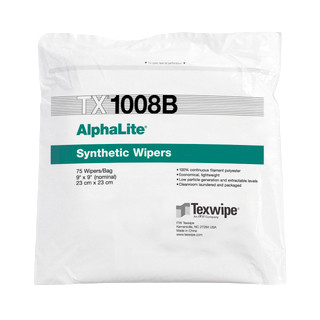
Texwipe TX1008B AlphaLite 9" x 9" Polyester Cleanroom Wiper

$41.67
(No reviews yet)
SKU:
TX1008B BAG
Availability:
Stock Item
Shipping:
Calculated at Checkout
Quantity Option (Bag):
150 Wipers Per Bag (2 Inner Bags of 75 Wipers)
Quantity Option (Case):
10 Bags of 150 Wipers Per Case
Type:
Dry Wiper
Wiper Family:
AlphaLite
Wiper Material:
Polyester
Wiper Size:
9" x 9"
Wiper Edge:
Cut Edge
ISO Class:
ISO 4 (Class 10)
ISO Class:
ISO 5 (Class 100)
ISO Class:
ISO 6 (Class 1,000)
ISO Class:
ISO 7 (Class 10,000)
ISO Class:
ISO 8 (Class 100,000)

TX1008B AlphaLite 9" x 9" Polyester Cleanroom Wiper

TX1008B AlphaLite is a low-linting (no wiper is truly ‘zero-lint’ in every process condition), lightweight knitted polyester wiper used for routine wipe-downs, spill control, and surface cleaning in controlled environments. It is constructed from 100% continuous-filament polyester and cleanroom laundered to help deliver ultra-clean performance with an economical, bulk-packed presentation for high-volume use.

Best-seller note: TX1008B is widely selected when teams want an economical, ultra-clean polyester knit wiper in bulk packaging for daily cleanroom wipe-downs and spill response.

Specifications:
  • Size: 9" x 9" (23 cm x 23 cm) nominal
  • Material: 100% continuous-filament polyester
  • Construction: Lightweight, knitted polyester wiper
  • Edge: Cut edge
  • Packaging: 150 wipers/bag (2 inner bags of 75); 10 bags/case; bulk packed (not neatly stacked)
  • Use environments: Commonly used across ISO-class controlled environments (ISO 4–8 are commonly referenced; final suitability depends on your process, cleaning agent, and method)
About the Manufacturer: 

Texwipe (an ITW company) differentiates itself in cleanroom wiping by treating the wiper as an engineered product, not a commodity consumable. Its manufacturing approach starts with fabric and yarn selection (often continuous-filament polyester for lower shedding), then controls edge construction (cut-edge, sealed-edge, and sealed-border options), controlled cleaning/laundering, and packaging aligned to cleanroom application tiers.


Texwipe also emphasizes verification through particles/ions/residue testing and describes automation-forward processes to improve lot-to-lot consistency and reduce handling-driven contamination risk. SOSCleanroom (SOS) supports that manufacturing discipline with a close working relationship with Texwipe focused on continuity of supply, clean documentation handoff (certs, lot traceability), and practical application support—so customers can standardize wiping materials with predictable performance while maintaining procurement reliability and audit readiness.

TX1008B Features:
  • 100% synthetic fiber (continuous-filament, knitted polyester)
  • Laundered and packaged at ITW Texwipe’s Cleanroom Products Manufacturing Center
  • Solvent-safe Bag-Within-A-Bag cleanroom packaging
  • Economical packaging options; bulk packed presentation (not neatly stacked)
TX1008B Benefits:
  • Ultra-low contamination levels: Designed for ultra-low particulate and extractable levels to support controlled-environment cleaning (process-dependent)
  • Rigorous wiping with control: Permits more aggressive wipe-downs with minimal release of fibers and particles versus general-purpose alternatives
  • Cleanroom protection: Helps protect the cleanroom by minimizing fiber and particle release during routine wipe-down tasks
  • Economical and traceable: Cost-effective for high-usage programs while maintaining lot-to-lot traceability
Common Applications:
  • Superior for spill control and general wiping in ISO Class 5 and 6 environments
  • Wipe-downs where further reduction of particulate contamination is desired
  • Cleaning and burnishing magnetic media surfaces
  • Cleaning and wiping sensitive surfaces
  • General surface cleaning of benches, carts, tools, and equipment exteriors (as permitted by your SOP and compatibility requirements)
Best-Practice Use:
  • Fold for control: Fold into quarters to create multiple clean faces; rotate faces instead of re-wiping with a loaded surface.
  • Wipe pattern: Use straight-line strokes (top-to-bottom or left-to-right) to avoid re-depositing contamination.
  • Wet vs. dry: For solvent wipe-downs, dampen—do not over-saturate—so you maintain control and reduce dripping.
  • Change-out triggers: Replace the wiper when the face becomes visibly soiled, tacky, or leaves streaks/residue.
  • Bulk-pack handling: If staging into a dispenser or tray, handle only the wipers you need with clean gloves and avoid touching product-contact faces to preserve cleanliness.
Selection Notes (TX1008B vs. Other Options)
  • TX1008B vs. TX1008: Same AlphaLite family and nominal size; TX1008B is bulk packed (not neatly stacked), while TX1008 is the stacked presentation.
  • TX1008B vs. TX1009/TX1009B: AlphaWipe is a heavier-duty polyester knit (double-knit, no-run interlock) often selected when added durability/absorbency is preferred for wet processing steps and rougher surfaces.
  • Cut edge vs. sealed-edge/border options: If your process is highly particle-sensitive or you want additional edge-based contamination control, consider sealed-edge or sealed-border wipers in the appropriate ISO tier.

Link to Texwipe Technical Datasheet:
Click Here

Other Similar Products Available From SOSCleanroom.com

AlphaLite / Polyester Dry Wipers

  • TX1008: 9" x 9" nominal (23 cm x 23 cm), stacked presentation
  • TX1009B: 9" x 9" nominal (23 cm x 23 cm), AlphaWipe heavier-duty knit
  • TX2069: 9" x 9" nominal (23 cm x 23 cm), laser-cut sealed edges for added edge control
  • TX404: 4" x 4" nominal, hydroentangled polyester for soft, nonabrasive wiping

Pre-Wetted Options (when consistent wetting reduces handling)

  • TX1039: 9" x 9" pre-wetted 70% IPA
  • TX8410: 9" x 9" pre-wetted 100% IPA
  • TX1051: 9" x 11" polypropylene pre-wetted 70% IPA
  • TX1065: 9" x 11" cellulose/polyester pre-wetted 70% IPA

Notes: Looking for application guidance or qualification context for Texwipe TX1008B AlphaLite 9" x 9" polyester cleanroom wipers? Open the SOSCleanroom Technical Vault tab above for practical wiping technique, selection notes (TX1008B vs. alternatives), and the documentation details teams typically review when standardizing cleanroom wipes across ISO-class controlled environments.

SOSCleanroom.com supports contamination-control programs with cleanroom consumables in stock, fair pricing, and responsive technical support—backed by same-day shipping options and customer service that understands real cleanroom workflows.

Product page updated: Jan. 1, 2026 (SOS Technical Staff)

© 2026 SOS Supply. All rights reserved.

The Technical Vault
By SOSCleanroom
When “Lighter Weight” Is the Control: How TX1008B AlphaLite Improves Throughput Without Over-Specifying the Wipe
Last reviewed: Jan. 1, 2026 |  Audience: contamination control, cleanroom operations, EHS, quality

Texwipe TX1008B AlphaLite (9" × 9") is a dry, knitted polyester cleanroom wiper designed for routine controlled-environment wiping where teams want low-linting performance, solvent compatibility, and abrasion tolerance—without jumping to heavier fabric weights or sealed-edge formats by default. AlphaLite is deliberately positioned as a lighter-weight knit option that still follows cleanroom laundering and packaging controls, which helps operators move faster while maintaining process discipline.

In daily wiping, the wipe often fails as a control input due to handling: overusing one face, hesitating to grab a fresh wipe, or switching to uncontrolled substitutes when wipes run short. AlphaLite’s practical value is that it supports high-frequency wipe change-outs and consistent technique while keeping contamination-control documentation in scope through SOSCleanroom.

What it’s for

TX1008B is commonly used for general wipe-down, routine bench and tool cleaning, equipment exterior wipe-offs, and controlled-area housekeeping where teams want a reliable polyester knit that performs across a wide range of surfaces. It is frequently selected for programs that need a consistent “daily driver” wipe for ISO-class controlled environments and adjacent support areas. Manufacturer positioning also supports use on abrasive or rough surfaces where snagging and wipe degradation can become a particle/fiber source.

Decision drivers

TX1008B earns its place when you want a polyester knit wipe that is easy to use at high frequency—without letting the wipe become the uncontrolled variable:

  • Substrate and knit stability: polyester knit construction supports low-linting behavior under real wiping force and repeated folding.
  • Lighter-weight workflow advantage: encourages frequent change-outs and reduces “I’ll just keep using this one wipe” behavior in high-throughput stations.
  • Chemical compatibility: compatible with common cleanroom solvents and cleaning solutions used for routine wipe-downs.
  • Rough-surface resilience: positioned to withstand use on more abrasive surfaces, reducing snag-driven wipe breakdown events.
  • Packaging discipline: cleanroom packaging supports controlled introduction and staging practices; SOSCleanroom supply continuity helps prevent unqualified substitutions.
  • Program traceability posture: engineered cleanroom wipe families typically include lot identification and documentation framework that supports investigations and change control.
Materials and construction – explained like an engineer

“Polyester wipe” is not a sufficient spec. What matters is how the material behaves when folded, pressed into corners, and dragged across stainless, anodized aluminum, painted surfaces, and fixtures with fasteners or seams. AlphaLite’s knit construction is selected to maintain structure during handling so the wipe does not unravel or shed simply because the operator increased speed or pressure to finish a wipe-down.

The “lighter weight” concept is operational—not cosmetic. A wipe that is easy to handle and easy to discard at the right time is often the more controlled choice for routine wipe-downs, because it supports the behavior you actually want: fresh faces, short face-life, and consistent stroke discipline.

Specifications (quick reference)
  • Size: 9" × 9" nominal
  • Material: polyester knit cleanroom wiper
  • Edge strategy: cut-edge knit (qualification depends on edge-driven releasables risk in your process)
  • Packaging: 150 wipers per bag; 10 bags per case (verify the label on the configuration you receive)
  • Use environments: controlled environments (final suitability depends on your process, technique, and acceptance criteria)
Cleanliness and performance metrics

For most facilities, wipe qualification comes down to three technical risk categories: releasables (particles/fibers), residues (NVR/extractables), and ions (corrosion/ECM risk in sensitive assemblies). Published typical data is best treated as a qualification starting point, not a contractual limit.

Functionally, AlphaLite is intended to deliver predictable low-linting performance for routine wipe-down work while maintaining compatibility with common cleanroom chemistries. If your failures show up after dry-down (haze, streaking, “mystery film”), the controlling levers are usually technique (fresh faces, directional strokes) and wetness discipline—more than wiping force.

Why “lighter weight” matters operationally

In real operations, wipes become uncontrolled variables when operators stretch face life too far, hesitate to discard, or “make it work” with the wrong wipe at the wrong time. A lighter-weight knit can be a practical control because it supports the habit of using more wipes, correctly—fresh faces, faster swaps, and less overworking. The control only holds if the program also enforces handling discipline: staging, clean storage, and defined change-out triggers.

Rule of thumb: When the constraint is operator throughput and consistent face rotation, a lighter-weight knit can be the more controlled “daily” choice. When the constraint is edge-driven fibers or the most defect-sensitive surfaces, step up to a sealed-edge/sealed-border knit. When wetness repeatability is the constraint, use a controlled pre-wetted system.

Best-practice use

TX1008B performs best when technique is treated as part of the contamination control plan:

  • Quarter-fold consistently: create multiple clean faces and rotate faces aggressively.
  • Directional strokes: use controlled, overlapping, single-direction passes; avoid back-and-forth scrubbing on residue-sensitive surfaces.
  • Wetness discipline: damp is usually the control target; over-wetting can drive pooling, seam wicking, and residue after dry-down.
  • Change-out triggers: discard once a face is loaded, smeary, or near saturation—do not “wipe until it feels dry.”
  • Separate cleaning vs. sampling: if the step becomes measurement-driven (TOC/HPLC/residue recovery), use method-aligned sampling consumables and written controls.
Common failure modes — and how TX1008B helps

Wipes become contamination sources in predictable ways: snagging on fasteners, edge degradation during rough wiping, reusing a contaminated face too long, and leaving residues due to inconsistent solvent loading. TX1008B’s knit polyester construction helps reduce snag-driven degradation during routine wipe-downs and supports consistent folding/handling. The remaining controls are procedural: face rotation, directional strokes, and chemistry discipline.

Closest comparators

The most defensible comparisons are to other polyester knit cleanroom wipes intended for similar ISO ranges and daily wiping tasks.

Contec Polynit (knife-cut edge polyester knit) is a close comparator when surface gentleness is a priority; buyers often evaluate it against Alpha-family knits when they want a similar category but a different “hand feel” for sensitive surfaces.

Berkshire MicroSeal 1200 (ultrasonically sealed-edge polyester knit) is the appropriate comparator when edge-driven releasables become the dominant risk. Sealed-edge knits are commonly selected when fiber/stringer risk from folding and aggressive wipe patterns must be reduced.

Where TX1008B fits in a cleanroom wiping program

TX1008B is a strong choice as a high-throughput daily knit polyester wiper when the facility wants low-linting performance and solvent compatibility while keeping wipe handling fast and consistent. It fits well in routine bench, tool, cart, and equipment exterior wipe-down roles where the dominant risks are handling drift and inconsistent technique. When edge control becomes the primary acceptance driver, the technical step-up is typically a sealed-edge/sealed-border knit. When wetness repeatability becomes the constraint, the appropriate step sideways is a validated pre-wetted system designed for consistent solvent loading.

Terminology note: TX1008B is engineered for low-linting performance; no wiper is truly “lint-free” in every process condition.

Source basis
  • SOSCleanroom product page: “Texwipe TX1008B AlphaLite 9" × 9" Polyester Cleanroom Wiper” (packaging configuration, positioning, features/benefits, intended use). https://www.soscleanroom.com/product/wipers/texwipe-tx1008b-alphalite-9-x-9-polyester-cleanroom-wiper/
  • Texwipe / ITW product information: AlphaLite dry knit wipe family (positioning, use on abrasive surfaces, cleanroom use and handling posture). https://www.texwipe.eu/en/product/alphalite-dry/
  • Comparator context: Contec Polynit (knife-cut edge polyester knit wipe) product literature and datasheet. https://contecinc.com/products/polynit-wipes/
  • Comparator context: Berkshire MicroSeal 1200 (sealed-edge polyester knit wipe) product literature and technical data. https://www.berkshire.com/products/microseal-1200/
Source: SOSCleanroom (SOS Supply) |  Last reviewed: Jan. 1, 2026
© 2026 SOS Supply. All rights reserved.

Other Wipers We Recommend