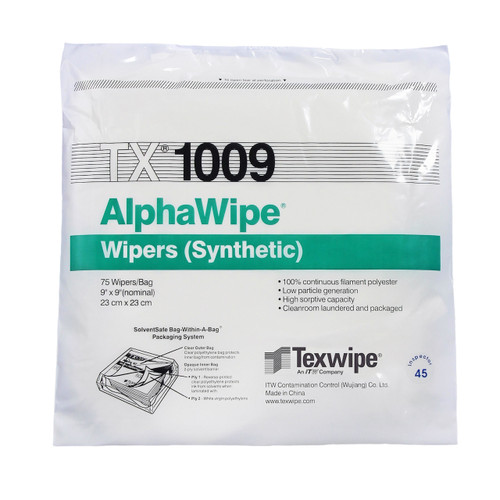
Texwipe TX1009B AlphaWipe 9" x 9" Polyester Cleanroom Wiper

$43.27
(No reviews yet)
SKU:
TX1009B BAG
Availability:
Stock Item
Shipping:
Calculated at Checkout
International Shipping:
Available for this product
Quantity Option (Bag):
150 Wipers per bag (2 Inner Bags of 75 Wipers)
Quantity Option (Case):
10 Bags of 150 Wipers Per Case
Type:
Dry Wiper
Wiper Material:
Polyester
Wiper Size:
9" x 9"
Wiper Edge:
Cut Edge
ISO Class:
ISO 4 (Class 10) - ISO 8 (Class 100,000)
Country of Origin:
Made in China

TX1009B AlphaWipe 9" x 9" 100% Polyester Cleanroom Wiper

TX1009B AlphaWipe is low-linting (no wiper is truly ‘zero-lint’ in every process condition), high-absorbency polyester knit wiper used for critical cleaning, spill control, and solution application in controlled environments. It is made from 100% continuous-filament polyester in a double-knit, no-run interlock pattern for durability on equipment, fixtures, and rougher surfaces.

Bulk-pack note: TX1009B is the AlphaWipe 9" x 9" format in a bulk-packed presentation (not neatly stacked), often chosen for faster grab-and-go access at benches, carts, and wipe stations.

Specifications:
  • Size: 9" x 9" (23 cm x 23 cm) nominal
  • Material: 100% continuous-filament polyester
  • Construction: Double-knit, no-run interlock
  • Edge: Laundered cut edge
  • Packaging: 150 wipers/bag (2 inner bags of 75); 10 bags/case
  • Use environments: Commonly used across a wide range of ISO-class cleanrooms and controlled areas (final suitability depends on your process and cleaning method)
About the Manufacturer: 

Texwipe (an ITW company) differentiates itself in cleanroom wiping by treating the wiper as an engineered product, not a commodity consumable. Its manufacturing approach starts with fabric and yarn selection (often continuous-filament polyester for lower shedding), then controls edge construction (cut-edge, sealed-edge, and patented sealed-border options), controlled cleaning/laundering, and packaging aligned to cleanroom application tiers.


Texwipe also emphasizes verification through fibers/particles/ions/residue/endotoxin testing and describes automation-forward processes—such as Vectra® continuous cleaning with 100% machine-vision inspection and hands-free sterile manufacturing steps—to improve lot-to-lot consistency and reduce handling-driven contamination risk. SOSCleanroom (SOS) supports that manufacturing discipline with a close working relationship with Texwipe focused on continuity of supply, clean documentation handoff (certs, lot traceability), and practical application support—so customers can standardize wiping materials with predictable performance while maintaining procurement reliability and audit readiness.

TX1009B Features:
  • 100% polyester fiber — continuous-filament, double-knit
  • Cleanroom laundered and packaged
  • Solvent-safe packaging
  • Lot-to-lot traceability
TX1009B Benefits:
  • Low-linting performance: Designed to help reduce particle and fiber contribution during wipe-downs (process-dependent)
  • Durability on surfaces: No-run interlock knit helps resist snagging and abrasion on rougher equipment and fixtures
  • Absorbency for wet steps: Effective for spill pickup and applying/removing cleaning agents and process solutions
  • Chemical resistance: Polyester knit construction is commonly used with IPA and many other cleanroom-compatible solvents/cleaners (verify compatibility to your chemistry and SOP)
Common Applications:
  • General wiping of benches, carts, tools, equipment exteriors, and fixtures
  • Spill control and pickup of process fluids
  • Cleaning and polishing stainless steel
  • Applying and removing disinfectants, cleaners, and process solutions
  • Protective covering for parts and product during staging, transfer, or temporary storage
Best-Practice Use:
  • Fold for control: Fold into quarters to create multiple clean faces; rotate faces instead of re-wiping with a loaded surface.
  • Wipe pattern: Use straight-line strokes (top-to-bottom or left-to-right) to avoid re-depositing contamination.
  • Wet vs. dry: For solvent wipe-downs, dampen—do not over-saturate—so you maintain control and reduce dripping.
  • Change-out triggers: Replace the wiper when the face becomes visibly soiled, tacky, or leaves streaks/residue.
  • Part protection: When lining trays, avoid dragging parts across the wiper; lift and place to reduce particulate transfer.
Selection Notes (TX1009B vs. Other Options)
  • TX1009B vs. TX1009: Same AlphaWipe family and nominal size, but TX1009B is bulk packed (not neatly stacked) for faster grab-and-go access; TX1009 is typically selected when a neatly stacked presentation is preferred.
  • Dry vs. pre-wetted: If you want consistent wetting and reduced solvent handling, consider AlphaSat pre-wetted wipers (70% IPA options are common for routine wipe-downs).
  • Size-up/size-down: Use smaller wipes for tight work areas; use 12" x 12" or larger formats when coverage per wipe matters.

Link to Texwipe Technical Datasheet:
Click Here

Other Similar Products Available From SOSCleanroom.com

AlphaWipe Dry Wipers

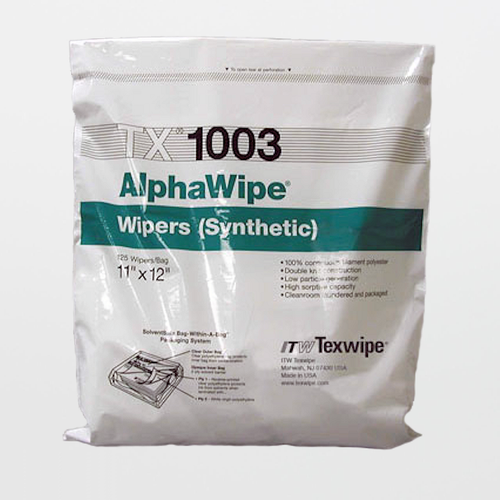
  • TX1004: 4" x 4" nominal (10 cm x 10 cm), 300 wipers/bag
  • TX1009: 9" x 9" nominal (23 cm x 23 cm), neatly stacked presentation
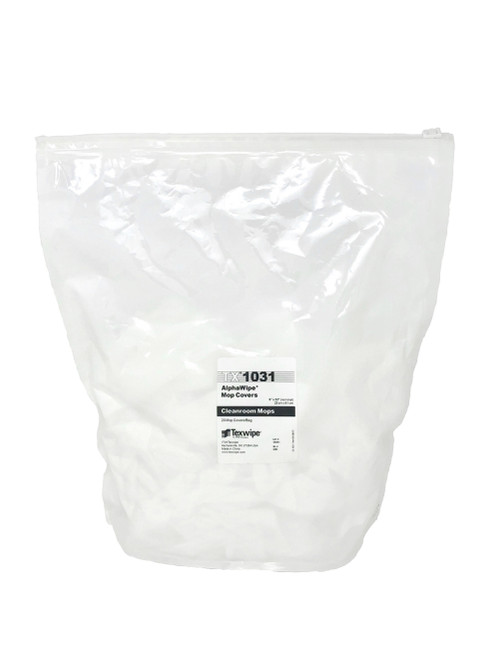
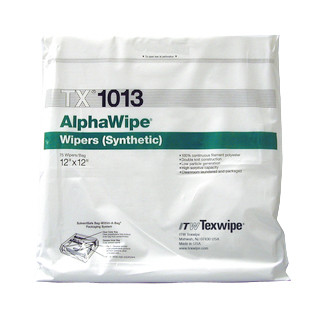
  • TX1013: 12" x 12" nominal (31 cm x 31 cm), 75 wipers/bag
  • TX1025: 24" x 44" nominal (60 cm x 112 cm), also used as a mop cover

AlphaSat Pre-Wetted Wipers

  • TX1034: 4" x 4" pre-wetted 70% IPA
  • TX1036: 6" x 6" pre-wetted 70% IPA
  • TX1039: 9" x 9" pre-wetted 70% IPA
  • TX7031: 9" x 32" pre-wetted 6% IPA

Notes: Looking for application guidance or qualification context for Texwipe TX1009B AlphaWipe 9" x 9" polyester cleanroom wipers? Open the SOSCleanroom Technical Vault tab above for practical wiping technique, selection notes (TX1009B vs. alternatives), and the documentation details teams typically review when standardizing cleanroom wipes across ISO-class controlled environments.

SOSCleanroom.com supports contamination-control programs with cleanroom consumables in stock, fair pricing, and responsive technical support—backed by same-day shipping options and customer service that understands real cleanroom workflows.

Product page updated: Jan. 1, 2026 (SOS Technical Staff)

© 2026 SOS Supply. All rights reserved.

The Technical Vault
By SOSCleanroom
When “Bulk Packed” Is a Feature: Why TX1009B Often Outperforms Expectations in Daily Cleanroom Wiping
Last reviewed: Jan. 1, 2026 |  Audience: contamination control, cleanroom operations, EHS, quality

Texwipe TX1009B AlphaWipe (9" × 9") is a dry, knitted polyester cleanroom wiper designed to be a reliable “default” for routine controlled-environment cleaning—particularly when you need low-linting performance, solvent compatibility, and abrasion tolerance without stepping into sealed-edge formats.

What differentiates TX1009B from many similarly named wipers is not the substrate itself (it is the same proven AlphaWipe construction), but the bulk-packed presentation: it is supplied bulk packed (not neatly stacked) in a bag format that supports fast access and high-throughput wiping at benches, carts, equipment wipe-down stations, and material handling points where operators want wipes ready without managing a stacked bundle.

What it’s for

TX1009B is best used for general wiping, spill control, cleaning and polishing stainless steel, and protective covering for parts and product in controlled environments. Its knit construction and laundering/packaging controls make it suitable when the wipe must clean effectively while limiting fiber and particle contribution to the process environment. This is a common selection for daily cleaning where the facility wants a consistent wipe that performs well across many surfaces and many operators.

Decision drivers

TX1009B earns its place in a cleanroom program based on a short list of technical controls:

  • Substrate and construction: 100% continuous-filament polyester, double-knit, no-run interlock for durability and low-linting behavior under wiping force.
  • Edge strategy: laundered cut edge appropriate for many ISO 4–8 use cases; sealed-edge is typically reserved for higher edge-shedding risk points.
  • Chemical compatibility: designed for solvent and cleaning-chemistry use; solvent-safe packaging supports common cleanroom solvent workflows.
  • Cleanliness framework: published typical values for particles/fibers, nonvolatile residue (NVR), and extractable ions support qualification discussions.
  • Packaging discipline: bulk-packed bag format supports rapid access and high utilization; double inner-bagging supports controlled introduction.
  • Traceability: lot-to-lot traceability is part of the AlphaWipe program, which matters for change control and investigations.
Materials and construction – explained like an engineer

“Polyester cleanroom wiper” is an overly broad label. What matters is continuous-filament polyester (long filaments) versus chopped or staple fiber constructions that can generate more loose ends under abrasion. TX1009B uses continuous-filament polyester in a stable interlock knit. That knit pattern is intentionally selected to resist unraveling and to hold together when the wipe is folded, pressed into corners, or dragged across brushed stainless and equipment surfaces.

This is why TX1009B is positioned for abrasive or rough surfaces where some wipes can snag, degrade, and become a source of particles and fibers.

Cleanliness and performance metrics

For many facilities, the decision to standardize a wiper comes down to whether it introduces risk in three categories: releasables (particles/fibers), residues (NVR), and ions. TX1009B’s published typical values cover those categories and should be treated as a qualification starting point rather than a contractual specification.

Functionally, AlphaWipe 9" × 9" wipers are built to be highly sorbent for routine cleaning and spill pickup, with fast uptake and robust capacity per unit area. From a contamination standpoint, typical results include low particle and fiber levels for a laundered cut-edge knit wipe, along with low NVR and low ionic extractables—important when wiping steps occur near residue-sensitive processes or where ionic contamination is a known risk factor.

Why “bulk packed” matters operationally

In real cleanrooms, wipes fail less often due to the substrate and more often due to handling—how quickly operators can obtain a fresh wipe face, how often they overuse a single wipe, and whether packaging drives consistent behavior across shifts. TX1009B’s bulk-packed presentation is a practical advantage in high-throughput areas because it reduces “fuss time” at the wipe station and encourages operators to take a new wipe when they should. The key is to pair bulk access with disciplined technique: fold consistently, rotate faces aggressively, and discard once the wipe is loaded.

Best-practice use

Even the best wipe can redeposit contamination if technique is casual. TX1009B performs best when operators use quarter-folding to create multiple clean faces, wipe in controlled, overlapping, single-direction strokes, and change to a fresh face frequently.

Avoid “scrub back and forth” wiping on residue-sensitive surfaces; it can redistribute soils and create streaking. For solvent wiping, apply solvent consistently (or standardize on a validated pre-wetted format where solvent loading must be tightly controlled), and avoid over-wetting that can mobilize residues beyond the intended wipe path.

Common failure modes — and how TX1009B helps

A wiper becomes a contamination source in predictable ways: edge degradation during rough wiping, snagging on fasteners or textured surfaces, reusing a contaminated face too long, and leaving residues due to inconsistent solvent loading. TX1009B’s continuous-filament knit helps reduce degradation during abrasive wiping, and its cleanroom laundering and packaging controls help limit incoming variability. The remaining controls are procedural: face rotation, directional strokes, and chemistry discipline.

Closest comparators

The most defensible comparisons are to other polyester knit cleanroom wipes intended for similar ISO ranges and wiping tasks.

Contec Polynit (knife-cut edge polyester knit) is a close comparator when surface gentleness is a priority; it is positioned as a soft wipe for surfaces vulnerable to scratching while remaining chemically resistant and low in particles and fibers. Buyers often evaluate Contec Polynit versus AlphaWipe when they want a similar polyester knit category but prefer a different “hand feel” or edge profile for sensitive surfaces.

Berkshire MicroSeal 1200 (ultrasonically sealed-edge polyester knit) is the appropriate comparator when edge-driven releasables are the dominant risk. Sealed-edge knits are commonly selected for more critical surfaces or higher defect sensitivity because the edge is engineered to reduce fiber contribution during folding and aggressive wipe patterns. If a process is struggling with edge-related fibers or stringers, sealed-edge formats are often the next logical control step.

Rule of thumb: When edge control becomes the acceptance driver, sealed-edge/sealed-border is typically the next control step. When wetness repeatability is the constraint, consider a controlled pre-wetted system.

Where TX1009B fits in a cleanroom wiping program

TX1009B is a strong choice as the “daily driver” 9" × 9" dry polyester knit wiper in ISO 4–8 environments where the facility wants repeatable cleanliness, chemical compatibility, and abrasion tolerance—paired with a bulk-packed format that supports fast access and high utilization. When the risk shifts to the most defect-sensitive surfaces or when edge control becomes the primary concern, the technical step-up is typically a sealed-edge or sealed-border polyester knit wiper. When solvent loading repeatability becomes the constraint, the step sideways is a pre-wetted system designed for consistent wetness and reduced operator variability.

Terminology note: TX1009B is engineered for low-linting performance; no wiper is truly “lint-free” in every process condition.

Source basis
  • SOSCleanroom product page: “Texwipe TX1009B AlphaWipe 9" × 9" Polyester Cleanroom Wiper” (packaging configuration, bulk-packed note, positioning, features/benefits, ISO class listing).
  • ITW Texwipe datasheet: “AlphaWipe Dry Wipers” covering TX1009/TX1009B family (construction, laundering/packaging controls, typical performance and contamination characteristics; notes on methodology references and typical-value framing).
  • Contec product information and data sheet: “Polynit Wipes” (material, edge type, intended use and positioning).
  • Berkshire product information and technical data: “MicroSeal 1200” (sealed-edge positioning, intended ISO range, performance framework).

Videos Hide Videos Show Videos