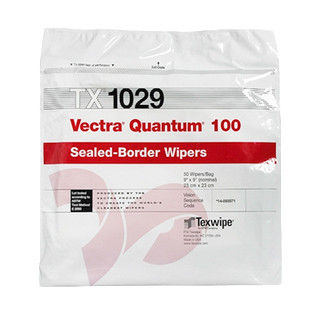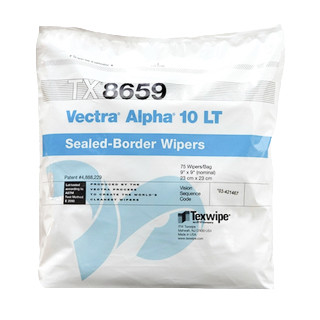
Texwipe TX1010 Vectra Alpha10 9" x 9" Polyester Cleanroom Wiper

$52.33
(No reviews yet)
SKU:
TX1010 BAG
Availability:
Stock Item
Shipping:
Calculated at Checkout
Quantity Option (Bag):
100 Wipers Per Bag (2 Inner Bags of 50 Wipers)
Quantity Option (Case):
10 Bags of 100 Wipers Per Case
Type:
Dry Wiper
Wiper Family:
Vectra Alpha 10
Wiper Material:
Polyester
Wiper Size:
9" x 9"
Wiper Edge:
Sealed Border
ISO Class:
ISO 2 (Class < 1)
ISO Class:
ISO 3 (Class 1)
ISO Class:
ISO 4 (Class 10)
ISO Class:
ISO 5 (Class 100)
ISO Class:
ISO 6 (Class 1,000)
ISO Class:
ISO 7 (Class 10,000)
ISO Class:
ISO 8 (Class 100,000)

TX1010 Vectra Alpha10 9" x 9" 100% Polyester Sealed-Border Cleanroom Wiper

TX1010 Vectra Alpha10 is low-linting (no wiper is truly ‘zero-lint’ in every process condition), sealed-border polyester knit wiper engineered for critical cleaning in controlled environments where edge integrity and consistent cleanliness matter. It is made from 100% continuous-filament polyester in a no-run interlock, double-knit fabric and processed on Texwipe’s Vectra® automated cleaning system to help deliver low levels of ions, nonvolatile residues (NVRs), particles, and fibers for particle- and residue-sensitive wipe-downs.

Edge-control note: TX1010 is widely chosen when cut edges become the variable—abrasive fixtures, snag-prone corners, and repeatable wipe-downs where a sealed border helps reduce edge-driven fiber/particle release during wiping and folding.

Specifications:
  • Size: 9" x 9" (23 cm x 23 cm) nominal
  • Material: 100% continuous-filament polyester
  • Construction: No-run interlock, double-knit
  • Edge: Sealed border (four fully sealed borders)
  • Packaging: 100 wipers/bag (2 inner bags of 50); 10 bags/case
  • Use environments: Designed for use in ISO Class 3–5 cleanroom environments; also used in broader controlled areas where contamination control is paramount (final suitability depends on your process and cleaning method)
About the Manufacturer: 

Texwipe (an ITW company) differentiates itself in cleanroom wiping by treating the wiper as an engineered product, not a commodity consumable. Its manufacturing approach starts with fabric and yarn selection (often continuous-filament polyester for lower shedding), then controls edge construction (cut-edge, sealed-edge, and patented sealed-border options), controlled cleaning/laundering, and packaging aligned to cleanroom application tiers.


Texwipe also emphasizes verification through fibers/particles/ions/residue/endotoxin testing and describes automation-forward processes—such as Vectra® continuous cleaning with 100% machine-vision inspection and hands-free sterile manufacturing steps—to improve lot-to-lot consistency and reduce handling-driven contamination risk. SOSCleanroom (SOS) supports that manufacturing discipline with a close working relationship with Texwipe focused on continuity of supply, clean documentation handoff (certs, lot traceability), and practical application support—so customers can standardize wiping materials with predictable performance while maintaining procurement reliability and audit readiness.

TX1010 Features:
  • Fully sealed border to help prevent edge fray and fiber release
  • Vectra® Process for clean, consistent wipers
  • 100% continuous-filament, double-knit polyester (no-run interlock)
  • Solvent-safe Bag-Within-A-Bag® cleanroom packaging
  • Statistical quality control / Six Sigma quality assurance
TX1010 Benefits:
  • Cleanliness for critical wiping: Designed to help assure ultra-low levels of ions and extractables for residue- and corrosion-sensitive work (process-dependent)
  • Abrasion resistance where edges fail first: Resists abrasion under rigorous use or when wiping rough surfaces; sealed border targets edge-driven shedding
  • Reduced contamination contribution: Helps minimize fiber and particle release during wipe-downs, folding, and handling (process-dependent)
  • Lot traceability: Complete traceability of each bag supports investigations, qualification, and audit readiness
Common Applications:
  • General wiping in environments where contamination control is of paramount importance
  • Wiping interior of process tools, chambers, and other equipment where edge integrity matters
  • Abrasive or snag-prone surface wiping (textured hardware, fixtures, machined corners)
  • Solvent wipe-downs where residue behavior is part of the acceptance criteria (verify compatibility to your chemistry and SOP)
Best-Practice Use:
  • Fold for control: Fold into quarters (or eighths) to create multiple clean faces; rotate faces instead of re-wiping with a loaded surface.
  • Wipe pattern: Use straight-line strokes (top-to-bottom or left-to-right) to avoid re-depositing contamination.
  • Wet vs. dry: For solvent wipe-downs, dampen—do not over-saturate—so you maintain control and reduce dripping and residue risk.
  • Change-out triggers: Replace the wiper when the face becomes visibly soiled, tacky, or leaves streaks/residue—and if the border snags or the fold loses integrity.
  • Border discipline: Treat the sealed perimeter as part of the control plan—avoid aggressive scrubbing and excessive pressure that can elevate particle release even with sealed-border wipers.
Selection Notes (TX1010 vs. Other Options)
  • TX1010 vs. cut-edge knit polyester (e.g., AlphaWipe family): Choose TX1010 when edge fray, snagging, or edge-driven shedding is the risk; choose cut-edge knit wipers when a sealed border is not required for your surfaces and you prefer that construction/pack format.
  • Dry vs. pre-wetted: If you want consistent wetness and reduced solvent handling, select pre-wetted Vectra Alpha 10 formats (AlphaSat/CleanPaks) aligned to your solvent and workflow controls.
  • Non-sterile vs. sterile: TX1010 is typically used as a non-sterile cleanroom wiper; aseptic workflows generally require sterile, validated wipes with defined transfer and documentation controls.

Link to Texwipe Technical Datasheet:
Click Here

Other Similar Products Available From SOSCleanroom.com

9" x 9" Polyester Wipers (Dry)

  • TX1009: 9" x 9" nominal (23 cm x 23 cm) polyester wipers, 150 wipers/bag
  • TX1009B: 9" x 9" nominal (23 cm x 23 cm) polyester wipers, bulk packed presentation
  • TX8949: 9" x 9" nominal (23 cm x 23 cm) sealed-edge polyester wipers, 150 wipers/bag

Cellulose/Polyester Blend Wipers (Dry)

  • TX609: 9" x 9" cellulose/polyester blend for general wiping and spill control
  • TX612: 12" x 12" cellulose/polyester blend for broader coverage per wipe

Notes: Looking for application guidance or qualification context for Texwipe TX1010 Vectra Alpha10 9" x 9" sealed-border polyester cleanroom wipers? Open the SOSCleanroom Technical Vault tab above for practical wiping technique (folding discipline, stroke control, wetness control), selection notes (sealed-border vs. cut-edge knit options), and the documentation details teams typically review when standardizing critical wipers across ISO-class controlled environments.

SOSCleanroom.com supports contamination-control programs with cleanroom consumables in stock, fair pricing, and responsive technical support—backed by same-day shipping options and customer service that understands real cleanroom workflows.

Product page updated: Jan. 1, 2026 (SOS Technical Staff)

© 2026 SOS Supply. All rights reserved.

The Technical Vault
By SOSCleanroom
The wiper that makes edges stop being the variable: why TX1010 Vectra Alpha 10 earns its keep in particle- and residue-sensitive work
Last reviewed: Jan. 1, 2026  |  Audience: contamination control, cleanroom operations, EHS, quality

In cleanrooms, many “mystery particles” do not come from the center of a wiper. They come from the edge: fraying at a cut perimeter, snagging on fasteners and burrs, or a border that sheds when it is dragged across an abrasive surface. Texwipe TX1010 Vectra Alpha 10 is built to reduce that failure mode with a sealed-border, double-knit, continuous-filament polyester construction designed for controlled wiping where low-linting behavior and repeatable cleanliness matter.

Reliability is part of the control plan. SOSCleanroom’s long-standing relationship with Texwipe is built around continuity of supply, documentation discipline, and lot-level traceability — the safeguards that help facilities avoid unqualified substitutions when schedules tighten and “whatever is available” becomes the contamination event you end up investigating.

What it’s for

TX1010 is a 9" x 9" cleanroom wiper intended for precision wiping where the goal is controlled soil pickup with minimal fiber/particle contribution. It is commonly selected for cleaning work surfaces, fixtures, and equipment in controlled environments, and for solvent wiping (IPA and other process-approved solvents) when residue behavior is part of the acceptance criteria.

Operationally, it is most valuable in two situations: (1) when wiping across abrasive or snag-prone surfaces, and (2) when edge integrity and consistency across operators drive yield and rework.

Decision drivers
  • Sealed-border design: reduces edge fray and helps control fiber release during wiping and folding, especially on abrasive surfaces.
  • Continuous-filament, double-knit polyester: built for durability and consistent contact, supporting repeatable strokes without the “pilling” behavior seen in lower-grade textiles.
  • Cleaned for controlled environments: Vectra processing is positioned to deliver low levels of ions, nonvolatile residue (NVR), particles, and fibers relative to general-purpose wipes.
  • Technique-tolerant, not technique-proof: construction helps, but outcomes still depend on folding discipline, stroke direction, wetness control, and discard rules.
  • Documentation and program stability: consistent sourcing through SOSCleanroom helps keep the wiper from becoming an uncontrolled variable across shifts, sites, or quarters.
  • Fits a wide range of solvent workflows: commonly used with IPA-based wiping where fast dry-down is needed, and where residue budgets are defined by inspection criteria.
Materials and construction: practical implications

TX1010 is made from 100% continuous-filament polyester in a double-knit format. In practical terms, that combination targets durability and control: the knit structure maintains face integrity under wiping pressure, and continuous-filament yarns reduce the short-fiber shedding pathways more common in staple-fiber textiles.

The defining feature is the sealed border. Edges are where many wipes fail: an unsealed cut can fray, snag, or shed when it is dragged across fastener heads, machined corners, or textured coatings. A sealed perimeter is not a marketing detail — it is a defect-mechanism control when you are wiping abrasive surfaces or cleaning around sharp geometry.

An important realism check: no wiper is truly lint-free. The goal is low-linting performance in your use condition. Excess pressure, dry wiping, circular scrubbing, and reusing a loaded fold are the fastest routes to particle complaints — even with premium knit polyester.

Specifications in context

The 9" x 9" format is a workhorse size because it supports controlled folding into repeatable “clean faces” without becoming too bulky at the edge. In practice, operators can fold into quarters (or eighths) to create multiple fresh wiping surfaces and standardize discard rules.

Treat published cleanliness values (ions, NVR, particles/fibers) as typical performance indicators unless explicitly stated as specification limits. Typical data is still useful because it reflects what the laundering and packaging process is designed to achieve, but residue-sensitive programs should confirm performance in their own solvents, surfaces, and acceptance criteria.

Cleanliness and performance: interpreting the data
  1. Particles and fibers: the sealed border and knit structure are designed to reduce edge-driven shedding, but technique still governs outcomes. Single-direction strokes, controlled pressure, and frequent refolding are what keep low-linting behavior consistent.
  2. Ions (ionic extractables): ionic background matters in corrosion-sensitive assemblies, high-impedance electronics, and any workflow where conductivity/ion chromatography is part of the verification story. A “clean” wipe can still be the dominant source of ionic signal if the solvent is low-background and the surface is highly sensitive.
  3. NVR (nonvolatile residue): NVR is what remains after evaporation. If you see haze, streaking, or adhesion failures after solvent wiping, the root cause is often the combination of solvent grade, wetness control, and the wiper’s residue background — not simply the surface you wiped.
  4. Abrasive surfaces are a special case: textured coatings, machined finishes, and rough hardware amplify edge failure. This is where sealed-border, durable knit construction tends to pay for itself by reducing edge fray and “edge-generated” contamination events.

Interpretation tip: If the defect mechanism smells like “edge + abrasive surface,” shift first to sealed-border and then tighten technique controls (dampness, fold/rotate, one-direction strokes).

Why packaging, sterility decisions, and traceability matter

Packaging discipline is part of the cleanliness spec. Keep bags closed until point of use, stage only what the task requires, and avoid carrying open packs across zones. If you need a simple SOP template, the core controls are: staged issuance, time-limited exposure, gloved-hand discipline, and defined discard criteria.

Sterility is a separate decision gate. TX1010 is used primarily as a non-sterile cleanroom wiper for contamination control; aseptic or sterile manufacturing workflows typically require sterile, validated wipes (with defined sterilization method, sterility assurance posture, and sterile transfer steps documented in the SOP).

Traceability matters when you are troubleshooting a trend: residue complaints, particle excursions, or a yield shift after a process change. Lot-level traceability and consistent sourcing through SOSCleanroom reduce investigation time because you can confirm whether a material change occurred — or rule it out quickly.

Best-practice use
  • Fold into a defined geometry (quarters/eighths). Treat each fold face as single-pass, then refold or discard.
  • Work cleanest to dirtiest. Use one-direction strokes with parallel, overlapping passes.
  • Avoid circular scrubbing unless a written procedure requires it for a specific soil.
  • Control wetness: aim for damp, not wet. Damp lifts and captures; over-wet spreads soils and elevates residue risk after evaporation.
  • Do not re-dip a used wipe into a shared solvent container. Use controlled dispensing (squirt bottle with discipline, pre-aliquots, or validated wetting systems).
  • Set discard rules that match the risk: discoloration, visible loading, edge snagging, or loss of face integrity are hard stop conditions.
Common failure modes — and how to prevent them
  • Over-wetting: turns wiping into residue redistribution. Prevent with controlled dispensing and multiple wipes instead of overworking one.
  • Reusing a loaded fold face: causes redeposit and “it looked clean” failures. Prevent with aggressive refolding and defined discard rules.
  • Dry wiping on abrasive surfaces: increases friction-driven particle generation. Prevent by using an approved damp-wipe method where appropriate.
  • Dragging edges across burrs or sharp features: can damage the perimeter and elevate shedding. Prevent with angle control, lighter pressure, and switching to a swab architecture when geometry demands it.
  • Uncontrolled substitutions: a “similar-looking” wipe can change ions/NVR/edge behavior. Prevent with approved sourcing and documented equivalency requirements.
Closest competitors

Contec Anticon® knit polyester wipers
A credible peer family in knit polyester wipes. Compare edge construction, published contamination data, and real-world performance on your roughest surfaces and solvents.

Berkshire knit polyester cleanroom wipers (cleaned/packaged programs)
Common in controlled environments. Compare launder process controls, lot documentation, and edge integrity under snag-prone wiping.

Kimberly-Clark Kimtech™ cleanroom knit offerings
Often specified in facility-wide programs. Evaluate consistency of edge behavior, background residue performance, and availability tied to your replenishment model.

Where TX1010 fits in a controlled cleaning program

TX1010 is a core wipe for particle- and residue-conscious wiping where edge integrity, durability, and repeatable cleanliness matter — especially on abrasive or snag-prone surfaces. Use wipes like TX1010 for planar surfaces and broad contact cleaning; use swabs for seams, joints, pockets, and tight geometry where contact control is the requirement. When the workflow becomes validation-sensitive (where wiping is part of the measurement system), add written method controls: defined area, defined strokes, controlled wetting, chain of custody, and a documented rationale for the consumable’s background behavior.

Source basis
  • SOSCleanroom product page: Texwipe TX1010 Vectra Alpha10 9" x 9" polyester cleanroom wiper (product positioning; construction notes; ordering model). https://www.soscleanroom.com/product/wipers/texwipe-tx1010-vectra-alpha10-9-x-9-polyester-cleanroom-wiper/
  • ITW Texwipe overview: Vectra Alpha 10 wipers (construction: continuous-filament polyester, double-knit, sealed border; laundering/processing intent; positioning for low ions/NVR/particles/fibers; abrasive-surface note). https://www.texwipe.com/category/blog/vectra-alpha-10-wipers/
  • General cleanroom wiping control basis applied: one-direction strokes, overlapping passes, fold-face rotation/discard discipline, wetness control, and separation of cleaning vs. sampling methods (program discipline and repeatability).

Videos Hide Videos Show Videos