The Technical Vault
By SOSCleanroom
Small-Format Solvent Control: Why TX1034 AlphaSat Improves 70% IPA Wipe-Down Repeatability in Tight Work Areas
Last reviewed: Jan. 2, 2026 | Audience: contamination control, cleanroom operations, EHS, quality
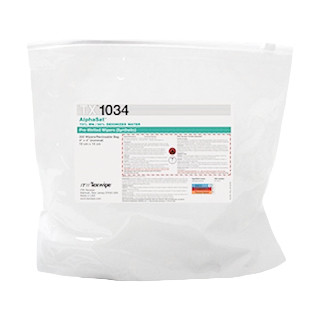
Texwipe TX1034 AlphaSat (4" × 4") is a pre-wetted, knitted polyester cleanroom wiper saturated with 70% IPA for controlled-environment wipe-downs where the “solvent step” must behave like a repeatable process input—not a technician-dependent variable.
The technical value is not just that it contains IPA; it is that the wipe arrives with a defined wetness condition in a sealed, reclosable package. That reduces common failure modes in real cleaning: squeeze-bottle over-application that floods seams, open-beaker evaporation that changes dry-down behavior, and re-dipping practices that convert a wipe into a cross-contamination tool.
What it’s for
TX1034 is best used for small-area, point-of-use solvent cleaning—tight fixtures, tool touchpoints, connector faces, small stainless surfaces, pass-through hardware, and localized wipe-down steps where a full-size wipe is unnecessary or increases incidental contact risk. SOSCleanroom positions TX1034 for controlled environments (commonly listed across ISO 4–9 program tiers depending on the step and technique), and for technicians who want a solvent wipe that is ready immediately, without open-solvent handling at the bench.
Decision drivers
TX1034 earns its place when the program is trying to reduce solvent-handling variability without over-complicating the wipe-down workflow:
- Pre-wetted 70% IPA delivery: stabilizes the wetness condition and reduces operator-driven “too wet / too dry” outcomes.
- Small-format control: 4" × 4" reduces overreach, minimizes collateral contact, and supports localized cleaning without a large wipe dragging across adjacent surfaces.
- Polyester knit strength: knit polyester resists tearing during corner work and hardware wipe-downs where nonwovens can break down under pressure.
- Cleanroom packaging discipline: supplied in a reclosable bag format that supports staged use and reduces evaporation exposure once opened.
- Planning-friendly pack-out: listed as 200 wipes per bag, 4 bags per case for predictable kitting and point-of-use stocking.
- Documentation posture: published typical cleanliness data (particles/fibers, NVR, ions) supports qualification conversations and change-control discipline.
Materials and construction – explained like an engineer
With pre-wetted wipes, you are qualifying a system: the wiper architecture plus the solvent load plus the package that preserves it. TX1034 uses a knitted polyester substrate intended to hold together when folded, pinched into corners, and pulled across hardware features. In small-format cleaning, mechanical integrity matters because a 4" × 4" wipe is routinely used with higher localized pressure than a 9" × 9" wipe.
Operationally, the 70% IPA saturation is what reduces “wet-cleaning variability.” When the solvent load is consistent, the step becomes easier to standardize: contact time, stroke count, and dry-down window are less dependent on individual squeeze force, bottle tip condition, or how long a beaker has been sitting open.
Cleanliness and performance metrics
For many programs, a pre-wetted wipe is evaluated across four releasables categories: particles/fibers, residues (NVR), ions, and “in-use behavior” (streaking, redeposit, and technique sensitivity). TX1034’s published typical results should be treated as a qualification starting point rather than a contractual per-lot specification.
- Sorption (capacity and rate): typical sorptive capacity and sorptive rate data are provided for the AlphaSat family, supporting placement in routine wet-cleaning steps where fast wetting and controlled pickup matter.
- Particles and fibers: typical particle and fiber data help with placement decisions (routine wipe-down vs. defect-critical finishing). Small-format wipes are often used with higher pressure; technique discipline (single-direction strokes, frequent face changes) is the primary control lever.
- NVR (film risk): typical NVR data (IPA and DI water extractants) support residue-risk discussions. If haze or streaking appears after dry-down, the leading causes are usually overworking a loaded face, over-wetting, or wiping soils across a surface feature—not “insufficient wiping force.”
- Ions: published ionic extractables are relevant for corrosion-sensitive assemblies, high-impedance electronics, and processes vulnerable to electrochemical migration. If ionic background is a controlling risk, validate the wipe-down step in your real solvent and acceptance window.
Best-practice use
TX1034 performs best when the technique is engineered, not improvised. Small-format wipes are particularly sensitive to “overuse” because the usable clean face area is limited.
- Define the wipe path: cleanest-to-dirtiest with straight, overlapping passes; avoid circular scrubbing unless the work instruction requires it.
- Face management: fold/rotate aggressively; treat each exposed face as single-pass on residue-sensitive steps.
- Edge and seam awareness: avoid pushing solvent into seams, fastener interfaces, and under labels; localized pooling is a common hidden residue mechanism.
- Do not “top off”: do not add solvent to the bag; it changes saturation level and undermines repeatability and traceability.
- EHS posture: treat as a flammable solvent-containing consumable; follow facility ventilation, storage, and ignition-source controls.
Common failure modes — and how TX1034 helps
Pre-wetted wipes reduce several failure modes automatically (mixing errors, open-container evaporation, re-dipping), but they do not eliminate technique-driven failures. The most common issues are overworking one face, wiping back-and-forth across a feature line, and using a small wipe as if it were a large-area mop. TX1034 helps by standardizing wetness and improving point-of-use discipline; the remaining controls are procedural: directional strokes, face rotation, and early discard.
Closest comparators
The most defensible comparisons are to other cleanroom-oriented, presaturated 70% IPA wipe programs where packaging discipline and documentation depth are part of the product posture.
Contec PROSAT® presaturated wipes (70% IPA / 30% DI water) are a category peer often evaluated when sterility options, packaging configurations, and documentation depth are key procurement drivers.
Berkshire SatPax® presaturated IPA wipes are frequently evaluated for resealable pouch workflows; selection should be based on substrate architecture, saturation stability across pack life, and residue behavior in the actual dry-down window.
Valutek pre-wetted IPA wipe families appear in many purchasing systems as an alternative presaturated option; qualification should focus on cleanliness documentation, pack integrity, and fit to the process residue budget.
Rule of thumb: When wetness repeatability is the constraint, presaturated wipes are often the right control step. When edge-driven releasables are the constraint, sealed-edge/sealed-border polyester knits are typically the next step.
Where TX1034 fits in a cleanroom wiping program
TX1034 is a strong fit for localized, repeatable solvent wipe-downs where small-format access and wetness control drive outcomes: tight work zones, tool touchpoints, fixtures, and hardware wipe-down steps that are otherwise dominated by squeeze-bottle variability. Use it to stabilize the solvent step and reduce open-solvent handling. When the process shifts to the most defect-sensitive surfaces (optics, critical coatings, ultra-trace residue steps), the program typically escalates to a qualified finishing wipe architecture and method-aligned solvent strategy.
Terminology note: TX1034 is engineered for low-linting performance; no wiper is truly “lint-free” in every process condition.
Source basis
- SOSCleanroom product page: “Texwipe TX1034 AlphaSat 4" × 4" Polyester Cleanroom Wiper Pre-Wetted 70% IPA” (size, construction, packaging, positioning).
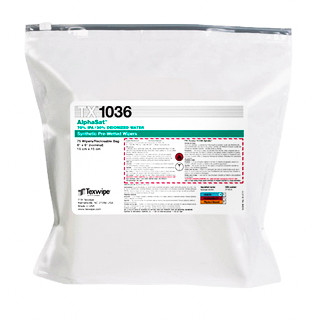
- ITW Texwipe / AlphaSat family technical datasheet (TX1034 / TX1036 / TX1039) (typical performance and contamination characteristics; typical-value framing).
- Contec product listing: PROSAT® Sterile™ PS-911EB (70% IPA / 30% DI water) (category context for presaturated wipe programs).
- Berkshire product listing: SatPax® presaturated IPA wipes (category context for resealable pouch wipe programs).
- Valutek presaturated IPA wipe offering (category context for pre-wetted wipe families).
Source: SOSCleanroom Technical Vault (SOS Supply). | Last reviewed: Jan. 2, 2026
© 2026 SOS Supply. All rights reserved.