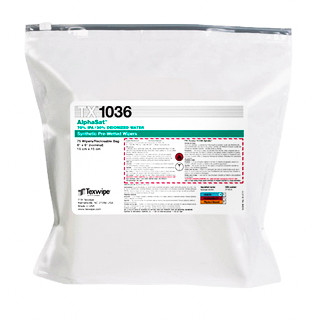
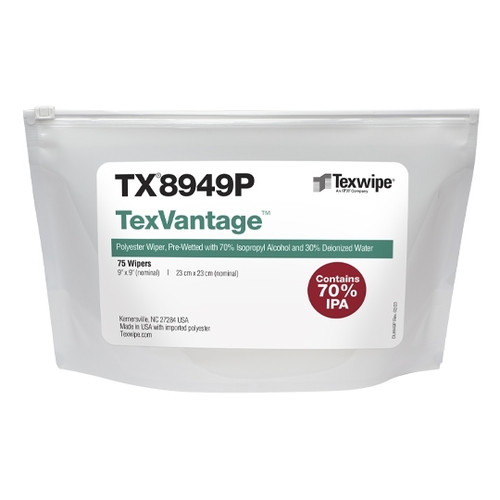
Texwipe TX1039 AlphaSat 9" x 9" Polyester Cleanroom Wiper Pre-Wetted 70% IPA

$222.67
(No reviews yet)
SKU:
TX1039
Availability:
Stock Item
Shipping:
Calculated at Checkout
Quantity Option (Case):
4 Bags of 50 Wipers Per Case
Type:
Pre-Wet Wiper
Wiper Family:
AlphaSat
Wiper Material:
Polyester
Wiper Size:
9" x 9"
Wiper Edge:
Cut Edge
ISO Class:
ISO 4 (Class 10)
ISO Class:
ISO 5 (Class 100)
ISO Class:
ISO 6 (Class 1,000)
ISO Class:
ISO 7 (Class 10,000)
ISO Class:
ISO 8 (Class 100,000)

TX1039 AlphaSat 9" x 9" Polyester Cleanroom Wiper Pre-Wetted 70% IPA

TX1039 AlphaSat is a low-linting in context (no wiper is truly ‘zero-lint’ in every process condition), high-absorbency knitted polyester wiper pre-wetted for rapid wipe-downs, spill control, and solution application in controlled environments. It uses AlphaWipe® material constructed from 100% continuous-filament polyester in a double-knit, no-run interlock pattern with a laundered cut edge for durability on equipment, fixtures, and rougher surfaces. TX1039 is pre-wetted with a 0.2 µm filtered, USP-grade 70% isopropyl alcohol (IPA) / 30% deionized water (DIW) solution in a reclosable package to help preserve consistent wetness and VOC control.

Shipping note (Hazmat): This item is considered a Hazardous shipment and can only be shipped Ground. All Hazmat shipments require a $35.00 Hazmat shipping charge added for each package/case. Commercial address only.

Specifications:
  • Size: 9" x 9" (23 cm x 23 cm) nominal
  • Material: 100% continuous-filament polyester
  • Construction: Double-knit, no-run interlock
  • Edge: Laundered cut edge (cut edge)
  • Wet chemistry: 70% IPA / 30% DIW; 0.2 µm filtered; USP-grade solution
  • Packaging: 50 wipers/reclosable bag; 4 bags/case (200 wipers total/case)
  • Use environments: ISO 4 (Class 10), ISO 5 (Class 100), ISO 6 (Class 1,000), ISO 7 (Class 10,000), ISO 8 (Class 100,000) (final suitability depends on your process and cleaning method)
  • Typical performance/cleanliness metrics (datasheet): Basis weight 158 g/m2; sorptive capacity 530 mL/m2; sorptive rate 0.5 seconds; LPC ≥ 0.5 µm: 8.4 x 10⁶ particles/m2; particles 0.5–5.0 µm: 10 x 106 particles/m2; 5.0–100 µm: 200,000 particles/m2; fibers > 100 µm: 2,000 fibers/m2; NVR (IPA): 0.04 g/m2; NVR (DIW): 0.02 g/m2; ions (Na/K/Cl): 0.22/0.06/0.05 ppm (typical values, not specifications)
About the Manufacturer: 

Texwipe (an ITW company) differentiates itself in cleanroom wiping by treating the wiper as an engineered product, not a commodity consumable. Its manufacturing approach starts with fabric and yarn selection (often continuous-filament polyester for lower shedding), then controls edge construction (cut-edge, sealed-edge, and patented sealed-border options), controlled cleaning/laundering, and packaging aligned to cleanroom application tiers.


For pre-wetted programs like AlphaSat, Texwipe emphasizes solution purity/filtration, measured wet-out for repeatable wetness and VOC control, and reclosable packaging intended to reduce evaporation between uses. SOSCleanroom (SOS) supports that discipline with a close working relationship with Texwipe focused on continuity of supply, clean documentation handoff (certs, lot traceability), and practical application support—so customers can standardize pre-wetted wiping materials with predictable performance while maintaining procurement reliability and audit readiness.

TX1039 Features:
  • 100% polyester fiber — continuous-filament, double-knit
  • Cleanroom laundered and packaged
  • Solvent-safe packaging
  • Lot-to-lot traceability
  • Pre-wetted with 70% IPA / 30% DIW solution (0.2 µm filtered) in a reclosable bag to help preserve consistent wetness
TX1039 Benefits:
  • Ultra low levels of particles and extractables: Designed to help reduce contamination contribution during wipe-downs (process-dependent)
  • Continuous-filament fiber prevents shedding: Helps maintain wipe integrity during repeated folds and strokes
  • Durability on rougher surfaces: No-run interlock knit helps resist snagging and abrasion on fixtures and tool edges
  • Excellent chemical resistance: Polyester knit construction is commonly used with IPA and many other cleanroom-compatible solvents/cleaners (verify compatibility to your chemistry and SOP)
  • Consistent wet-out: Pre-wetted presentation supports repeatable wetness and VOC control without squirt bottles or in-house mixing
Common Applications:
  • General wiping of benches, carts, tools, equipment exteriors, and fixtures
  • Spill control and pickup of process fluids
  • Cleaning and polishing stainless steel
  • Applying and removing disinfectants, cleaners, lubricants, adhesives, residues, and process solutions (per your SOP)
  • Protective covering for parts and product; lining trays for holding, protecting, drying, or storing parts and devices
  • Large surface areas and routine wipe-downs where consistent wetting improves repeatability
Best-Practice Use:
  • Keep the bag closed: Open only long enough to remove what you need; reclose promptly to reduce evaporation and preserve consistent wet-out.
  • Fold for control: Fold into quarters to create multiple clean faces; rotate faces instead of re-wiping with a loaded surface.
  • Wipe pattern: Use straight-line strokes (top-to-bottom or left-to-right) to avoid re-depositing contamination.
  • One wipe face per zone: Treat each face as a single-area pass; change out early when you see streaking, visible soil, or residue transfer.
  • Chemistry discipline: Do not “top off” the bag with other solvents; keep pre-wetted wipes dedicated to the chemistry listed on the label and your SOP.
Selection Notes (TX1039 vs. Other Options)
  • TX1039 vs. TX1036/TX1034: Same AlphaSat/AlphaWipe knit polyester platform and 70% IPA pre-wet; choose 9" x 9" when coverage per wipe matters, and 6" x 6" or 4" x 4" for tighter work areas and smaller surfaces.
  • Pre-wetted vs. dry (TX1009): If you need consistent wetting and reduced solvent handling, AlphaSat simplifies routine wipe-downs; choose dry AlphaWipe when your process requires custom chemistry, controlled dampening, or higher flexibility in solution selection.
  • Polyester pre-wet vs. polypropylene pre-wet (PolySat): Polyester knit is commonly selected when abrasion resistance and wipe durability are the control point; polypropylene is often selected for softness on very sensitive surfaces (validate to your contamination budget and acceptance criteria).

Link to Texwipe Technical Datasheet:
Click Here

Other Similar Products Available From SOSCleanroom.com

AlphaWipe Dry Wipers

  • TX1004: 4" x 4" nominal (10 cm x 10 cm), 300 wipers/bag
  • TX1009: 9" x 9" nominal (23 cm x 23 cm), 150 wipers/bag
  • TX1009B: 9" x 9" nominal (23 cm x 23 cm), bulk packed presentation
  • TX1013: 12" x 12" nominal (31 cm x 31 cm), 75 wipers/bag
  • TX1025: 24" x 44" nominal (60 cm x 112 cm), also used as a mop cover

AlphaSat Pre-Wetted Wipers

  • TX1034: 4" x 4" pre-wetted 70% IPA
  • TX1036: 6" x 6" pre-wetted 70% IPA
  • TX1039: 9" x 9" pre-wetted 70% IPA
  • TX7031: 9" x 32" pre-wetted 6% IPA

Notes: Looking for application guidance or qualification context for Texwipe TX1039 AlphaSat 9" x 9" polyester cleanroom wipers pre-wetted with 70% IPA? Open the SOSCleanroom Technical Vault tab above for practical wiping technique, selection notes (TX1039 vs. alternatives), and the documentation details teams typically review when standardizing pre-wetted wipes across ISO-class controlled environments.

SOSCleanroom.com supports contamination-control programs with cleanroom consumables in stock, fair pricing, and responsive technical support—backed by same-day shipping options and customer service that understands real cleanroom workflows.

Product page updated: Jan. 2, 2026 (SOS Technical Staff)

© 2026 SOS Supply. All rights reserved.

The Technical Vault
By SOSCleanroom
Control the Wetness, Control the Outcome: Why TX1039 AlphaSat Tightens 70% IPA Wipe-Down Repeatability
Last reviewed: Jan. 2, 2026 |  Audience: contamination control, cleanroom operations, EHS, quality

Texwipe TX1039 AlphaSat (9" × 9") is a pre-wetted cleanroom wiper that standardizes the most failure-prone part of many cleaning steps: solvent loading. Instead of relying on squeeze bottles, open beakers, re-dipping, and “how wet is wet enough” judgment calls, TX1039 delivers a controlled 70% IPA wipe in a sealed, point-of-use format. :contentReference[oaicite:0]{index=0}

In day-to-day wiping, most residue and re-clean events are workflow problems (over-wetting seams, uneven dry-down, inconsistent dwell, or reusing a loaded face). The technical advantage of a pre-wet system is repeatability: the wipe used late in the shift should behave like the first wipe pulled at the start.

What it’s for

TX1039 is intended for routine wipe-down where consistent solvent delivery is the control objective: benches, carts, tool exteriors, pass-through touchpoints, fixture wipe-offs, and maintenance wipe-downs where open-solvent handling is a contamination and consistency risk. It is supplied in resealable bags (50 wipes per bag) and sold as a case of four bags, supporting staged use and controlled issuance. :contentReference[oaicite:1]{index=1}

Decision drivers

TX1039 earns its place in a cleanroom program when you want to remove variability from the solvent step:

  • Standardized chemistry: pre-wetted with 70% IPA, reducing ad hoc mixing and evaporation-driven concentration drift. :contentReference[oaicite:2]{index=2}
  • Repeatable wetness at point of use: minimizes flooding, seam wicking, and “dry-on-contact” wipe behavior across shifts.
  • Polyester substrate control: a proven cleanroom wipe architecture when you need low-linting behavior and solvent compatibility for routine wiping. :contentReference[oaicite:3]{index=3}
  • Packaging discipline: resealable bag format supports “open–dispense–reseal” handling and staged consumption. :contentReference[oaicite:4]{index=4}
  • EHS/transport awareness: as an alcohol-containing product, TX1039 ships with hazmat/regulated-material considerations; plan logistics accordingly (especially when air shipment is restricted). :contentReference[oaicite:5]{index=5}

Program note: The biggest performance gain from a pre-wet wipe is not “more cleaning power.” It is fewer operator-driven variables—wetness, dwell, and re-wetting habits—so troubleshooting gets simpler.

Materials and construction – explained like an engineer

In a pre-wetted wipe, the “material” is the system: substrate + solvent loading + packaging. Polyester matters because it tends to maintain structure under wiping force and common solvent exposure, which helps keep the wipe predictable when folded, pressed into corners, or dragged across brushed stainless and tool surfaces. :contentReference[oaicite:6]{index=6}

Terminology check: no wiper is truly lint-free. The control target is low-linting behavior in your use condition—pressure, stroke direction, wetness, and surface texture dominate fiber and particle outcomes far more than marketing language.

Cleanliness and performance metrics

Qualification discussions typically revolve around three risk buckets: releasables (particles/fibers), residues (NVR/extractables), and ions. AlphaSat technical literature provides a starting point for that conversation and should be treated as typical capability context unless your program specifies otherwise. :contentReference[oaicite:7]{index=7}

The operational reality: if a wipe-down step fails visually (streaks/haze) or functionally (residue, corrosion/ECM concerns, adhesion issues), the primary levers are almost always wetness control, stroke discipline, and face rotation/discard timing—not scrubbing harder.

Why a pre-wetted 70% IPA system matters operationally

In practice, most variability in solvent cleaning comes from the delivery method: squeeze bottles that over-apply, beakers that evaporate, shared reservoirs that become back-contaminated, and technicians who re-wet mid-pass and drag dissolved soil into the next feature. TX1039 reduces these failure modes by packaging the solvent step into a controlled consumable—helping standardize outcomes across operators and shifts. :contentReference[oaicite:8]{index=8}

Rule of thumb: When wetness repeatability is the constraint, a controlled pre-wetted system is often the fastest way to reduce re-clean rates without changing your approved chemistry.

Best-practice use
  • Stage and reseal: open only when ready, dispense what you need, reseal immediately, and return the bag to controlled storage. :contentReference[oaicite:9]{index=9}
  • Quarter-fold for control: create multiple clean faces; treat each face as single-pass for higher-control wipe-downs.
  • One-direction strokes: use straight, overlapping passes; avoid back-and-forth “polishing” unless your SOP explicitly requires it.
  • Do not “top off” the bag: adding solvent breaks repeatability and can introduce contamination; treat saturation as a controlled input.
  • Change-out triggers: discard once the face loads, smears, or approaches saturation—loaded wipes redeposit.
Common failure modes — and how TX1039 helps

A solvent wipe-down step becomes a contamination source in predictable ways: over-wetting seams and edges, reusing a loaded face too long, letting solvent strength drift due to evaporation, and re-wetting mid-pass. TX1039’s pre-wetted format helps by stabilizing solvent loading and discouraging re-dipping behaviors; the remaining controls are procedural—face rotation, directional strokes, and disciplined staging/resealing. :contentReference[oaicite:10]{index=10}

Closest comparators

The most defensible comparisons are to other controlled pre-wetted IPA wipe systems intended for similar wipe-down tasks.

Contec PROSAT® pre-saturated wipe formats are a close comparator class when packaging discipline and solvent control drive the decision; qualification typically focuses on wetness stability, fabric behavior on your surfaces, and documentation posture.

Berkshire SatPax® presaturated IPA wipe families are commonly evaluated for similar 70% IPA wipe-down roles; compare fabric architecture, packaging configuration, and residue behavior in your dry-down window.

Valutek pre-wetted IPA wipe formats are credible alternatives for routine solvent wipe-down; compare cleanliness documentation depth and lot-to-lot stability if investigation speed matters.

Where TX1039 fits in a cleanroom wiping program

TX1039 fits as a standardized solvent wipe-down tool for routine cleaning where the dominant risk is operator-driven variability in solvent handling. Use it to stabilize day-to-day cleaning and reduce open-solvent failure modes. When the risk shifts to the most defect-sensitive surfaces, the technical step-up is typically a higher-control finishing wipe architecture (often sealed-edge polyester knit) paired with your approved solvent strategy. :contentReference[oaicite:11]{index=11}

EHS note: Alcohol-containing wipes remain flammable materials in handling and storage. Follow your facility’s ventilation, ignition-source control, and storage/transport requirements, and plan shipping constraints early. :contentReference[oaicite:12]{index=12}

Source basis
  • SOSCleanroom product page: “Texwipe TX1039 AlphaSat 9" × 9" Polyester Cleanroom Wiper Pre-Wetted 70% IPA” (format, bag quantity, case pack, hazmat/shipping notes). https://www.soscleanroom.com/product/wipers/texwipe-tx1039-alphasat-9-x-9-polyester-cleanroom-wiper-pre-wetted-70-ipa/ :contentReference[oaicite:13]{index=13}
  • ITW Texwipe technical literature (AlphaSat / pre-wetted wipe family) accessed via SOSCleanroom product-page technical-document link (system design intent, typical performance/contamination framework). :contentReference[oaicite:14]{index=14}
Source: SOSCleanroom Technical Vault |  Last reviewed: Jan. 2, 2026
© 2026 SOS Supply. All rights reserved.