The Technical Vault
By SOSCleanroom
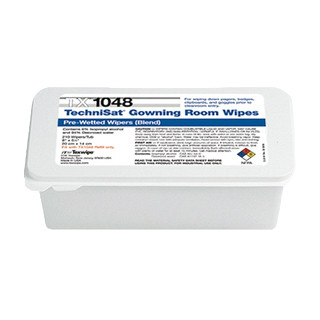
TX1048 TechniSat 6% IPA gowning-room wipes: controlled wetness for consistent pre-entry wipe-downs
Last reviewed: Jan. 4, 2026 | Audience: contamination control, cleanroom operations, EHS, quality
The gowning room is where cleanroom discipline either becomes repeatable—or becomes improvised. The most common failure pattern is not intent; it is variability:
inconsistent bottle dilution, inconsistent spray volume, inconsistent wipe wetness, and inconsistent glove and touch-point wipe technique. That variability shows up as re-wiping,
over-wetting, faster solvent flash-off, and more “I’ll just wipe it again” behavior.
Texwipe TX1048 TechniSat is engineered to reduce that variability by delivering a fixed, repeatable wetness level using a 0.2 µm filtered 6% IPA / 94% DI water solution,
packaged in a tub/refill system built to control evaporation and standardize withdrawal. The 8" x 5" cut-edge cellulose/polyester nonwoven format is tuned for gowning-room
and controlled-area wipe-downs where controlled wetting matters more than aggressive solvent loading.
What it’s for
TX1048 is best used for gowning-room and controlled-area wipe-down tasks where you want the benefits of pre-wetted control without the operational downsides of high-alcohol wipes.
Typical use cases include glove wipe-down during gowning, wiping items entering the cleanroom (phones, notebooks, badge clips, tools), cleaning environmental touch points
(handles, pass-through surfaces, carts), and light wipe-downs of equipment exteriors where controlled wetness and low extractables are valued.
Decision drivers
When you select a gowning-room wipe, the decision is less about “does it clean” and more about whether it enforces consistent behavior while minimizing unintended risk.
- Controlled wetness and VOC discipline: 6% IPA / 94% DIW supports repeatable wetting and reduces over-wetting and rapid flash-off that can drive rewipe behavior.
- Contamination performance (typicals): Particle/fiber release, NVR and ionic background inform whether the wipe is appropriate for the intended zone and residue sensitivity.
- ISO range alignment: Designed for ISO Class 5–8 environments, supporting common gowning-room and controlled-area classifications.
- Packaging as a process control: Tub + refill architecture is an engineering control for evaporation, withdrawal consistency and clean introduction.
- Edge strategy: Cut edge is appropriate for gowning-room wipe-downs; escalate to sealed-edge polyester when fiber/edge control is the gating risk.
- Program fit and compliance pressures: Commonly selected where USP <797>/<800> operational practices influence wiping discipline and consistency requirements.
Materials and construction
TX1048 uses a hydroentangled nonwoven blend (55% cellulose / 45% polyester) that balances absorbency (cellulose) with tensile strength and wet strength (polyester).
Hydroentangling avoids binders typical of some bonded nonwovens and is widely used for controlled-environment wiping where low extractables and solvent compatibility matter.
The wipe is cut-edge and cleanroom manufactured, then pre-wetted with a 0.2 µm filtered 6% IPA / 94% DIW solution. In practice, the engineered value is not only the substrate;
it is the combination of substrate + fixed wetness + controlled packaging that reduces operator-to-operator variation during gowning and material transfer workflows.
Specifications in context
Format: 8" x 5" (20 cm x 13 cm) pre-wetted gowning-room wipe.
Material: 55% cellulose / 45% polyester hydroentangled nonwoven; edge: cut edge.
Solution: 0.2 µm filtered 6% IPA / 94% DIW (fixed wetness level).
Cleanroom environment: ISO Class 5–8 (Class 100–100,000; EU Grade B–D).
Packaging (case): 12 refill packs of 210 wipers plus 1 flip-top tub (2,520 total wipers).
Shelf life (manufacturer guidance): non-sterile pre-wetted wipes are typically 3 years from date of manufacture (verify by lot documentation for your program).
Cleanliness and performance metrics
In controlled environments, “typical” data is a starting point for risk assessment, not a substitute for qualification. Focus on what drives your failure modes: particle/fiber release,
nonvolatile residue (NVR) that can form films, and ions that can impact corrosion or process sensitivity.
Typical analyses (substrate family):
Particles ≥0.5 µm: 72 x 106 particles/m2
Fibers >100 µm: 55,000 fibers/m2
NVR: IPA extractant 0.01 g/m2; DIW extractant 0.03 g/m2; ethanol extractant 0.01 g/m2
Ions: sodium 12 ppm; potassium 1 ppm; chloride 10 ppm
Absorbency (sorptive capacity): 360 mL/m2; sorptive rate <0.3 seconds; basis weight 69 g/m2
Operational interpretation: TX1048 is well-positioned for gowning and controlled-area wipe-downs where the priority is consistent wetting and light removal of transferable contamination.
If your critical step is residue-sensitive (optics, high-vac, lithography, precision coating), validate the wipe/solvent pairing against your acceptance criteria and consider a sealed-edge polyester wiper
for the final wipe step when edge control is the gating risk.
Packaging, wetness control, and EHS handling
The flip-top tub is not “just packaging.” It is a process control that protects saturation, reduces evaporation-driven dry wipes, and standardizes one-at-a-time withdrawal behavior.
TX1048 is commonly configured as 12 refills and one tub (2,520 wipes total), enabling predictable replenishment and consistent operator access at gowning stations.
Because it is an alcohol-containing presaturated product, programs should plan for appropriate transport and storage controls and follow site EHS guidance for flammables.
Rule of thumb: Treat the tub lid like a cleanroom door—open only long enough to withdraw wipes, then close immediately to protect wetness and reduce VOC drift.
Best-practice use
Use technique to convert “a wipe” into contamination control. TX1048 is most effective when your SOP emphasizes one-direction wiping, clean-face management, and defined touch-point priorities.
- Fold for clean faces: Fold to create multiple clean surfaces; rotate to a fresh face frequently to avoid re-depositing soils.
- One direction, light pressure: Wipe in one direction with controlled pressure; avoid circular scrubbing unless your SOP explicitly calls for it.
- Glove wipe-down discipline: Wipe fingertips, palm, then back of glove; repeat on the second hand with a fresh wipe face.
- Entry item wipe-down: Prioritize high-touch surfaces (edges, handles, clips) before placing items on gowning benches or pass-through surfaces.
- Know what 6% IPA is (and isn’t): 6% IPA supports controlled wetting and light film removal; it is not a sporicide and may not meet your disinfection/contact-time intent. Use validated disinfectants when microbial kill is the requirement.
Common failure modes
Lid left open: Evaporation shifts wetness and drives dry wiping and re-wipe behavior. Keep the lid closed between withdrawals.
Using gowning wipes for final critical wipes: Cut-edge nonwoven blends may not be the best choice when your final step is fiber/edge-limited; escalate to sealed-edge polyester for ultra-critical surfaces.
Cross-contamination via “same wipe, too long”: Overusing one wipe face redeposits soils. Fold, rotate, and discard early.
Over-wetting expectations: If operators expect “wet like a spray bottle,” they will overwork the surface. Train to the intended wetness level and wipe pattern.
Assuming all IPA wipes equal disinfection: Align wipe selection with your validated cleaning/disinfection strategy and required contact times.
Closest competitors
Contec gowning-room presaturated wipes (6% IPA / 94% DI water): Similar intent (glove wipe-down during gowning) and solution ratio; selection often comes down to packaging/withdrawal preference,
availability, and your program’s documentation and lot-traceability expectations.
Berkshire Choice® SatPax 500 (6% IPA gowning wipes) and SatPax® 1000 (6% IPA variants): Functional peers in the presaturated gowning wipe category; compare substrate blend,
pack architecture (tub vs pouch), and how well the format supports your withdrawal discipline and evaporation control at the point of use.
Where it fits in a cleanroom wiping program
Place TX1048 at the boundary where behavior matters most: gowning benches, entry staging, pass-through handling points, and controlled-area touch surfaces.
It is a strong choice for standardizing pre-entry wipe-downs and reducing variability in wetting and withdrawal technique.
For higher-criticality final wipes (residue-sensitive or fiber/edge-limited processes), pair the gowning-room wipe with a defined escalation path to sealed-edge polyester wipers
and validated solvents/disinfectants aligned to your process qualification and contamination risk model.
Terminology note: Engineered for low-linting performance; no wiper is truly “lint-free” in every process condition.
Source basis
- SOSCleanroom product page (TX1048 TechniSat 8" x 5" Gowning Room Wipe Pre-Wetted 6% IPA): https://www.soscleanroom.com/product/wipers/texwipe-tx1048-technisat-8-x-5-cleanroom-gowning-room-wipe-pre-wetted-6-ipa/
- SOS-hosted Texwipe TechniSat datasheet (Effective: June 2011; includes TX1048 packaging line): https://www.soscleanroom.com/content/texwipe_pdf/1041%201045%201048%201065%201067%208488.pdf
- Texwipe Technical Data Sheet (TechniCloth / TechniSat family; US-TDS-003 Rev.4/23; includes typical particles, fibers, NVR, ions): https://www.texwipe.com/images/uploaded/documents/Wipers/Texwipe-TechniCloth-TDS-ENG.pdf
- Texwipe product page (TX1048; specs, ISO range, technical downloads): https://www.texwipe.com/technisat-tx1048
- Texwipe SDS (TX1048 6% IPA wipes; dated May 31, 2023): https://www.texwipe.com/images/uploaded/documents/Safety%20Data%20Sheets/2023%20wipe%20sds%20us-can-mex/6/TX1048_US_CA_SDS_ENG_May_31_2023.pdf
- Contec gowning-room wipes (6% isopropanol / 94% DI water; tub/refill architecture): https://cleanroom.contecinc.com/product/1779515231
- Berkshire Choice® SatPax 500 6% IPA gowning wipes (product page): https://berkshire.com/shop/presaturated-cleanroom-wipes/ipa-wipes-isopropyl-alcohol/resealable-pouch-wipes/choice-satpax-500/choice-satpax-500-6-x-8-case-6-ipa-gowning-wipes/
- Berkshire SatPax® 1000 IPA wipes (product category page; includes 6% IPA variants): https://berkshire.com/product-category/presaturated-cleanroom-wipes/ipa-wipes-isopropyl-alcohol/resealable-pouch-wipes/satpax-1000/
Source: SOSCleanroom Technical Vault | Last reviewed: Jan. 4, 2026
© 2026 SOS Supply. All rights reserved.