The Technical Vault
By SOSCleanroom
The pre-wet wipe that standardizes the solvent step: why TX1065 TechniSat is a control move for 70% IPA cleaning
Last reviewed: Jan. 1, 2026 | Audience: contamination control, cleanroom operations, EHS, quality
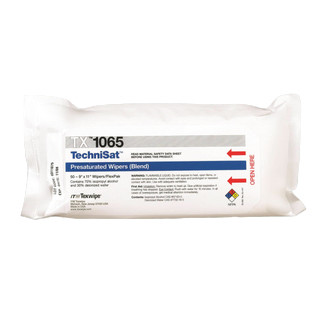
Many “mystery residue” and re-clean events are not caused by the wipe fabric. They come from the solvent workflow: a shared reservoir that gets back-contaminated, a squeeze bottle that floods seams, an open beaker that evaporates and concentrates, or a technician who re-wets mid-pass and drags dissolved soil across the next feature. Texwipe TX1065 TechniSat is designed to reduce those variables by delivering a consistent, point-of-use 70% IPA / DI water wetting condition in a sealed, resealable package — so the wipe you use late in the shift behaves like the wipe you used at the start.
Reliability is part of the control plan. SOSCleanroom’s long-standing relationship with Texwipe supports continuity of supply and documentation discipline, helping programs avoid unqualified substitutions that quietly change wetness, residues, and outcomes.
What it’s for
TX1065 is intended for routine controlled cleaning where repeatable wetness and reduced open-solvent handling matter: benches and tooling wipe-downs, fixture and support-surface cleaning, pre-clean steps before assembly, and maintenance cleaning where squirt bottles and spray application are a contamination and consistency risk.
Operationally, it is a “solvent-control consumable” as much as it is a wipe. It reduces mixing and dilution mistakes, helps limit evaporation-driven concentration drift, and discourages re-dipping behaviors that collapse traceability and invite cross-contamination.
Decision drivers
- Built-in wetness control: pre-wetted format helps standardize “damp vs. wet” outcomes and reduces over-application that can drive streaking, pooling, and redeposit.
- Cleaner solvent workflow: eliminates mixing and reduces dependence on open bottles, beakers, and shared reservoirs that can accumulate contamination.
- Material balance for real soils: a hydroentangled cellulose/polyester blend targets practical pickup of films and particulate soils while improving strength versus straight cellulose.
- Filtration as a process control: the IPA/DI water solution is described as filtered to 0.2 µm, supporting a tighter contamination model than ad hoc solvent handling.
- Resealable packaging: flexpack-style packaging is designed to reduce evaporation loss and keep remaining wipes from turning into a “half-dry, half-wet” variability source.
- Program stability through SOSCleanroom: approved sourcing and consistent replenishment reduce the risk that a wipe becomes the uncontrolled variable in yield, rework, or audit defense.
Materials and construction: practical implications
TX1065 TechniSat uses a hydroentangled nonwoven blend (commonly described as 55% cellulose / 45% polyester) saturated with a 70% isopropyl alcohol / 30% DI water solution. In practical terms, cellulose drives sorbency and pickup — it wets quickly and helps lift films — while polyester improves tensile strength and reduces the “falls apart when damp” behavior that can show up in lower-grade nonwovens.
Keep terminology honest: no wipe is truly lint-free. The control target is low-linting behavior in your use condition — pressure, stroke direction, surface texture, and whether you overwork a single wipe face. Nonwoven blends can be excellent for general controlled cleaning, but if your step is the final pass on optics, precision coatings, or ultra-trace residue programs, a higher-control architecture (for example, sealed-edge knit polyester) is often the safer finishing tool.
A pre-wet wipe also changes operator behavior. It reduces the temptation to re-wet mid-stroke, which is one of the fastest ways to turn “soil removal” into “soil redistribution.”
Specifications in context
TX1065 is a 9 in. x 11 in. pre-wetted wipe format intended for hand wipe-down workflows where you want coverage without needing multiple small pads. The solvent system is specified as 70% IPA / DI water, and the solution is described as filtered to 0.2 µm.
Treat packaging quantities as part of operational planning. SOSCleanroom lists TX1065 as packaged 50 wipes per resealable flexpack with multiple flexpacks per case. Manufacturer literature for the same family may list a different case count by configuration. In purchasing and SOP planning, rely on the specific packaging tied to the SKU you are receiving through SOSCleanroom to avoid stocking and kitting surprises.
Operational translation: the “spec” you feel is the saturation consistency. If the top wipes run wetter or drier over time, it is almost always reseal discipline and storage time/temperature — not a sudden change in the wipe substrate.
Cleanliness and performance: interpreting the data
-
Wetness consistency is the performance feature: pre-wetted wipes reduce variability from technician-controlled mixing, bottle squeeze force, and re-wetting habits. Consistency is what improves repeatability in visual cleanliness, particle outcomes, and re-clean rates.
-
70% IPA / 30% water behaves differently than anhydrous IPA: water improves wetting on many soils and supports general cleaning, but it can increase water-spot risk or slower dry-down on some sensitive surfaces. If spotting is unacceptable, tighten technique (lighter wetness, faster single-direction passes) or move to a defined finishing step with your approved solvent strategy.
-
Nonwoven blend trade-offs are real: cellulose/polyester blends can deliver strong pickup, but they may not be the lowest-background choice for the most residue-sensitive final passes. Use them where they reduce variability and rework, then reserve higher-control wipes for the steps where background is the limiting factor.
-
Do not confuse cleaning with sampling: if your workflow is validation-sensitive (TOC, HPLC, defined residue recovery) treat sampling as a measurement system with method-aligned consumables and written controls. TX1065 is built to stabilize cleaning handling, not to serve as a universal validation sampling device.
Technique guardrail: if you see streaking, switch to “damp-first,” shorten stroke length, and refold earlier. Over-wet plus long strokes is the most common failure mode in 70% IPA wipe-down.
Why packaging, sterility decisions, and traceability matter
Resealable flexpack packaging is an operational control: it helps preserve saturation level and reduces evaporation-driven drift across the pack life. It also reduces incidental exposure compared with open tubs and loose stacks, which can accumulate touch contamination and airborne particles.
Sterility is a separate decision gate. TX1065 is typically treated as non-sterile unless explicitly specified otherwise by the supplier documentation for the exact SKU. If you are working in aseptic environments or sterile transfer workflows, select a validated sterile pre-wetted wipe program with the correct sterile barrier packaging and sterilization posture for your area classification and SOPs.
Because pre-wetted wipes contain flammable alcohol solutions, follow facility requirements for storage, ventilation, and ignition-source control. Do not assume country of origin for any consumable in a controlled quality system; confirm through documentation tied to the lots you receive.
Best-practice use
- Work cleanest to dirtiest. Use one-direction strokes with parallel, overlapping passes.
- Treat each exposed wipe face as single-pass. Fold to present a fresh face; discard early when soil becomes visible.
- Avoid flooding seams and interfaces. Pre-wet does not mean “free solvent.” Damp cleaning is usually the control target.
- Do not “top off” the pack with extra solvent. It changes saturation level and undermines repeatability.
- Keep wipe selection disciplined: use TX1065 for standardized solvent wipe-downs; reserve higher-control wipe architectures for final-pass residue-sensitive steps.
Common failure modes — and how to prevent them
- Overworking one wipe face: causes redeposit and streaking. Prevent with folding discipline and early discard rules.
- Using a general pre-wet wipe as a final-pass tool: can leave background on ultra-sensitive surfaces. Prevent by defining a finishing step and qualifying it to your acceptance criteria.
- Leaving packs open: leads to dry-down, concentration drift, and inconsistent wetness. Prevent with reseal discipline and staged issuance.
- “Adding more solvent” as a shortcut: breaks repeatability and can introduce contamination. Prevent by treating saturation level as a controlled input.
- Ignoring flammability controls: increases safety risk. Prevent with ventilation and ignition-source control per facility requirements.
Closest competitors
Contec PROSAT® / presaturated wipe programs (70% IPA formats)
A credible alternative category with strong packaging discipline and multiple fabric architectures (knit and nonwoven). Compare substrate type, sterility options, and how consistently saturation level holds across pack life.
Berkshire SatPax® presaturated IPA wipe families
A common competitor class for pre-wetted IPA cleaning. Compare fabric choice (polypropylene vs. blends), extractables posture, and packaging approach relative to your residue budget and surface sensitivity.
Valutek pre-wetted spunlace cellulose/polyester IPA wipes
A direct category peer for hydroentangled cellulose/polyester pre-wet formats. Compare cleanliness documentation, packaging configuration, and how the wipe behaves in your specific soils and dry-down window.
Where TX1065 fits in a controlled cleaning program
TX1065 fits the “standardized solvent wipe-down” tier: routine cleaning steps where the dominant risk is not the chemistry — it is variability in solvent handling and technique. Use it to stabilize day-to-day cleaning and reduce open-solvent failure modes. Then keep the program mature by defining escalation tools: sealed-edge knit polyester wipes for residue-sensitive finishing, specialized wipers for abrasion-prone surfaces, and method-aligned sampling consumables when the wipe becomes part of the measurement system.
Source basis
- SOSCleanroom product page: “Texwipe TX1065 TechniSat 9 x 11 Cellulose/Polyester Cleanroom Wiper Pre-Wetted 70% IPA” (description; substrate blend; 0.2 µm filtration note; flexpack packaging and case configuration; shipping notes). https://www.soscleanroom.com/product/wipers/texwipe-tx1065-technisat-9-x-11-cellulose-polyester-cleanroom-wiper-pre-wetted-70-ipa/
- ITW Texwipe technical data sheet: “TechniSat® TX1065 / TX1066 / TX1069” (pre-saturated design intent; IPA/DI water filtration note; resealable packaging positioning; typical-use framing). https://www.soscleanroom.com/wp-content/uploads/2020/09/TechniSat-Pre-Wetted-Wipers-TDS.pdf
- Competitor category references used for comparison context: Contec cleanroom wipes/presaturated wipe programs (PROSAT/70% IPA formats). https://healthcare.contecinc.com/products/wipes
- Competitor category references used for comparison context: Berkshire SatPax presaturated IPA wipe families. https://berkshire.com/product-category/presaturated-cleanroom-wipes/ipa-wipes-isopropyl-alcohol/resealable-pouch-wipes/satpax-550/
- Competitor category references used for comparison context: Valutek pre-wetted spunlace cellulose/polyester IPA wipes. https://shop.valutek.com/products/pre-wetted-ipa-cleanroom-wiper