The Technical Vault
By SOSCleanroom
Standardize the Solvent Step in Tight Workspaces: How TX1067 TechniSat Stabilizes 70% IPA Wipe-Downs
Last reviewed: Jan. 2, 2026 | Audience: contamination control, cleanroom operations, EHS, quality
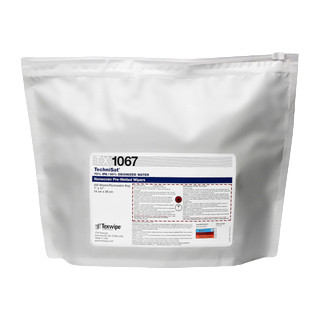
Many “mystery residue” and re-clean cycles do not come from the wiper substrate. They come from the solvent workflow: a shared bottle that gets back-contaminated, an open beaker that evaporates and concentrates, or a technician who re-wets mid-pass and drags dissolved soil across the next feature. Texwipe TX1067 TechniSat is engineered to reduce those variables by delivering a consistent, point-of-use USP-grade 70% IPA / 30% DI water wetting condition in a recloseable bag, so the wipe you use late in the shift behaves like the wipe you used at the start.
Program stability is part of the control plan. Sourcing through SOSCleanroom supports continuity of supply and clean documentation handoff so teams are not pushed into unqualified substitutions that quietly change wetness, residues, and outcomes.
What it’s for
TX1067 is a pre-wetted, non-sterile cleanroom wiper intended for routine controlled cleaning where repeatable wetness and reduced open-solvent handling matter: benches and tooling wipe-downs, fixtures and support-surface cleaning, pre-clean steps before assembly, and maintenance cleaning where squeeze bottles and spray application can become a contamination and consistency risk. It is commonly placed in ISO Class 5–8 environments for general wiping tasks when standardized solvent loading is the constraint.
Decision drivers
TX1067 earns its place in a cleaning program based on a short list of process controls:
- Pre-wet standardization: fixed solvent loading reduces “damp vs. wet” variability that drives streaking, pooling, and redeposit.
- Filtered solution control: TechniSat is positioned as pre-wetted with 0.2 µm filtered solution, tightening the contamination model versus ad hoc mixing and pouring.
- Substrate balance for real soils: nonwoven 45% polyester / 55% cellulose blend targets practical film/soil pickup while maintaining wet strength.
- Packaging discipline: recloseable bag presentation reduces evaporation loss and helps preserve consistent wetness across pack life.
- Regulatory alignment posture: the TechniSat program is positioned as meeting USP <797> and USP <800> requirements (confirm fit to your SOPs and environment).
- Program stability through SOSCleanroom: consistent replenishment reduces the risk that a wipe becomes the uncontrolled variable in yield, rework, or audit defense.
Materials and construction – explained like an engineer
“Pre-wetted wipe” is not a single category. The control question is whether the wipe behaves like a metered solvent delivery device or like a wet rag with drift. TX1067 uses a cleanroom-manufactured nonwoven blend (polyester/cellulose) engineered to hold together under wiping force while delivering the solvent film consistently across a folded face. The cellulose fraction supports rapid wet-out and pickup; the polyester fraction supports tensile strength and reduces “fall-apart when damp” behavior that can show up in lower-grade nonwovens.
The practical risk to manage is not “more solvent is better.” Over-wetting mobilizes residues beyond the intended wipe path and increases pooling at seams and interfaces. The purpose of TX1067 is to make the solvent step repeatable, not wetter.
Rule of thumb: When wetness repeatability is the constraint, a controlled pre-wet system is often the fastest stability win. When residue sensitivity is the constraint, pair the pre-wet step with a defined finishing wipe architecture and acceptance criteria.
Specifications in context
TX1067 is a 7" × 11" pre-wetted format packaged 200 wipers per recloseable bag, 4 bags per case (800 total/case). The 7" width is an operational advantage in tight spaces: it folds cleanly into stable faces for controlled strokes inside carts, around tooling, and along edges where a wider wipe tends to bunch, drag, or contact adjacent surfaces.
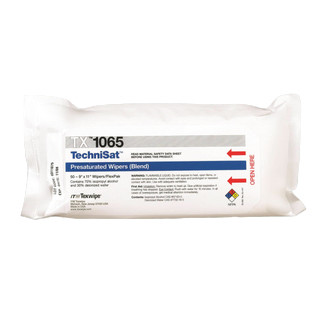
TechniSat wipes are positioned as pre-wetted with USP-grade 70% IPA / 30% DI water and the solution is described as 0.2 µm filtered. Treat those attributes as part of your controlled input set: do not “top off” bags with additional solvent, and do not commingle wipes across lots if traceability matters to investigations.
Cleanliness and performance metrics
Pre-wetted wipes shift the performance conversation from “how clean is the fabric” to “how controlled is the whole solvent event.” TX1067 is positioned to provide repeatable wetness and VOC levels and to reduce solution evaporation that can otherwise create “half-dry, half-wet” drift across the life of a pack.
Treat published cleanliness characteristics as qualification starting points rather than contractual specifications. If your process is residue-critical (optics/coatings, ultra-trace residues, high-impedance electronics), define the wipe’s role (bulk wipe vs. finishing wipe vs. sampling) and validate in your actual solvent set, surface condition, and acceptance window.
Why packaging discipline and EHS posture matter
The recloseable bag is a contamination control feature and an evaporation control feature. It reduces incidental exposure compared with open tubs and loose stacks, and it discourages re-dipping behaviors that collapse traceability and invite cross-contamination.
Because TX1067 contains flammable alcohol solution, follow facility requirements for storage, ventilation, ignition-source control, and waste handling. Shipping may be restricted by carrier and destination; plan replenishment lead times accordingly.
Best-practice use
- Reseal discipline: open, dispense, reseal. Leaving bags open drives dry-down and concentration drift.
- Fold for control: quarter-fold to create multiple faces; treat each face as single-pass for controlled wipe-downs.
- Stroke logic: wipe cleanest-to-dirtiest using parallel, overlapping, single-direction strokes; avoid “back-and-forth scrubbing” that redistributes soils.
- Change-out triggers: discard early when the face becomes visibly soiled or begins to smear; a loaded face becomes a redeposit tool.
- No “topping off”: do not add solvent to the bag; it changes saturation level and undermines repeatability.
Common failure modes — and how TX1067 helps
The dominant failure modes in solvent wiping are predictable: over-wetting and pooling at seams, reusing a loaded face too long, re-wetting mid-pass, and allowing evaporation drift across shifts. TX1067 reduces re-wetting and mixing variability by supplying a controlled wetness input; the remaining controls are procedural: face rotation, directional strokes, reseal discipline, and role separation (routine solvent wipe-down vs. final-pass finishing vs. sampling).
Closest comparators
The most defensible comparisons are to other controlled presaturated wipe programs intended for 70% IPA wipe-downs.
Contec PROSAT® presaturated wipe programs are a close comparator category when packaging discipline and multiple substrate architectures (knit vs. nonwoven) drive the decision.
Berkshire SatPax® presaturated IPA pouch programs are commonly evaluated for similar “repeatable wetness” objectives; compare substrate, saturation stability, and extractables posture relative to your residue budget.
Valutek presaturated IPA wipe families are a credible category peer for general wipe-down; comparison should focus on documentation depth, packaging configuration, and consistency over time.
Where TX1067 fits in a cleanroom wiping program
TX1067 fits the “standardized solvent wipe-down” tier: routine cleaning steps where the chemistry is known, but solvent handling variability is the dominant risk. Use it to stabilize day-to-day wipe-downs in ISO 5–8 environments and reduce open-solvent failure modes. Keep the program mature by defining escalation tools: sealed-edge knit polyester for residue-sensitive finishing, specialized wipers for abrasion-prone surfaces, and method-aligned sampling consumables when the wipe becomes part of the measurement system.
Terminology note: TX1067 is engineered for low-linting performance; no wiper is truly “lint-free” in every process condition.
Source basis
-
SOSCleanroom product page: “Texwipe TX1067 TechniSat 7" × 11" Cellulose/Polyester Cleanroom Wiper Pre-Wet 70% IPA”
(link)
(packaging configuration, positioning, shipping/handling notes).
-
Texwipe TechniSat program page (non-sterile):
(link)
(45% polyester / 55% cellulose material statement; USP-grade 70% IPA / 30% DIW; 0.2 µm filtration note; ISO Class 5–8 positioning; TX1067 packaging counts; USP <797>/<800> positioning).
-
Competitor category references for comparison context:
Contec presaturated wipe programs
(link);
Berkshire presaturated wipe families
(link);
Valutek presaturated IPA wipe families
(link).
Source: SOSCleanroom Technical Vault | Last reviewed: Jan. 2, 2026
© 2026 SOS Supply. All rights reserved.