The Technical Vault
By SOSCleanroom
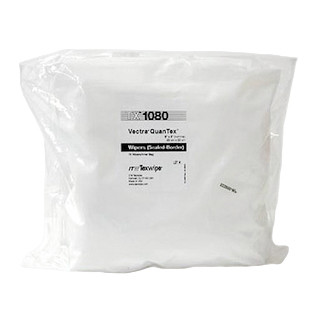
Edge-Control as a Process Input: Why TX1080 Vectra® QuanTex™ Is Selected When “What the Wipe Adds” Matters
Last reviewed: Jan. 2, 2026 | Audience: contamination control, cleanroom operations, EHS, quality
Texwipe TX1080 Vectra® QuanTex™ (9" × 9") is a dry, double-knit polyester cleanroom wiper built around a simple engineering premise: in many critical wipe-down steps, the dominant risk is not the soil you are removing—it is edge-driven releasables (fibers/particles) introduced when operators fold, press into corners, and drag edges across fixtures, tool faces, and panels.
TX1080 addresses that risk with a sealed-border architecture and published contamination metrics (particles, fibers, NVR, ions) that support qualification conversations. In programs where “wipe variability” becomes investigation fuel, the goal is to make the wipe behave like a controlled process input—not a consumable wildcard.
What it’s for
TX1080 is positioned for general wiping and cleaning applications in environments where contamination control is a primary constraint. Operationally, it is most valuable where personnel routinely fold and use edges to reach tight geometries—and where edge degradation would otherwise show up as fibers, stringers, or unexplained particle trends.
Decision drivers
TX1080 is typically selected when the facility wants edge control without moving into a different wipe size or a different solvent workflow:
- Sealed-border architecture: targets the most common “hidden emitter” in wipe-down work—edge wear during folding, corner work, and high-friction strokes.
- Polyester knit stability: double-knit polyester is selected for durability and low-linting behavior under wiping force and repeated folding.
- Published contamination framework: typical values for particles/fibers, NVR, and extractable ions help place the wipe appropriately in a program (qualification starting point, not a contractual limit).
- Absorbency that supports daily work: fast uptake and meaningful capacity per unit area support routine cleaning and spill response without overworking one face.
- Packaging built for controlled introduction: staged inner-bag presentation supports disciplined transfer and issuance.
- Program stability via SOSCleanroom: consistent sourcing, clean documentation handoff, and practical application support reduce untracked substitutions and shorten investigations when trends shift.
Materials and construction — explained like an engineer
“Polyester cleanroom wiper” is an umbrella term. What matters in use is how the fabric behaves when it is folded, loaded, and dragged across surfaces at real operator speeds. TX1080 uses a double-knit polyester construction designed to remain stable under mechanical stress, which is why it is often evaluated for wipe-down stations where operators work fast and edge contact is unavoidable.
The sealed-border feature is the functional differentiator: it is intended to reduce edge fray and the kind of edge-driven fibers that show up late in shifts when wipes are overworked or used aggressively around hardware, fasteners, and textured surfaces.
Terminology note: TX1080 is engineered for low-linting performance; no wiper is truly “lint-free” in every process condition.
Specifications in context
TX1080 is a 9" × 9" wipe supplied as 150 wipers per bag in a staged configuration (2 inner bags of 75) with 10 bags per case. The 9" × 9" footprint is a practical “control size” for many stations: large enough to quarter-fold into stable faces, small enough to limit accidental contact outside the intended wipe path.
Packaging controls matter operationally. Staged inner-bagging supports transfer discipline: open only what the shift needs, protect the remainder, and reduce handling exposure that turns a good wipe into a contaminated input.
Cleanliness and performance metrics
For most programs, the wipe must be defensible in four categories: releasables (particles/fibers), residues (NVR), ions, and wet-out behavior (uptake speed and capacity). TX1080’s published typical values cover those categories and should be treated as a qualification starting point rather than a per-lot acceptance limit.
- Absorbency: typical sorptive capacity 375 mL/m²; sorptive rate 0.5 seconds.
- Particles (LPC): >0.5 µm typical 6.7 × 10⁶ particles/m².
- Particles and fibers: 0.5–5.0 µm typical 1.3 × 10⁶ particles/m²; 5.0–100 µm typical 69,000 particles/m²; fibers >100 µm typical 220 fibers/m².
- NVR: IPA extractant typical 0.03 g/m²; DI water extractant typical 0.01 g/m².
- Ions: sodium 0.17 ppm; potassium 0.05 ppm; chloride 0.01 ppm.
How to use the numbers: If you see streaking, haze, or redeposit, the biggest levers are technique (directional strokes, face rotation, early discard) and wetness control. “Wipe harder” is rarely the fix—it increases friction and can increase releasables.
Why sealed-border matters operationally
In day-to-day wiping, operators naturally use edges to reach corners, wipe around standoffs, and trace along hardware lines. That makes edges the highest-risk geometry for fiber generation and particle release. Sealed-border designs are intended to reduce edge degradation during folding and high-friction strokes, which is why they are often evaluated as the step-up when a laundered cut edge is “good” but not good enough for the defect sensitivity of the step.
Best-practice use
TX1080 performs best when the wipe is treated as a controlled tool, not a rag:
- Quarter-fold for face control: create multiple clean faces; treat each face as single-pass for critical wipe-downs.
- Directional strokes: use straight-line, overlapping passes; avoid back-and-forth scrubbing that redistributes soils.
- Rotate and discard early: once the face is loaded, it becomes a redeposition tool—take a new wipe instead of overworking one.
- Wetness discipline: if solvent is used, standardize application (amount, dwell logic, wipe path) and avoid flooding seams and interfaces.
- Station controls: keep open bags protected; stage only what the shift needs; do not set wipes on exposed benches where they become airborne-collection media.
Common failure modes — and how to prevent them
Most wipe-related excursions come from predictable behaviors:
- Overusing one face: increases redeposit and streaking. Prevent with aggressive folding and early discard rules.
- High-pressure scrubbing on textured surfaces: increases friction-driven particles. Prevent with lighter pressure, defined wipe paths, and appropriate chemistry.
- Edge abuse at corners/hardware: drives stringers in cut-edge wipes. Prevent by selecting edge-control architectures (sealed-border/sealed-edge) and training corner technique.
- Open packaging on the bench: increases touch contamination and airborne loading. Prevent with staged issuance and protected storage between uses.
Closest comparators
The most defensible comparisons are to other polyester knit cleanroom wipes selected for similar ISO ranges and edge-control needs.
Contec Anticon® Gold (polyester knit cleanroom wipe) is commonly evaluated as a peer option in programs that want a robust polyester knit with cleanroom control posture. When comparing, focus on edge strategy, published releasables and extractables, and how the wipe behaves under your actual wipe force and solvent/disinfectant set.
Berkshire MicroSeal® 1200 (sealed-edge polyester knit) is an appropriate comparator when edge-driven releasables are the controlling risk. Sealed-edge formats are typically the next control step when a process is struggling with edge-related fibers or when defect sensitivity makes edge control non-negotiable.
Rule of thumb: When edge control becomes the acceptance driver, sealed-edge/sealed-border is usually the step-up. When wetness repeatability becomes the constraint, consider a controlled pre-wetted system designed for consistent loading and reduced operator variability.
Where TX1080 fits in a cleanroom wiping program
TX1080 is a strong fit as a daily-use polyester knit wipe when the program wants the familiarity of a 9" × 9" format but needs an additional layer of control against edge-driven contamination. It is most defensible in stations where folds and edges are unavoidable and where the facility wants published contamination context to support qualification and change control. If the process constraint shifts from edge control to solvent-loading repeatability, the logical step is a validated pre-wetted system; if the constraint shifts to ultra-sensitive residue or defect requirements, tighten the full cleaning method (chemistry, technique, verification) and consider escalation architectures aligned to that acceptance window.
Source basis
- SOSCleanroom product page: “Texwipe TX1080 Vectra QuanTex 9" × 9" Polyester Cleanroom Wiper” (positioning, SKU context, ordering configuration): https://www.soscleanroom.com/product/wipers/texwipe-tx1080-vectra-quantex-9-x-9-polyester-cleanroom-wiper/
- ITW Texwipe datasheet DS-1080: “Vectra® QuanTex™ Wipers” (packaging; construction; absorbency; particles/fibers; NVR; ions; typical-value framing): https://www.soscleanroom.com/content/texwipe_pdf/1080.pdf
- IEST-RP-CC004.3 context referenced in Texwipe test-method framework (evaluation of wiping materials used in cleanrooms and controlled environments).
- Contec product information: Anticon® Gold (category comparator): https://www.contecinc.com/products/anticon-gold
- Berkshire product information: MicroSeal® 1200 (sealed-edge comparator): https://berkshire.com/wp-content/uploads/2019/02/MicroSeal-1200.pdf
Source: SOSCleanroom Technical Vault (SOS Supply) |
Last reviewed: Jan. 2, 2026
© 2026 SOS Supply. All rights reserved.