The Technical Vault
By SOSCleanroom
Sealed-Edge Polyester for Rough Wiping: Why TX2069 ThermaSeal 60 Is Built for Abrasion, Chemistry, and Control
Last reviewed: Jan. 1, 2026 | Audience: contamination control, cleanroom operations, EHS, quality
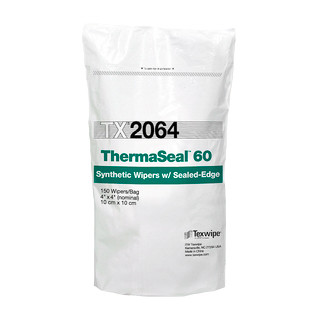
Texwipe TX2069 ThermaSeal™ 60 (9" × 9") is a dry, sealed-edge 100% polyester cleanroom wiper engineered for the situations that tend to punish standard cut-edge wipes:
rough stainless, sharp fasteners, textured housings, aggressive wipe patterns, and solvent-heavy cleaning that exposes weak edge construction.
The control idea is simple: when a wipe is being used in a high-abrasion or high-chemistry step, the edge and the construction are often the dominant defect mechanism.
TX2069 is designed to reduce edge-driven releasables while staying compatible with common solvents and process chemistries used in ISO-class controlled environments.
What it’s for
TX2069 is typically selected for general wiping, spill pickup, and cleaning of rough or abrasion-prone surfaces where the wipe must remain intact and predictable.
It is commonly used with cleanroom solvent workflows (for example IPA, ethanol, acetone and other process-approved cleaners) and is positioned for ISO-controlled environments where fiber/particle contribution must remain in scope.
Decision drivers
TX2069 earns its place when your process risk is driven by abrasion, chemistry, and repeatability:
- Sealed-edge strategy: engineered edges help reduce edge fray and “stringers” during folding, corner work, and higher-pressure wipe patterns.
- 100% polyester substrate: supports solvent compatibility and mechanical stability versus cellulose-containing blends in harsh wipe-down steps.
- Chemistry posture: positioned for use with common solvents (including IPA, ethanol, acetone) and a range of cleaners/degreasers used in controlled environments.
- Temperature tolerance note: often specified for applications up to <400°F (process suitability still depends on the full exposure scenario and acceptance criteria).
- Cleanliness framework: published typical values for particles/fibers, NVR, and ionic extractables support qualification discussions.
- Program-ready packaging: double-bagged presentation supports controlled introduction and staging.
- Quality-system fit: positioned as meeting USP <797> and USP <800> wiper requirements for facilities aligning consumables to compounding/handling controls (verify against your SOPs and supplier documentation for the exact SKU/lot).
Materials and construction – explained like an engineer
In abrasive wipe-downs, the edge is where many wipes fail first. A cut edge can begin to fray under repeated folding and pressure, especially when the wipe is dragged across brushed stainless, screw heads, or textured plastics.
TX2069 is built around a sealed-edge approach intended to reduce that failure mode so the wipe stays mechanically stable during real operator technique.
Polyester also matters because many high-throughput cleanroom wipe-downs are chemistry-driven: solvent wetting, degreasing, disinfectant residues and rapid rework.
A 100% polyester wipe maintains a more predictable response to common cleanroom solvents than blended nonwovens when the job shifts from “light housekeeping” to “remove the film and move on.”
Terminology note: TX2069 is engineered for low-linting performance; no wiper is truly “lint-free” in every process condition.
Specifications (what matters in use)
- Size: 9" × 9" (nominal)
- Material: 100% polyester
- Edge: sealed edge
- Packaging: 150 wipers/bag (2 inner bags of 75); 10 bags/case (double-bagged presentation)
- Controlled environments: commonly placed across ISO-controlled areas (confirm suitability to your process and cleaning method)
Cleanliness and performance metrics
Facilities typically qualify wipes against three risk categories: releasables (particles/fibers), residues (NVR), and ionic extractables.
TX2069’s published typical values cover those categories and should be treated as a qualification starting point rather than a contractual specification.
- Absorbency: typical sorbent capacity ~350 mL/m²; typical sorptive rate ~0.5 seconds.
- Readily releasable particles/fibers: typical particles >0.5 µm ~3.5 × 10⁶/m²; typical fibers >100 µm ~600/m².
- NVR: typical 0.03 g/m² (IPA extractant) and 0.01 g/m² (DI water extractant).
- Ionic extractables: published typicals include low sodium/potassium/chloride levels (process-sensitive assemblies should validate in the actual solvent and acceptance window).
Why sealed edge matters operationally
In day-to-day cleanroom work, wipes become contamination sources in predictable ways: edge degradation on rough surfaces, snagging on hardware, and reuse of a loaded face.
A sealed edge is a practical control because it reduces the chance that wiping force turns the edge into a fiber generator—particularly during quarter-folding, corner wiping, and repeated passes across brushed stainless.
Rule of thumb: When edge control becomes the acceptance driver, sealed-edge/sealed-border wipes are typically the next technical step. When wetness repeatability is the constraint, consider a controlled pre-wetted system.
Best-practice use
TX2069 performs best when technique is consistent: quarter-fold to create multiple clean faces, wipe in controlled overlapping single-direction strokes, and rotate faces aggressively.
- Face discipline: treat each exposed face as single-pass in higher-sensitivity wipe-downs; discard early when loaded.
- Directional control: avoid “scrub back and forth” wiping on residue-sensitive surfaces; it can redeposit soils and leave streaking.
- Wetness control: aim for damp, not wet. Over-wetting increases pooling, wicking into seams, and residue after dry-down.
- Edge advantage: use the sealed-edge benefit intentionally for corners/edges/fasteners where cut-edge wipes tend to fray.
Common failure modes — and how TX2069 helps
Even a high-control wipe can fail if the workflow is casual. The most common drivers are procedural—and predictable:
- Edge-driven releasables on rough surfaces: sealed edge helps reduce fray during abrasive wiping, but pressure and technique still matter.
- Reusing a loaded face too long: turns sorption into redeposit. Prevent with face rotation and early discard rules.
- Over-wetting and pooling: increases streaking and residue after dry-down. Prevent with controlled solvent application and consistent wipe patterns.
- Snagging on hardware: sealed edge reduces edge failure risk, but avoid catching the wipe on sharp features; change angle and reduce pressure.
Closest comparators
The most defensible comparisons are to other sealed-edge polyester wipes positioned for similar ISO ranges and abrasion/chemistry wiping tasks:
Berkshire MicroSeal™ 1200 (sealed-edge polyester knit) is an appropriate comparator when edge control and low releasables are the dominant risk and the program prefers a sealed-edge knit architecture.
Contec Anticon® sealed-edge polyester wipe families (sealed edges; cleanroom laundered/packaged) are relevant comparators when facilities want a sealed-edge polyester option with published typical contamination and absorbency context.
Valutek sealed-edge polyester wipe options are credible category peers for routine wiping programs; comparison should focus on edge construction, published cleanliness metrics, and packaging discipline that supports consistent operator behavior.
Where TX2069 fits in a cleanroom wiping program
TX2069 is a strong choice when the program needs a sealed-edge, 9" × 9" polyester wipe that can hold up to rough wiping and solvent workflows while keeping releasables, residues, and ions within a documented framework.
It is well suited as a “problem-surface” control wipe: fasteners, textured equipment, brushed stainless, maintenance wipe-down points, and other abrasion-prone areas that can turn cut-edge wipes into an investigation driver.
When the risk shifts to the most defect-sensitive surfaces, the next control step is usually tighter edge/border engineering and method-validated technique. When solvent loading repeatability becomes the constraint, the step sideways is a validated pre-wetted system designed for consistent wetness and reduced operator variability.
Source basis
- SOSCleanroom product page: “Texwipe TX2069 ThermaSeal60 9" × 9" Polyester Cleanroom Wiper” (specs, packaging configuration, chemistry and temperature notes, USP <797>/<800> positioning): https://www.soscleanroom.com/product/wipers/texwipe-tx2069-thermaseal60-9-x-9-polyester-cleanroom-wiper/
- ITW Texwipe technical datasheet: “ThermaSeal® 60 Series” (materials, sealed-edge construction, typical absorbency and contamination characteristics, autoclavable/lot coding/shelf-life notes, made-in-USA statement): https://www.texwipe.com/wp-content/uploads/2021/09/ThermaSeal-60-Wipers-TDS.pdf
- Comparator context: Berkshire MicroSeal 1200 (sealed-edge polyester knit): https://berkshire.com/wp-content/uploads/2020/09/MicroSeal-1200-Product-Data-Sheet.pdf
- Comparator context: Contec sealed-edge polyester wipe families (Anticon line; sealed-edge and cleanliness positioning): https://cleanroom.contecinc.com/product/1779203166
- Comparator context: Valutek sealed-edge polyester wipe options (category positioning): https://www.valutek.com/cleanroom-wipers/
Source: SOSCleanroom (SOS Supply) | Last reviewed: Jan. 1, 2026
© 2026 SOS Supply. All rights reserved.