The Technical Vault
By SOSCleanroom
Sealed-Edge Sterile Absorption as a Process Control: Where TX3049 Vertex® Earns Its Place in Critical Wipe-Downs
Last reviewed: Jan. 2, 2026 | Audience: contamination control, cleanroom operations, sterile/aseptic workflows, quality
Sterile wiping failures rarely look like “a bad wipe.” They show up as repeat cleaning, unexplained particles, rework after dry-down, or sterile technique deviations caused by packaging and handling friction.
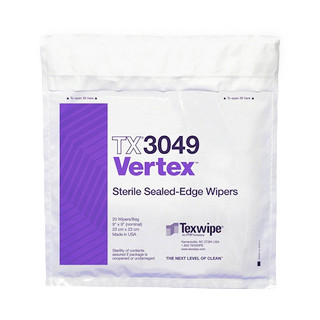
Texwipe TX3049 Vertex® (9" × 9") is built as a control input for those conditions: a dry, sterile, sealed-edge 100% polyester wiper engineered for high sorption, low releasables, and disciplined sterile presentation.
Program stability matters in sterile and high-sensitivity environments. Sourcing through SOSCleanroom supports continuity of supply and consistent documentation handoff, reducing the risk of unqualified substitutions that quietly change edge behavior, absorbency, or sterility posture.
What it’s for
TX3049 is intended for critical cleaning and wipe-down where a sterile, sealed-edge polyester wiper helps control the common defect mechanisms: edge-driven fibers, inconsistent wipe “face life,” and handling contamination. Vertex® positioning includes wiping and cleaning surfaces, equipment, and parts; applying and removing lubricants, adhesives, residues, and disinfectants; solvent cleaning (IPA, ethanol, acetone, degreasers); and lining trays for holding, drying, and storing parts and devices.
Decision drivers
TX3049 earns selection when the wipe is expected to do real work while staying inside a tight contamination and sterility model:
- Sealed-edge architecture: edge processing is a primary control lever when folding, corner work, and repeated strokes can turn edges into a releasables source.
- Sorption capacity by design: positioned for spill control, cleaning, and solution application where faster uptake reduces “multiple-pass spread.”
- Sterile posture you can defend: gamma irradiated to a 10−6 sterility assurance level (SAL), with compliance/irradiation documentation available for traceability.
- Cleanroom environment alignment: Vertex® positioning spans ISO Class 3–7 (EU Grade A–D), supporting use across a wide set of controlled environments when SOPs are aligned.
- Packaging that supports aseptic handling: triple-bag configuration plus smaller inner packs reduces exposure time and improves staged transfer discipline.
- Qualification friendliness: Vertex® is positioned as low in ions, NVR, particles, and fibers, and is individually lot coded to support investigations and change control.
Materials and construction – explained like an engineer
“Polyester wiper” is not specific enough for risk placement. In sterile or high-sensitivity cleaning, the edge is often the highest-risk geometry because it is folded, pinched, and dragged into corners.
TX3049 is a 100% polyester wiper with a sealed edge, produced on an automated manufacturing system.
The practical implication is less edge fray during folding and less edge-driven releasables when the wipe is worked harder than ideal technique would recommend.
Terminology discipline still applies: TX3049 is engineered for low-linting performance; no wiper is truly “lint-free” in every process condition.
Specifications in context
- Size: 9" × 9" (23 cm × 23 cm)
- Format: dry, sterile
- Packaging: 100 wipers/bag (5 inner bags of 20 wipers), 5 bags/case; triple-bag configuration supports staged introduction
- Sterility: gamma irradiated to SAL 10−6; documentation (compliance/analysis/irradiation) available
- Environment fit (positioning): ISO Class 3–7; EU Grade A–D (final suitability is always process- and SOP-dependent)
Cleanliness and performance metrics — how to use what’s published
Vertex® is positioned to provide low levels of ions, NVR (non-volatile residues), particles, and fibers for critical cleaning applications.
Treat published cleanliness framing as a qualification starting point rather than a contractual guarantee, then confirm method suitability in your actual chemistry, surfaces, and acceptance window.
The practical decision logic is simple: if you are fighting edge-related fibers, inconsistent wipe “face life,” or sterile transfer complexity, a sealed-edge sterile polyester wipe tends to reduce those variables compared with cut-edge or non-sterile general-purpose wipes.
Why sterile + sealed edge matters operationally
In controlled environments, the dominant failure modes are often handling-driven. TX3049’s combination of sterile validation posture, triple-bag staging, and sealed-edge behavior helps teams keep wiping inside the process model:
fewer open-handling events, easier stepwise transfer, less temptation to “make do” with a loaded face, and fewer surprises after dry-down when residues and particles are most visible.
Rule of thumb: When sterile handling and edge control are the acceptance drivers, sealed-edge sterile wipes are a logical control step. When wetness repeatability is the constraint, a validated pre-wetted system is often the better control move.
Best-practice use
- Stage the transfer: treat outer-to-inner bag removal as part of aseptic technique; open only the level required at the point of use.
- Quarter-folding discipline: fold into stable faces, rotate faces aggressively, and discard once loaded to prevent redeposit.
- Directional strokes: use controlled, overlapping, single-direction passes; avoid back-and-forth scrubbing unless an SOP requires it.
- Wetness control: if adding solvent/disinfectant, target damp-to-wet as required by contact time, but avoid flooding seams, fasteners, and interfaces that can trap chemistry and redeposit residues.
- Separate “cleaning” from “sampling”: when the wipe becomes part of a measurement system (TOC, defined residue recovery), use method-aligned sampling consumables and documented controls.
Common failure modes — and how TX3049 helps
- Edge-driven fibers during folding/corner work: sealed-edge construction reduces the edge degradation mechanism compared with cut-edge wipes under similar use.
- Overusing a loaded face: high sorption can tempt overwork; face rotation and early discard are still the real controls.
- Breaking sterile presentation: triple-bag staging helps keep handling events intentional and SOP-aligned.
- Residue after dry-down: do not “wipe harder.” Tighten chemistry concentration control, contact time logic, and face change-out frequency.
Closest comparators
The most defensible comparisons are to other sterile, sealed-edge polyester cleanroom wipes intended for similar ISO ranges and wiping tasks. Compare:
(1) edge processing method and face durability, (2) sterility validation posture and documentation availability, (3) packaging configuration for staged transfer, and
(4) cleanliness framework (ions, NVR, particles/fibers) as it relates to your acceptance criteria.
Where TX3049 fits in a cleanroom wiping program
TX3049 is a strong fit when a facility needs a sterile, sealed-edge, high-sorption polyester wipe to stabilize day-to-day wipe-downs without introducing edge-driven releasables or sterile handling drift.
It belongs in programs that treat wiping as a controlled process input: staged introduction, technique discipline, and lot-level traceability so investigations stay short when trends shift.
Safety note: If using solvent/disinfectant chemistries, follow facility EHS controls for storage, ventilation, ignition-source management, and waste handling.
Source basis
-
SOSCleanroom product page: “Texwipe TX3049 Sterile Vertex 9" × 9" Polyester High Absorption Sealed Edge Wiper”
(packaging configuration; sterile positioning; triple-bag presentation; application framing).
https://www.soscleanroom.com/product/wipers/texwipe-tx3049-sterile-vertex-9-x-9-polyester-high-absorption-sealed-edge-wiper/
-
Texwipe technical data sheet (Vertex® series): “Texwipe VertexSeries TDS”
(sealed-edge 100% polyester description; applications; sterile posture incl. SAL 10−6; ISO Class 3–7 positioning; packaging table for TX3049).
https://www.texwipe.com/images/uploaded/documents/Wipers/Texwipe-VertexSeries-TDS.pdf
Source: SOSCleanroom Technical Vault | Last reviewed: Jan. 2, 2026
© 2026 SOS Supply. All rights reserved.