The Technical Vault
By SOSCleanroom
Sterile + Sealed-Edge + Pre-Wetted: Why TX3049P Vertex Stabilizes High-Sorption Wiping in Aseptic Workflows
Last reviewed: Jan. 3, 2026 | Audience: contamination control, aseptic processing, cleanroom operations, EHS, quality
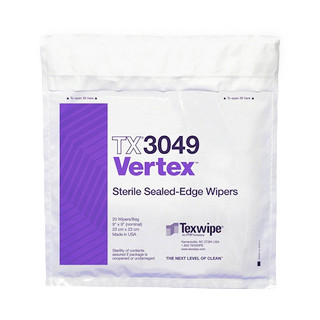
Texwipe TX3049P Vertex® Sterile High-Sorption Wipers (9" × 9") are engineered for a very specific problem: when you need
high uptake and gentle surface behavior, but you cannot afford to introduce an edge-shedding or “operator-wetness” variable into a sterile workflow.
TX3049P pairs a sealed-edge, continuous-filament polyester knit substrate with a controlled wetting system:
70% USP-grade IPA / 30% USP purified water, supplied as a sterile, triple-bagged pre-wetted format.
In practice, TX3049P is not a “generic IPA wipe.” It is a controlled process input designed to reduce failure modes that show up during real work:
over-wetting seams, re-wetting mid-pass, under-wetting late in a shift, and edge-driven fibers when wiping force increases. Those are the problems that turn wipe-downs into investigations.
What it’s for
TX3049P is best used when you need sterile presentation and repeatable solvent delivery for wipe-downs in sterile or aseptic-controlled areas:
benches, carts, tool exteriors, pass-through touchpoints, and controlled wipe-down steps where an alcohol wipe is part of the work instruction and
the risk is less “chemistry” and more handling variability.
Decision drivers
TX3049P earns its place in an aseptic wiping program based on a short list of controls:
- Sterility posture: gamma irradiated to a 10−6 SAL and produced as a sterile wiper program aligned to ISO 11137 sterilization practice (per manufacturer datasheet).
- Wetting system discipline: pre-wetted with 70% USP-grade IPA / 30% USP purified water, reducing operator-controlled wetness variability and re-wetting behaviors.
- Edge strategy: sealed-edge knit construction to reduce edge-driven releasables under folding and wiping force.
- High-sorption architecture: designed to reduce the number of wipers needed for spill control while staying stable in use (a key operational lever when “more wipes” increases handling events).
- Traceability package: Certificates of Processing and Compliance are attached to each case, supporting change control and investigation speed.
- Microbial/endotoxin posture: quarterly microbial testing and LAL endotoxin testing are part of the program claims; endotoxin limit is positioned as not more than 20 EU/device (manufacturer statement).
- Packaging discipline: triple-bagged sterile presentation and case configuration supports staged introduction and reduced exposure time.
Materials and construction – explained like an engineer
“Polyester wipe” is not a spec. The technical differentiator is continuous-filament polyester knit combined with an engineered edge.
TX3049P is built on the Vertex® platform: a sealed-edge knit designed to stay mechanically stable when you fold, press into corners, and wipe with real force.
That stability matters because most “wipe particles” in the field are technique-amplified (pressure, speed, textured surfaces) and edge-amplified (folding, dragging, catching).
The pre-wetted system is equally important. When a wipe is pre-wetted at a defined load, you reduce the two largest operator variables:
(1) how wet the wipe actually is and (2) how often operators re-wet mid-task.
Re-wetting is a common pathway to streaking, redeposit, and hidden carryover because it mobilizes soils and pulls them across the next feature.
Cleanliness and performance metrics
For sterile wipe programs, the risk model still reduces to the same three buckets: releasables (particles/fibers), residues (NVR),
and process sensitivity (ions/endotoxin/bioburden controls as applicable). Published values should be treated as qualification starting points rather than contractual specifications.
- Sorption (why it’s called “high-sorption”): typical sorptive capacity 450 mL/m²; typical sorptive rate 0.3 seconds.
- LPC (≥0.5 μm): typical 9.5 × 10⁶ particles/m².
- Particles and fibers: typical particles 0.5–5.0 μm: 3.0 × 10⁶ particles/m²; 5–100 μm: 66,000 particles/m²; fibers >100 μm: 200 fibers/m².
- NVR: typical 0.02 g/m² (IPA extractant); 0.01 g/m² (DIW extractant).
Operational translation: TX3049P is built to wet fast, hold fluid, and maintain wipe integrity while keeping releasables and residues in a range that supports controlled wiping—
especially when the alternative is multiple lower-capacity wipes (more handling events, more face misuse, more variability).
Why sterile + sealed-edge + pre-wetted matters operationally
In aseptic environments, wipes fail less often due to “wrong chemistry” and more often due to handling mechanics:
opening too much product at once, dragging edges across textured hardware, reusing loaded faces, and altering wetness mid-task.
TX3049P’s combination of sterile presentation, sealed-edge construction, and a defined 70% IPA wetting system is specifically designed to reduce those handling-driven failure modes.
Best-practice use
- Stage the sterile barrier: open only the bag level required by your transfer SOP; keep remaining bags sealed until point of use.
- Fold for control: quarter-fold to create multiple clean faces; treat each face as single-pass for critical wipe-downs.
- One-direction strokes: use parallel, overlapping passes; avoid “scrub back-and-forth” unless a validated SOP requires it.
- Do not top off: do not add solvent to the bag. It breaks wetness repeatability and can compromise your contamination model.
- Change-out triggers: discard when the face is loaded, near saturation, or begins to smear; high-sorption is an advantage only while the face is still “capturing,” not “redistributing.”
- EHS reality: pre-wetted alcohol wipes are flammable; plan for approved storage, ventilation, and ground-shipping constraints where applicable.
Common failure modes — and how TX3049P helps
- Over-wetting seams and interfaces: causes pooling, wicking, and streaking. Pre-wetted control reduces flood events versus squeeze bottles and ad hoc beakers.
- Reusing a loaded face: turns wiping into redeposit. High-sorption helps capture, but only if face rotation and discard discipline are enforced.
- Edge-driven fibers under force: shows up when operators fold hard and wipe fast. Sealed-edge construction is the control move when edges become the failure mechanism.
- Breaking sterile presentation: opening too much product at once increases exposure time and touch contamination risk. Triple-bagging supports staged use when the SOP is written to take advantage of it.
Terminology note: TX3049P is engineered for low-linting performance; no wiper is truly “lint-free” in every process condition.
Closest comparators
The most defensible comparisons are to other sterile, pre-wetted IPA wipe programs where edge strategy and documentation depth are part of the control plan:
Contec sterile presaturated wipe programs (70% IPA formats) are a common comparator when facilities want sterile presentation with controlled wetness and multiple substrate options.
The evaluation should focus on edge construction, wetness stability over pack life, and sterility/traceability package.
Berkshire sterile presaturated wipe families are often evaluated in the same category.
Compare substrate architecture (knit vs. nonwoven), edge treatment, and documentation posture against your residue and releasables risk.
Rule of thumb: When edge control becomes the acceptance driver, sealed-edge/sealed-border is typically the next control step.
When wetness repeatability is the constraint, a controlled pre-wetted system is usually the fastest way to reduce variability.
Where TX3049P fits in a cleanroom wiping program
TX3049P fits best in aseptic or sterile-controlled wipe-down steps where the program needs three things at once:
(1) sterile presentation, (2) high-sorption, gentle wiping behavior, and (3) a standardized alcohol wetness condition that reduces operator variability.
It is a strong choice for wipe-downs that must be repeatable across shifts, techs, and stations—especially where “more wipes” increases handling events and risk.
If your constraint is purely particle minimization on the most defect-sensitive surfaces, evaluate whether an alternate sealed-edge polyester knit with different surface “hand” is the better finishing tool.
If your constraint is sterility and documentation posture, keep the sterile barrier handling and transfer SOP as the governing control—product selection cannot compensate for weak staging discipline.
Source basis
- SOSCleanroom product page: “Texwipe TX3049P Sterile Vertex 9" × 9" Polyester Sealed Edge Wiper Pre-Wetted 70% IPA” (packaging configuration; sterile posture; application/positioning; shipping notes). https://www.soscleanroom.com/product/wipers/texwipe-tx3049p-sterile-vertex-9-x-9-polyester-sealed-edge-wiper-pre-wetted-70-ipa/
- ITW Texwipe datasheet (via SOSCleanroom PDF): “Vertex® Sterile High-Sorption Wipers” (TX3049P composition: 70% USP-grade IPA / 30% USP purified water; triple-bag configuration; SAL; program documentation claims; typical sorption, particles/fibers, and NVR; ISO Class 3 manufacturing statement). https://www.soscleanroom.com/content/texwipe_pdf/3042%203049%203042p%203049p.pdf
Source: SOSCleanroom Technical Vault | Last reviewed: Jan. 3, 2026
© 2026 SOS Supply. All rights reserved.