
The Technical Vault
By SOSCleanroom
Sterile, Pre-Wetted, Repeatable: Why TX3213 Sterile PolySat Turns 70% IPA Wiping Into a Controlled Step
Last reviewed: Jan. 1, 2026 | Audience: contamination control, aseptic operations, cleanroom EHS, quality
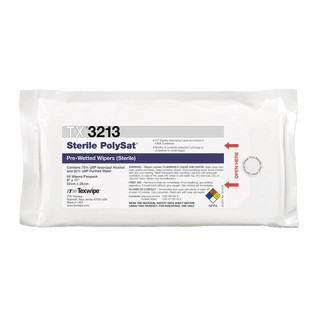
Sterile surface wiping fails in predictable ways: open-bottle variability, untracked dilution, re-dipping that back-contaminates solvent, and “wetness drift” as containers sit open and evaporate across a shift. Texwipe TX3213 Sterile PolySat (9" × 11") is built to remove those failure modes by delivering a pre-wetted 70% IPA / 30% DI water wipe in a resealable FlexPack, sterilized by gamma irradiation to a 10−6 Sterility Assurance Level (SAL).
In an aseptic or sterile suite, consistency is not a convenience feature — it is a control. SOSCleanroom supports stable programs by keeping the approved SKU, packaging configuration, and documentation handoff consistent so teams are not forced into last-minute substitutions that change wetness, residues, or sterility posture.
What it’s for
TX3213 is intended for alcohol wiping in sterile environments — including pharmaceutical aseptic fill areas, biotechnology manufacturing, microbiological labs, sterile suites, and prep rooms. It is commonly used to clean and polish equipment and environmental surfaces during and following production flow, and for cleanup of soiled surfaces where a sterile, controlled 70% IPA wipe step is required.
Decision drivers
TX3213 is selected when teams want the solvent step to behave like a controlled process input:
- Sterility posture: gamma irradiated to 10−6 SAL (sterility assurance framework aligned to AAMI guidance), supported by sterility controls and audits.
- Solvent standardization: 70% IPA / 30% DI water delivered at point of use; reduces mixing errors and ad hoc dilution.
- Filtration control: wetting solution described as filtered through a 0.2 µm filter, tightening the contamination model versus open-container solvent handling.
- Substrate strategy: 100% melt-blown polypropylene engineered for practical wipe-down and surface cleaning where polypropylene’s chemical compatibility is advantageous.
- Packaging discipline: resealable FlexPack supports “open–dispense–reseal” behavior and helps reduce spill potential and evaporation-driven drift.
- Documentation and traceability: lot-specific shipment information (e.g., certificate of irradiation, certification of compliance, and expiration date marking) supports investigations and recordkeeping.
Materials and construction – explained like an engineer
“Pre-wetted sterile wipe” is a category label; the control comes from the interaction of (1) substrate architecture, (2) wetting chemistry, and (3) packaging/sterility discipline. TX3213 uses melt-blown polypropylene — a nonwoven structure that provides broad-area contact for wipe-down while maintaining chemical compatibility with common cleaning chemistries. The key functional advantage is that the wipe arrives with the solvent loading already controlled, which reduces operator-to-operator variability in wetness and dwell behavior.
The sterility and documentation posture matter just as much as the fabric. In sterile suites, a wipe becomes a process input that must be introduced, staged, and used with the same discipline as other sterile consumables — including managing expiration, transfer presentation, and lot traceability.
Specifications that actually affect outcomes
- Wipe size: 9" × 11" (23 cm × 28 cm) — enough area for defined, overlapping strokes while still supporting folding into controlled faces.
- Sell pack: commonly listed as 50 wipes per resealable FlexPack; use the label on the received configuration as the governing control for SOP kitting and staging.
- Case configuration note: published case counts can differ by listing and documentation vintage. For SOPs and Kanban planning, treat the received case label as the source of truth to avoid stocking surprises.
- Expiration management: sterile programs should treat the pack’s expiration marking as an operational gate (staging time, issuance rules, and discard logic).
Why the FlexPack format matters operationally
In sterile operations, most variability comes from handling, not chemistry. A resealable pack supports a disciplined loop: dispense what you need, reseal immediately, and return the pack to controlled storage. That reduces uncontrolled evaporation and helps keep late-shift wipes behaving like early-shift wipes. Texwipe also positions the packaging as enabling alcohol wipe-down of the exterior bag before introduction into sterile suites — a practical control when transfer and staging are part of the contamination-control plan.
Best-practice use
- Plan the wipe path: work cleanest-to-dirtiest with parallel, overlapping, single-direction strokes; avoid “back-and-forth scrubbing” unless your SOP explicitly requires it.
- Control faces: fold to create multiple clean faces; treat each face as single-pass when wiping critical surfaces or interfaces.
- Keep the solvent step controlled: do not “top off” packs with additional IPA — it breaks saturation repeatability and can introduce contamination.
- Respect sterile transfer logic: stage and present the pack per your sterile barrier and transfer SOP (outer bag wipe-down, peel discipline, and defined staging time limits).
- Replace early: once a face is loaded, the wipe becomes a redeposition tool. Swap to a fresh face or fresh wipe before you chase streaks.
Common failure modes — and how to prevent them
- Leaving packs open: drives wetness drift. Prevent with open–dispense–reseal discipline and defined storage locations.
- Overworking a loaded face: creates streaking and redeposit. Prevent with aggressive folding and early discard rules.
- Turning cleaning into sampling: if TOC/HPLC/residue recovery is in scope, use method-aligned sampling tools and chain-of-custody controls; do not assume a cleaning wipe is a validated sampling device.
- Breaking sterile presentation: uncontrolled staging time, casual peel technique, or poor outer-bag wipe-down can collapse your sterility posture. Prevent with SOP-driven transfer steps and training.
- Ignoring flammability controls: solvent-containing wipes require ventilation and ignition-source control per facility EHS requirements.
Closest comparators
The defensible comparisons are to other sterile, presaturated 70% IPA wipe systems with strong packaging discipline and clear documentation posture:
Contec PROSAT sterile presaturated wipes (70% IPA formats) are commonly evaluated when teams want a sterile presaturated system with multiple wipe architectures and packaging configurations. Compare substrate behavior on your surfaces, reseal integrity over pack life, and the depth of sterility/lot documentation required by your quality system.
Berkshire sterile presaturated 70% IPA pouch wipes (SatPax / sterile IPA systems) are frequently considered for similar solvent standardization goals. Compare packaging presentation for your transfer SOP, wetness stability, and how the wipe behaves under your real wipe force and dwell-time requirements.
Rule of thumb: When sterile presentation is the gate, choose the wipe system that best matches your transfer and documentation controls. When wetness repeatability is the constraint, presaturated systems like TX3213 are often the simplest way to reduce operator-driven variability.
Where TX3213 fits in a sterile wiping program
TX3213 fits best as a sterile, standardized alcohol wipe-down tool for equipment and environmental surfaces where you need (1) a consistent 70% IPA wetting condition, (2) packaging that supports disciplined dispensing and transfer, and (3) a sterility/documentation posture that stands up to quality review. Use it to stabilize routine sterile wipe-down steps, reduce open-solvent handling, and keep investigations short by maintaining lot traceability and expiration control.
Terminology note: TX3213 is engineered for low-linting performance in typical controlled wiping; no wiper is truly “lint-free” in every process condition.
Source basis
-
SOSCleanroom product page (TX3213): product configuration, pack/case listing, and positioning:
https://www.soscleanroom.com/product/wipers/texwipe-tx3213-sterile-polysat-9-x-11-polypropylene-cleanroom-wiper-pre-wetted-70-ipa/
-
ITW Texwipe technical datasheet (Sterile PolySat TX3213/TX3216): SAL, filtration note, FlexPack packaging, applications, and documentation posture:
https://www.soscleanroom.com/content/texwipe_pdf/3213%203216.pdf
-
Contec PROSAT product information and downloads (category comparator for sterile presaturated wipes):
https://www.contecinc.com/products/prosat-sterile-presaturated-wipes/
-
Berkshire sterile 70% IPA system documentation (category comparator for sterile presaturated pouch wipes):
https://www.berkshire.com/technical-documents/ss1000-001-24-technical-data-sheet/
Source: SOSCleanroom Technical Vault | Last reviewed: Jan. 1, 2026
© 2026 SOS Supply. All rights reserved.