
The Technical Vault
By SOSCleanroom
Sterile 70% IPA, Without the Open-Bottle Failure Modes: How TX3216 Stabilizes Point-of-Use Alcohol Wiping
Last reviewed: Jan. 2, 2026 | Audience: aseptic operations, contamination control, cleanroom operations, EHS, quality
Many alcohol wipe-down excursions are not chemistry problems. They are workflow problems: topping off bottles, re-dipping wipes, evaporation drift across a shift,
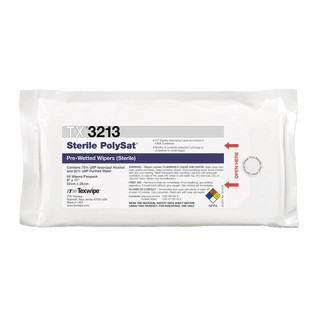
and cross-contamination when the same open solvent container follows technicians from station to station. Texwipe TX3216 Sterile PolySat (9" × 11")
is designed to reduce those variables by delivering a pre-saturated 70% IPA / 30% DI water wiping step in a sterile, controlled-packaging format.
The result is a more repeatable “alcohol step” that behaves like a controlled process input rather than a technician-dependent consumable. :contentReference[oaicite:0]{index=0}
Program reliability matters in sterile programs. Sourcing through SOSCleanroom supports continuity of supply and consistent documentation handoff—reducing the likelihood of
last-minute substitutions that change wetness, dry-down behavior, and residue outcomes when schedules tighten. :contentReference[oaicite:1]{index=1}
What it’s for
TX3216 is intended for sterile, routine surface wipe-down where a controlled 70% IPA step is part of the procedure—benches, carts, tool exteriors,
pass-through touchpoints, and equipment surfaces where you want to reduce open-solvent handling and standardize wetness at point of use. It is positioned for
ISO 5–8 environments (final suitability depends on your process, technique, and acceptance criteria). :contentReference[oaicite:2]{index=2}
Decision drivers
TX3216 earns its place in sterile wipe-down workflows based on a short list of controls:
- Controlled solvent composition: pre-saturated with 70% IPA / 30% DI water—reducing ad hoc dilution and “mystery concentration drift.” :contentReference[oaicite:3]{index=3}
- Filtered wetting solution: the IPA/DI solution is described as 0.2 μm filtered—supporting a tighter contamination model than open-bottle workflows. :contentReference[oaicite:4]{index=4}
- Sterile posture: positioned as sterile via gamma irradiation with a stated 10−6 SAL (sterility assurance level). :contentReference[oaicite:5]{index=5}
- Substrate designed for wet cleaning: 100% melt-blown polypropylene supports routine alcohol wipe-down while keeping the handling model straightforward. :contentReference[oaicite:6]{index=6}
- Packaging discipline: sterile 20 wipes/flexpack, 24 flexpacks/case supports staged use and reduces exposure time compared with bulk-open stacks. :contentReference[oaicite:7]{index=7}
- Operational practicality: designed so wipes are wet for cleaning but with no free liquid present—helping reduce dripping, pooling, and seam-wicking. :contentReference[oaicite:8]{index=8}
Materials and construction – explained like an engineer
TX3216 uses a melt-blown polypropylene nonwoven. In wipe-down mechanics, polypropylene in this format is less about absorbency like a textile and more
about controlled wet delivery and predictable glide when the wipe is folded and applied with consistent pressure. Melt-blown structures can provide a practical
“wet contact” behavior for alcohol cleaning while remaining compatible with common cleanroom wipe-down chemistries. :contentReference[oaicite:9]{index=9}
Keep terminology honest: no wipe is truly lint-free. The control target is low-linting behavior in your use condition—pressure, surface texture, edge contact,
and how long an operator overworks a single face drive most releasables events.
Cleanliness and performance metrics
In sterile wipe-down programs, performance typically comes down to three risk categories: releasables (particles/fibers), residues (NVR),
and ions (corrosion/ECM sensitivity). Texwipe publishes typical contamination characteristics for the PolySat family; treat them as a qualification starting point
rather than a contractual limit unless explicitly stated otherwise. :contentReference[oaicite:10]{index=10}
Operationally, TX3216’s defining “performance feature” is wetness repeatability: a consistent alcohol/water loading reduces the technician-driven variability
that often drives streaking, pooling, inconsistent dry-down, and re-clean loops. :contentReference[oaicite:11]{index=11}
Why sterile flexpack presentation matters operationally
Pre-wetted sterile products succeed or fail on packaging discipline. TX3216 is supplied as a sterile flexpack configuration (20 wipes per flexpack) and
is positioned to keep wipes wet without introducing a “shared reservoir” contamination problem. This is also where sterile staging discipline lives:
open only what you need, reseal where applicable, and remove the pack from the work zone when the task is complete. :contentReference[oaicite:12]{index=12}
EHS note: TX3216 contains isopropyl alcohol. Follow facility controls for flammable liquids, ventilation, ignition-source control, and waste handling.
(IPA is listed as a flammable liquid in the associated SDS; evaluate per your site EHS program.) :contentReference[oaicite:13]{index=13}
Best-practice use
Pre-wetted wipes reduce variability, but technique still determines outcomes. TX3216 performs best when operators treat the wipe as a controlled input, not a “wet rag.”
- Fold for control: fold to create multiple clean faces; treat each face as single-pass in higher-risk wipe-down steps.
- Direction matters: use straight-line, overlapping passes; avoid circular scrubbing unless the SOP explicitly requires it.
- Control wetness at the surface: pre-wetted does not mean flooding—avoid pushing liquid into seams, fastener interfaces, or under edges.
- Change-out triggers: discard early when the face is loaded or the wipe is near saturation; a loaded face becomes a redeposition tool.
- Do not “top off” packs: adding solvent changes saturation level and undermines repeatability and contamination control logic.
Common failure modes — and how TX3216 helps
A pre-wetted sterile wipe cannot fix a poor process, but it can remove predictable failure modes: mixing errors, evaporation drift, re-dipping, and uncontrolled wetness.
The remaining controls are procedural—face rotation, directional strokes, avoiding seam flooding, and discarding wipes before they become overloaded.
TX3216 is specifically positioned to provide controlled wetness with no free liquid present and a sterile presentation posture aligned to aseptic needs. :contentReference[oaicite:14]{index=14}
Closest comparators
The most defensible comparisons are to other sterile presaturated 70% IPA wipe systems with controlled packaging intended for cleanroom and aseptic wipe-down.
Contec PROSAT Sterile Wipes (70% IPA / 30% DI) are a close category peer with strong documentation and sterile presentation options; compare packaging,
saturation stability, and how the wipe behaves in your dry-down window. :contentReference[oaicite:15]{index=15}
Berkshire Sterile SatPax (70% IPA / 30% DI) is an appropriate comparator when evaluating sterile presaturated systems; compare substrate architecture,
pouch integrity, and consistency across the working life of the pack. :contentReference[oaicite:16]{index=16}
Where TX3216 fits in a controlled cleaning program
TX3216 fits the sterile standardized alcohol wipe-down tier: routine cleaning steps where the dominant risk is not the solvent chemistry—it is variability in
solvent handling and technician technique. Use it to stabilize the alcohol step, reduce open-container behaviors, and preserve sterile handling discipline. When the process
shifts to the most defect-sensitive surfaces, escalation is typically driven by surface requirements (scratch risk, residue budget, edge control) and by whether the wiping step
is cleaning versus validation-sensitive sampling.
Source basis
- SOSCleanroom product page: “Texwipe TX3216 Sterile PolySat 9" × 11" Polypropylene Cleanroom Wiper Pre-Wetted 70% IPA” (positioning, packaging, ISO range, handling/shipping notes). https://www.soscleanroom.com/product/wipers/texwipe-tx3216-sterile-polysat-9-x-11-polypropylene-cleanroom-wiper-pre-wetted-70-ipa/ :contentReference[oaicite:17]{index=17}
- ITW Texwipe technical data: “PolySat Sterile Pre-Wetted Wipers (TX3213 / TX3216)” (composition, 70% IPA/30% DI; 0.2 μm filtration; sterility and SAL; packaging; typical contamination characteristics; shelf life). https://www.texwipe.com/texwipe-assets/uploads/pdfs/DS-5441.pdf :contentReference[oaicite:18]{index=18}
- ITW Texwipe SDS covering isopropyl alcohol wipe products (flammability and safe-handling posture for alcohol-containing wipes). https://www.texwipe.com/texwipe-assets/uploads/pdfs/TSDS-0-437.pdf :contentReference[oaicite:19]{index=19}
- Category comparators for sterile presaturated 70% IPA wipe systems: Contec PROSAT sterile wipes; Berkshire sterile SatPax. :contentReference[oaicite:20]{index=20}
Source: SOSCleanroom | Last reviewed: Jan. 2, 2026
© 2026 SOS Supply. All rights reserved.