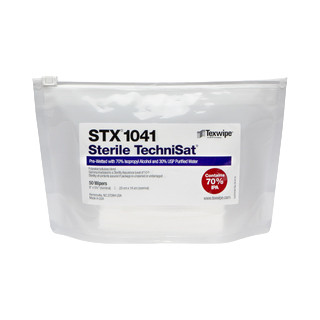
Texwipe TX3217 Sterile TechniSat 9" x 11" Polyester and Cellulose Wiper Pre-Wetted 70% IPA

$404.00
(No reviews yet)
SKU:
TX3217
Availability:
Stock Item
Shipping:
Calculated at Checkout
Quantity Option (Case Only):
24 Flexpacks of 20 Wipers Per Case
Type:
Pre-Wet Wiper
Wiper Family:
TechniSat
Wiper Material:
Cellulose/Polyester
Wiper Size:
9" x 11"
Wiper Edge:
Cut Edge
Sterile:
Yes
ISO Class:
ISO 5 (Class 100)
ISO Class:
ISO 6 (Class 1,000)
ISO Class:
ISO 7 (Class 10,000)
ISO Class:
ISO 8 (Class 100,000)

TX3217 Sterile TechniSat 9" x 11" Polyester and Cellulose Wiper Pre-Wetted 70% IPA

TX3217 Sterile TechniSat is a low-linting (no wiper is truly ‘zero-lint’ in every process condition), binder-free, hydro-entangled polyester/cellulose cleanroom wiper pre-wetted with 70% isopropyl alcohol / 30% deionized water (filtered through a 0.2µm filter) and packaged in a resealable flex-pack for consistent alcohol wiping in sterile workflows. Each package is gamma irradiated to a 10-6 Sterility Assurance Level (SAL), supporting routine wipe-downs and polish steps in pharmaceutical aseptic fill areas, biotech manufacturing, microbiological labs, sterile suites, and prep rooms. *This item is considered a Consumer Commodity ORM-D shipment and can only be shipped Ground

Best-seller note: TX3217 is commonly selected when teams want a sterile, pre-wetted 70% IPA flex-pack format that reduces on-site mixing/filtration steps while maintaining lot-specific documentation and expiry marking for aseptic-area traceability.

Specifications:
  • Size: 9" x 11" (23 cm x 28 cm) nominal
  • Material: Polyester/cellulose blend (binder-free)
  • Construction: Nonwoven, hydro-entangled substrate
  • Edge: Cut edge
  • Pre-wetted solution: 70% isopropyl alcohol / 30% deionized water, filtered through a 0.2µm filter
  • Sterility: Gamma irradiated to 10-6 Sterility Assurance Level (SAL), per manufacturer guidance
  • Packaging: 20 wipers/flexpack; 24 flexpacks/case (case only)
  • Use environments: ISO 5, ISO 6, ISO 7, ISO 8 (final suitability depends on your process, chemistry, and cleaning method)
About the Manufacturer: 

Texwipe (an ITW company) differentiates itself in contamination control by treating the wiper as an engineered product, not a commodity consumable. For sterile pre-wetted platforms like TechniSat, Texwipe emphasizes controlled solution preparation (including fine filtration), sterile processing via gamma irradiation, and packaging formats that support sterile transfer discipline—including the ability to wipe down the exterior pack prior to introduction into cleaner zones.


Texwipe also highlights lot-specific information (Certificates of Irradiation and Compliance) and expiration dating marked on each package to simplify record keeping and strengthen inspection readiness. SOSCleanroom (SOS) supports that documentation discipline with a close working relationship with Texwipe focused on continuity of supply, clean documentation handoff, and practical application support—so customers can standardize pre-wetted wipers with predictable performance while maintaining procurement reliability and audit readiness.

TX3217 Features:
  • Gamma irradiated to 10-6 Sterility Assurance Level, according to AAMI guidelines (per manufacturer guidance)
  • Lot-specific information simplifies record keeping
  • Certificate of Irradiation confirms radiation dosage
  • Certification of Compliance
  • Expiration date marked on each package
  • Pre-wetted with 70% isopropyl alcohol/30% deionized water, filtered through a 0.2µm filter
  • Binder-free, hydro-entangled polyester/cellulose substrate
  • Independent quality control audits for sterility assurance
TX3217 Benefits:
  • Optimizes solution usage: Pre-wetted presentation helps reduce over-wetting and spill potential versus uncontrolled bottle wetting (process-dependent)
  • Reduces in-house prep steps: Helps eliminate problems associated with filtration, sterilization, and mixing of alcohol and DI water
  • Supports sterile transfer discipline: Packaging permits alcohol wipe down of the exterior pack before introduction into sterile suites
  • Contamination control: Designed to offer low levels of solvent extractables and particle generation (process-dependent)
Common Applications:
  • Cleaning and polishing equipment and environmental surfaces during and following the production flow
  • Wiping gloved hands (as allowed by your gowning/aseptic SOP)
  • Sterile wiping of production equipment and laminar flow hoods requiring low solvent extractables and low particle generation
  • Routine alcohol wipe-downs in sterile environments (aseptic fill areas, sterile suites, prep rooms, microbiological laboratories)
Best-Practice Use:
  • Exterior wipe-down first: Before sterile transfer, wipe down the exterior flex-pack per your facility SOP, then introduce the pack into the cleaner zone.
  • One-wiper-at-a-time: Open only as needed; withdraw a single wiper and reseal promptly to limit IPA vapor loss and protect remaining wipers.
  • Wipe pattern: Use straight-line, overlapping strokes (top-to-bottom or left-to-right) to reduce re-deposition risk.
  • Fold for control: Fold to create multiple clean faces; rotate faces early rather than re-wiping with a loaded surface.
  • Change-out triggers: Replace when the face becomes visibly loaded, begins to smear residue, or loses wetting effectiveness on the target surface.
Selection Notes (TX3217 vs. Other Options)
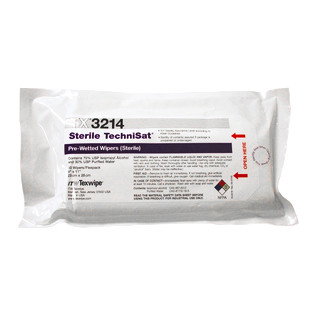
  • TX3217 vs. TX3214: Same Sterile TechniSat 9" x 11" platform and 70% IPA pre-wet chemistry, but TX3217 is packaged 20 wipers/flexpack (24 flexpacks/case) while TX3214 is packaged 50 wipers/flexpack (24 flexpacks/case) for higher per-pack capacity.
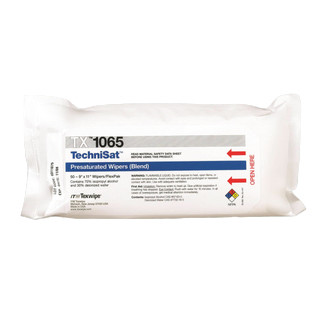
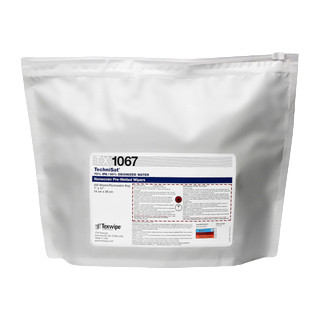
  • Sterile vs. non-sterile TechniSat (e.g., TX1065/TX1067): Choose TX3217 when gamma-irradiated sterile presentation, expiration dating, and sterile documentation are required; choose non-sterile pre-wetted TechniSat when sterile processing is not required by your workflow.
  • Flex-pack vs. tubs/canisters: Flex-packs typically reduce footprint and support reseal discipline; tubs/canisters may be preferred for high-frequency access points where your SOP supports canister staging and closure controls.

Link to Texwipe Technical Datasheet:
Click Here

Other Similar Products Available From SOSCleanroom.com

Sterile TechniSat Pre-Wetted 70% IPA (Flex-Pack)

  • TX3214: 9" x 11" nominal (23 cm x 28 cm), 50 wipers/flexpack; 24 flexpacks/case
  • TX3217: 9" x 11" nominal (23 cm x 28 cm), 20 wipers/flexpack; 24 flexpacks/case

Non-Sterile TechniSat Pre-Wetted 70% IPA

  • TX1065: 9" x 11" pre-wetted 70% IPA (non-sterile)
  • TX1067: 7" x 11" pre-wetted 70% IPA (non-sterile)
  • TX1045: 6" x 8" pre-wetted 70% IPA (non-sterile)

Notes: Looking for application guidance or qualification context for Texwipe TX3217 Sterile TechniSat 9" x 11" polyester/cellulose wipers pre-wetted with 70% IPA? Open the SOSCleanroom Technical Vault tab above for practical wiping technique, selection notes (TX3217 vs. alternatives), and the documentation details teams typically review when standardizing sterile pre-wetted wipes across ISO-class controlled environments.

SOSCleanroom.com supports contamination-control programs with cleanroom consumables in stock, fair pricing, and responsive technical support—backed by same-day shipping options and customer service that understands real cleanroom workflows.

Product page updated: Jan. 2, 2026 (SOS Technical Staff)

© 2026 SOS Supply. All rights reserved.

The Technical Vault
By SOSCleanroom
Sterile, Sealed, and Repeatable: How TX3217 Standardizes 70% IPA Wipe-Downs When Open-Solvent Handling Is the Risk
Last reviewed: Jan. 2, 2026 |  Audience: contamination control, cleanroom operations, aseptic processing, EHS, quality

Texwipe TX3217 Sterile TechniSat (9" × 11") is a sterile, pre-wetted cleanroom wiper engineered to remove a common “hidden variable” in controlled cleaning: how the solvent step is delivered. Instead of squeeze bottles, shared reservoirs, or open beakers that drift by evaporation and back-contamination, TX3217 delivers a repeatable 70% IPA / 30% DI water condition in a sealed, resealable flex-pack format.

The control value is operational. When every wipe is loaded consistently, teams reduce streaking, pooling, mid-pass re-wetting, and “mystery residue” re-clean cycles that come from inconsistent solvent handling rather than the surface itself. In sterile workflows, TX3217 adds a second layer of discipline: sterile presentation and lot documentation that supports audit readiness and faster investigations when a trend shifts. :contentReference[oaicite:1]{index=1}

What it’s for

TX3217 is best used for sterile, routine wipe-downs where repeatable wetness and reduced open-solvent exposure matter: benches and staging areas, equipment exteriors, carts, fixtures, and controlled cleaning steps where the process goal is consistent soil removal without solvent variability. It is supplied as a sterile, pre-wetted wiper saturated with 0.2 µm filtered 70% IPA / 30% DI water and packaged for point-of-use dispensing.

Decision drivers

TX3217 earns its place when the solvent step must be treated as a controlled input rather than an operator-dependent variable:

  • Standardized solvent delivery: pre-wetted format reduces dilution errors, evaporation drift, and re-wetting habits that turn cleaning into redistribution.
  • Sterility posture: gamma irradiated to a 10−6 SAL with lot documentation (CoC/CoA/processing/irradiation) available for sterile products. :contentReference[oaicite:4]{index=4}
  • Solvent quality alignment: for sterile products, the TechniSat program lists USP-grade IPA fill for TX3214 and TX3217. :contentReference[oaicite:5]{index=5}
  • Practical packaging control: resealable flex-pack helps prevent “half-dry / half-wet” drift and reduces incidental exposure versus open stacks.
  • Consumption planning that matches reality: 20 wipes per flex-pack, 24 flex-packs per case supports kitting and staged issuance without breaking sterile intent.
Materials and construction – explained like an engineer

TX3217 uses a hydroentangled polyester/cellulose nonwoven substrate. Hydroentanglement matters because the web is mechanically interlocked rather than binder-heavy—helpful when you are trying to keep extractables behavior predictable under alcohol/water exposure.

In practical wiping, the cellulose component improves wet-out and pickup (especially on aqueous films), while polyester supports tensile strength so the wipe maintains integrity when folded, pressed into corners, or used in longer wipe paths typical of equipment wipe-downs.

Terminology note: TX3217 is engineered for low-linting performance; no wiper is truly “lint-free” in every process condition. Technique (pressure, stroke direction, surface texture, and face rotation) is still the dominant control lever.

Cleanliness and performance metrics

For many facilities, the defensible reason to standardize a pre-wetted wipe is repeatability first, then contamination background (releasables, residues, and ions). Manufacturer documentation for the TechniCloth/TechniSat family frames performance data as typical analyses, which should be treated as a qualification starting point rather than a contractual specification. :contentReference[oaicite:9]{index=9}

Typical values published for this family include particles and fibers, NVR in common extractants, and ionic extractables (example typical ions shown include sodium, potassium, and chloride), along with absorbency metrics such as sorptive capacity and rate. Use these data to place the wipe in the right tier, then confirm fit in your own solvent contact time, surface sensitivity, and acceptance window—especially when streaking, spotting, corrosion sensitivity, or residue visibility is a known defect mechanism. :contentReference[oaicite:10]{index=10}

Process translation: If wipe-down outcomes drift over a shift, the first suspects are usually solvent handling (evaporation/concentration drift, re-dipping, bottle contamination) and technique (over-wetting, reusing loaded faces)—not “wiper quality.” TX3217 is designed to remove the solvent-handling variable.

Why sterile, pre-wetted packaging matters operationally

In sterile or aseptic-adjacent workflows, contamination risk is frequently handling-driven. A resealable pack reduces exposure time and discourages “top-off” behaviors that undermine repeatability. TX3217’s sterile posture and lot documentation support faster investigations and stronger change control when audit questions arise. :contentReference[oaicite:11]{index=11}

Safety note: pre-wetted wipes containing IPA are flammable. Follow your facility’s controls for storage, ventilation, and ignition-source management.

Best-practice use

TX3217 performs best when technique matches the intent of a standardized solvent step:

  • Face control: fold consistently to create multiple clean faces; treat each face as single-pass for higher-control wipe-downs.
  • Stroke discipline: use overlapping, single-direction strokes (cleanest to dirtiest); avoid back-and-forth scrubbing that redistributes dissolved soils.
  • Wetness discipline: “pre-wetted” should still behave like damp cleaning in most wipe-downs. If you are pooling, you are over-delivering solvent to seams and interfaces.
  • Do not top off: adding solvent changes loading and undermines the reason you chose a controlled pre-wet format.
  • Escalation logic: if residue sensitivity is the limiting factor, define a finishing step (often a tighter-control polyester knit/sealed-edge wipe) rather than forcing a general pre-wet wipe to do final-pass work.
Common failure modes — and how TX3217 helps

Pre-wetted wipes do not eliminate failure modes; they shift the control points to technique and role clarity:

  • Streaking from over-wetting: prevent by shortening wipe paths, swapping faces early, and avoiding seam flooding.
  • Redistribution from overuse: once the wipe face is loaded, it becomes a transfer tool; face rotation and early discard are the control.
  • Using the wrong architecture for the finish: if the step is ultra-residue-sensitive, define a finishing wipe rather than “wiping harder.”
  • Pack discipline lapses: leaving packs unsealed leads to dry-down and concentration drift—negating repeatability.
Closest comparators

The most relevant comparisons are other sterile presaturated 70% IPA wipe programs offered in resealable pouches. When comparing, focus on (1) sterility validation posture and available lot documentation, (2) substrate architecture (polyester knit vs. nonwoven blend), and (3) how well saturation level holds over pack life.

Practical comparator classes include sterile presaturated wipe programs from Contec, Berkshire (SatPax families), and Valutek in similar size and chemistry formats.

Where TX3217 fits in a cleanroom wiping program

TX3217 is a strong choice for the sterile standardized solvent wipe-down tier: a repeatable 70% IPA/DI wetting condition, sterile presentation (gamma irradiated SAL 10−6), and documentation posture that supports disciplined change control. It is most valuable where the dominant risk is solvent handling variability—especially across shifts—rather than “not enough wiping.” :contentReference[oaicite:12]{index=12}

Rule of thumb: When wetness repeatability and sterile presentation are the constraints, a controlled pre-wet system is often the cleanest control move. When edge control or the most defect-sensitive surfaces are the constraint, step to a sealed-edge knit polyester finishing wipe.

Source basis
  • SOSCleanroom product page: “Texwipe TX3217 Sterile TechniSat 9" × 11" Polyester and Cellulose Wiper Pre-Wetted 70% IPA” (chemistry and filtration note; flex-pack format; pack/case configuration; application positioning).
  • ITW Texwipe technical data sheet (TechniSat/TechniCloth family): sterility and documentation posture (gamma SAL 10−6; lot certificates available; TX3214/TX3217 USP-grade IPA fill); shelf-life framing for sterile pre-wetted products. :contentReference[oaicite:14]{index=14}
  • Test-method context referenced in manufacturer literature (e.g., IEST-RP-CC004.3; ASTM E2090) for typical-value reporting and interpretation. :contentReference[oaicite:15]{index=15}
Source: SOSCleanroom Technical Vault (SOS Supply) |  Last reviewed: Jan. 2, 2026
© 2026 SOS Supply. All rights reserved.