
The Technical Vault
By SOSCleanroom
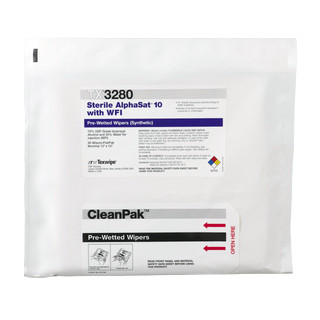
TX3280 Sterile AlphaSat10 With WFI: Sealed-Border Polyester Pre-Wetted Wiper for Repeatable IPA Cleaning
Last reviewed: Jan. 4, 2026 | Audience: contamination control, cleanroom operations, EHS, quality
Texwipe TX3280 is a sterile, sealed-border, 12" x 12" polyester knit wiper that ships pre-wetted with a controlled 70% USP-grade isopropyl alcohol (IPA) / 30% Water for Injection (WFI) blend. It is engineered for teams that need a consistent, audit-friendly way to wipe critical surfaces without operator-made IPA dilution, trigger-spray variability, or overspray-driven VOC spikes.
Where TX3280 earns its place is operational control: 0.2 µm-filtered fill, gamma sterilization validated to SAL 10−6, lot documentation, and packaging designed to protect wetness level over repeated openings. Used correctly, it supports standardized wiping outcomes across shifts and facilities in ISO-classified cleanrooms and aseptic processing areas.
What it’s for
Controlled, repeatable cleaning of equipment and environmental surfaces in sterile or sterile-adjacent operations (aseptic fill areas, biotech manufacturing, microbiological labs, sterile suites, prep rooms), including wipe-downs during and after production flow, and practical tasks like wiping gloved hands when your gowning/aseptic SOP allows it.
Decision drivers
Select TX3280 when your process needs consistency you can defend in a deviation review: controlled wetness, controlled cleanliness metrics, and lot-level sterility/quality documentation.
- WFI-based pre-wet: The 70% IPA / 30% WFI blend supports critical applications where water quality expectations exceed standard DI water and where endotoxin control matters.
- Sealed-border knit polyester: A sealed border is a direct contamination-control feature; it reduces edge-driven particle and fiber release compared with cut-edge constructions in abrasive wipe-downs.
- Sterility assurance and traceability: Gamma irradiation validated to SAL 10−6, with lot certificates and expiration labeling to support sterile-suite controls and documentation discipline.
- Process control vs. spray-and-wipe: Presaturation reduces overspray, reduces solvent waste, and reduces operator-to-operator variability in IPA application.
- Packaging that preserves wetness: Resealable flatpacks are built to reduce evaporation and help maintain a consistent wipe feel and cleaning behavior through the pack’s life.
Materials and construction
TX3280 is built on a 100% continuous-filament polyester knit substrate with a sealed border. Continuous filament matters because it reduces loose fiber ends compared with staple fibers, and the sealed border matters because the edge is where many wipes “shed” under abrasion, especially on textured stainless, powder-coated frames, and older epoxy floors.
The “pre-wetted” part is not a convenience detail; it is a process-control tool. Texwipe fills TX3280 with a 0.2 µm-filtered 70% USP-grade IPA / 30% WFI blend, then packages it to preserve wetness level. The result is fewer variables at the point of use: no in-room blending, no bottle labeling drift, and fewer opportunities for wrong concentration or wrong water grade.
Specifications in context
Size: 12" x 12" (31 cm x 31 cm) is the practical “workhorse” size for wiping benchtops, isolator exteriors, stainless panels, and equipment covers without excessive folding bulk.
Edge strategy: Sealed border/thermally sealed borders (sealed-border construction) to control edge-driven particles and fibers during rigorous wiping.
Solution: 70% USP-grade IPA / 30% WFI, filled with 0.2 µm filtration for control and repeatability.
Sterility: Gamma irradiated; sterile validated to SAL 10−6. In practice, that supports use where sterile materials are required at point of contact (per your facility SOP and risk assessment).
Cleanroom use range: Listed for ISO 2–8 on the SOSCleanroom product page; Texwipe positions the family for ISO Class 2–7 / EU Grade A–D. Operationally, the right question is not “what ISO number,” but “what surface and what risk”: tighter grades typically demand tighter wipe discipline (folding, one-pass, discard rules) and tighter ingress controls (triple bagging, wipe-down of outer packaging).
Cleanliness and performance metrics
Cleanroom wiping performance is best evaluated as a system: what the wipe releases (particles/fibers), what it extracts (NVR), and what it can contribute ionically. “Typical” values are a starting point for qualification, not a substitute for your internal validation.
Typical wipe release and extractables (Vectra® Alpha® 10 family):
• Particles ≥0.5 µm (LPC): 2.9 x 10⁶ particles/m2
• Particles 0.5–5.0 µm: 1.7 x 10⁶ particles/m2
• Particles 5.0–100 µm: 37,000 particles/m2
• Fibers >100 µm: 100 fibers/m2
• NVR (IPA extractant): 0.02 g/m2; NVR (DIW extractant): 0.003 g/m2
• Ions (typical): Sodium 0.04 ppm; Potassium 0.04 ppm; Chloride 0.009 ppm
• Physical (typical): Basis weight 130 g/m2; Sorptive capacity 320 mL/m2; Sorptive rate 0.5 second
Solution quality controls (TX3280 fill solution):
• IPA content: 68%–72%
• Endotoxin: <0.25 EU/mL
• Solution NVR limit: does not exceed 5 mg (0.01%)
Standards context: Texwipe’s published test-method references for particle/fiber release and extractables commonly cite IEST-RP-CC004 and ASTM E2090 approaches. For sterile processing controls, sterilization claims are tied to SAL 10−6 validation expectations and ISO 11137 framework concepts (per manufacturer documentation). Use these as anchors when building or updating your internal qualification package and cleaning validation rationale.
Packaging, sterility, and traceability controls
TX3280 is packaged for controlled entry and repeatable use: 50 wipers per flatpack, 5 flatpacks per case (250 total). Cases are triple-bagged, and the manufacturer documentation calls out lot-specific records support (Certificates of Processing/Compliance/Analysis) plus expiration marking on the package. In practical terms, this supports controlled staging (material airlock), line clearance expectations, and lot traceability when an investigation needs to tie cleaning materials back to a batch record.
Rule of thumb: Treat pre-wetted sterile wipes like a “controlled reagent.” Date/initial the first-open time per SOP, reseal immediately after pull, and discard any pack that shows dry edges, off-odor, or compromised seal integrity.
Shipping and EHS note: Because these are alcohol pre-wetted wipes, many programs handle them as regulated for transport and require ground shipping to commercial addresses. The SOSCleanroom product page flags ground-only and commercial-only shipping acknowledgments and a per-case hazmat shipping fee for this SKU category—plan procurement and receiving workflows accordingly.
Best-practice use
TX3280 performs best when the wiping method is standardized. The goal is not “wet surface,” it is “controlled removal without redeposit.” Build the method into training, qualification, and periodic observation.
- Fold for fresh faces: Quarter-fold to create multiple clean wiping faces. Rotate faces with a defined rule (for example: one face per pass on critical surfaces).
- One direction + overlap: Wipe in straight strokes with slight overlap; avoid circular scrubbing on critical surfaces unless your SOP explicitly requires it for residue break-up.
- Start clean to dirtier: Progress from higher-criticality zones to lower-criticality zones (or from visibly clean to visibly contaminated) to reduce cross-contamination.
- Control dwell time intentionally: IPA needs contact time to be effective as a sanitizing solvent. Do not immediately dry-wipe unless the process requires a dry finish; if you must dry, follow with an appropriate dry sterile wipe and document the rationale.
- Ingress discipline (sterile suites): Use the triple-bagging as intended. Wipe down the exterior bag before bringing inner bags into the controlled area, then open progressively per your material transfer SOP.
- Gloved-hand wiping: If your gowning SOP allows it, treat gloved-hand wiping as a controlled step: one wipe, defined hand sequence, then discard—never “re-dip” or reuse across multiple people.
Common failure modes
The most common failure is treating a presaturated wipe like a reusable rag: reusing the same face, re-entering a pack with contaminated gloves, or wiping from dirty to clean. Other practical failure modes include leaving packs partially open (drift in wetness level and IPA concentration), scrubbing aggressively on abrasive surfaces with a single face (localized particle release), and using IPA wiping as a substitute for a validated disinfectant rotation where spores or bio-burden risks exist. Prevention is straightforward: train the fold-and-rotate method, enforce “open-pull-reseal,” define discard rules, and align the wipe step with your facility’s validated cleaning and disinfection strategy.
Closest competitors
Contec PROSAT® Sterile™ Polywipe-C Heatseal wipes (70% IPA / 30% DI water): Similar “presaturated knit polyester + sealed edge” concept, often in peel-and-reseal packaging. The main mechanism difference is the water grade (DI water vs. WFI) and the specific edge bonding/heatseal approach. If WFI is a process requirement (or endotoxin control is a stated driver), TX3280 typically has the cleaner fit on paper.
Berkshire sterile SatPax® IPA wipes: Berkshire offers multiple presaturated sterile wipe constructions (often nonwoven blends) in resealable packaging. These can be strong options for general sterile wipe-downs, but substrate and edge strategy may differ from sealed-border knit polyester. For the lowest extractables and highest abrasion resistance on critical surfaces, sealed-border knit polyester constructions often remain the benchmark.
Veltek Process2Wipe® 70% IPA / 30% WFI presaturated polyester wipes: Another WFI-based pathway with a process-control narrative. As always, compare the qualification package: sterility validation approach, lot documentation, typical contamination metrics, and packaging/ingress controls.
Where it fits in a cleanroom wiping program
TX3280 fits as a “standardized solvent wipe” step in sterile and ISO-classified cleaning programs: pre-clean before applying a disinfectant, final wipe-down of equipment exteriors before staging, routine environmental surface wipe-downs, and controlled wipe-down of tools moving between zones. In higher-grade environments, it is typically paired with defined ingress practices (triple-bag transfer, outer-bag wipe-down) and an overall cleaning/disinfection strategy that addresses both chemical residues and microbiological risk (including validated disinfectant rotations where required).
Terminology note: Engineered for low-linting performance; no wiper is truly “lint-free” in every process condition.
Source basis
- SOSCleanroom product page (TX3280): https://www.soscleanroom.com/product/wipers/texwipe-tx3280-sterile-alphasat10-12-x-12-polyester-wiper-pre-wetted-70-ipa-30-wfi/
- Texwipe product page (TX3280): https://www.texwipe.com/sterile-alphasat-with-vectra-alpha-10-tx3280
- Texwipe Technical Data Sheet (Vectra® Alpha® 10), TEX-LIT-TDS-028 Rev.00-05/17 (PDF): https://www.texwipe.com/images/uploaded/documents/Wipers/Texwipe-VectraAlpha10-ENG.pdf
- SOS-hosted manufacturer datasheet copy (DS-3280, Effective: December 2009) (PDF): https://www.soscleanroom.com/content/texwipe_pdf/3280.pdf
- Texwipe Safety Data Sheet (Wipers pre-wetted with 60%–70% IPA), May 31, 2023 (PDF): https://www.texwipe.com/images/uploaded/documents/Safety%20Data%20Sheets/2023%20wipe%20sds%20us-can-mex/60-70/TX1034_US_CA_SDS_ENG_May_31_2023.pdf
- Contec comparator (PROSAT® Sterile™ Polywipe-C Heatseal wipes): https://cleanroom.contecinc.com/product/1779532925
- Berkshire comparator (Sterile SatPax® 670): https://berkshire.com/shop/presaturated-cleanroom-wipes/sterile-wipes/sterile-satpax-670/ssp67000124/
- Veltek comparator (Process2Wipe® Sterile 70% IPA presaturated polyester, PDF): https://www.cleanroomsupplies.com/wp-content/uploads/2025/05/Process2Wipe-Sterile-70_-IPA-Presaturated-Polyester-Wipe-From-Cleanroom-Connection.pdf
Source: SOSCleanroom Technical Vault | Last reviewed: Jan. 4, 2026
© 2026 SOS Supply. All rights reserved.